
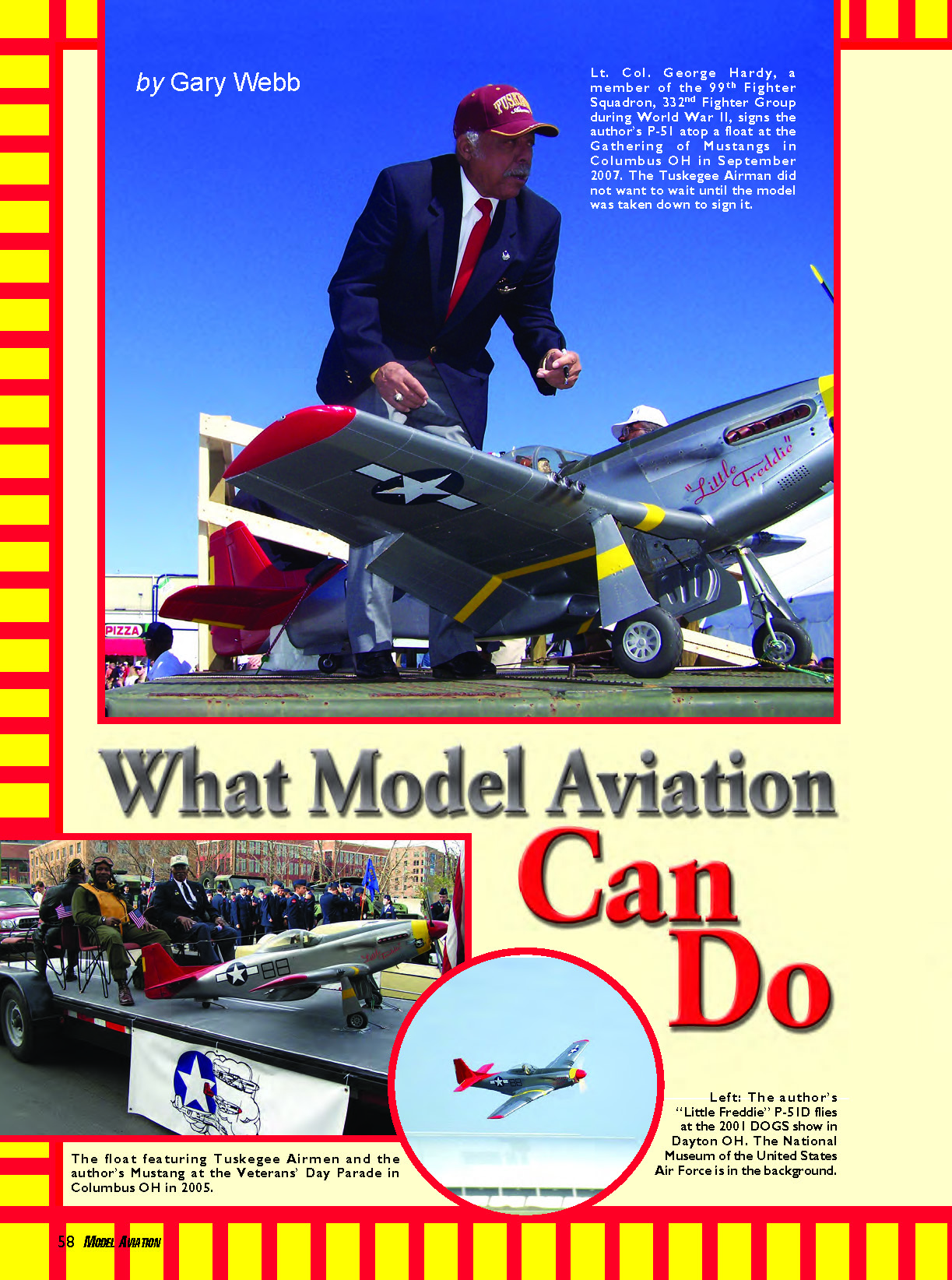
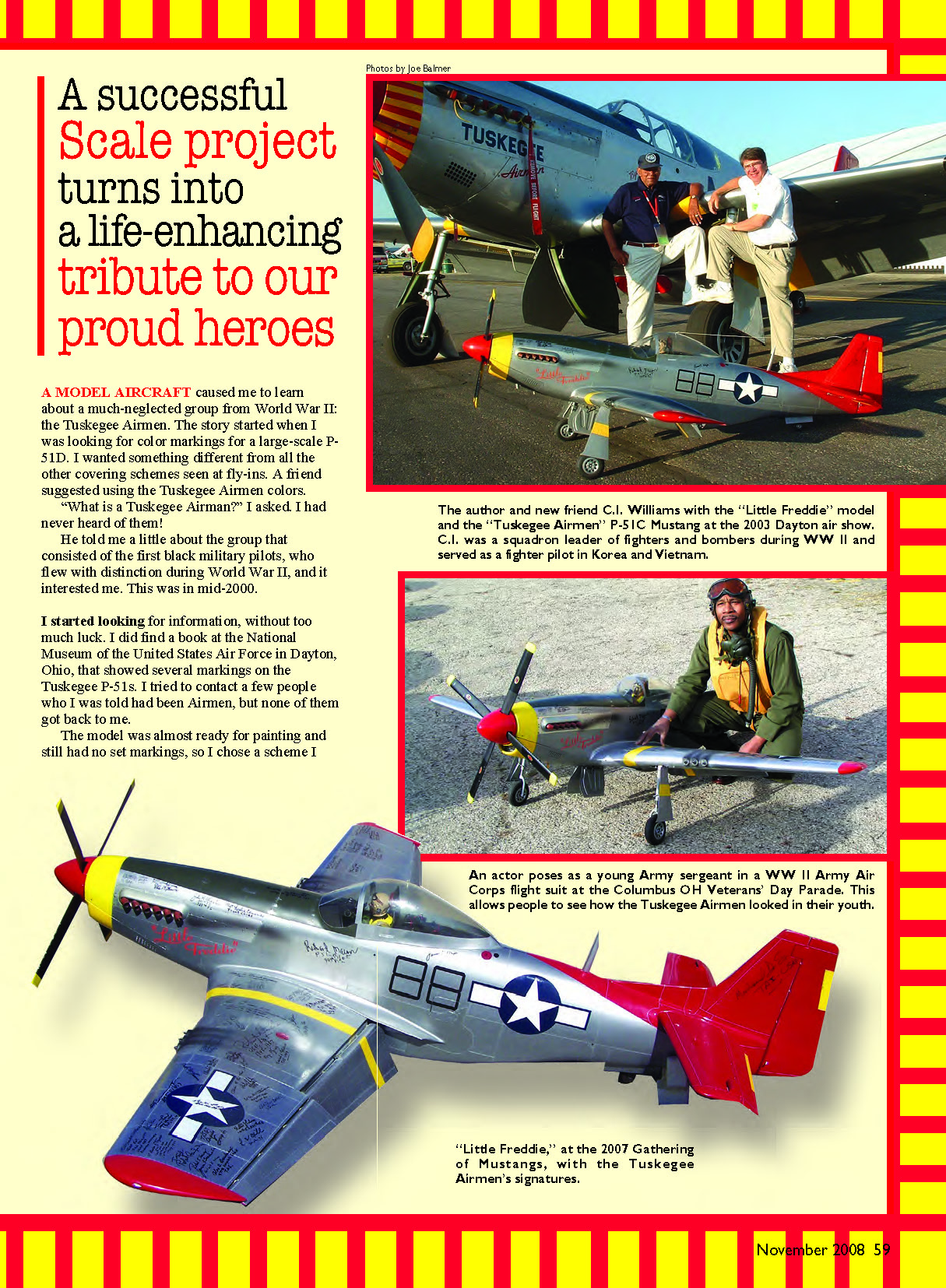
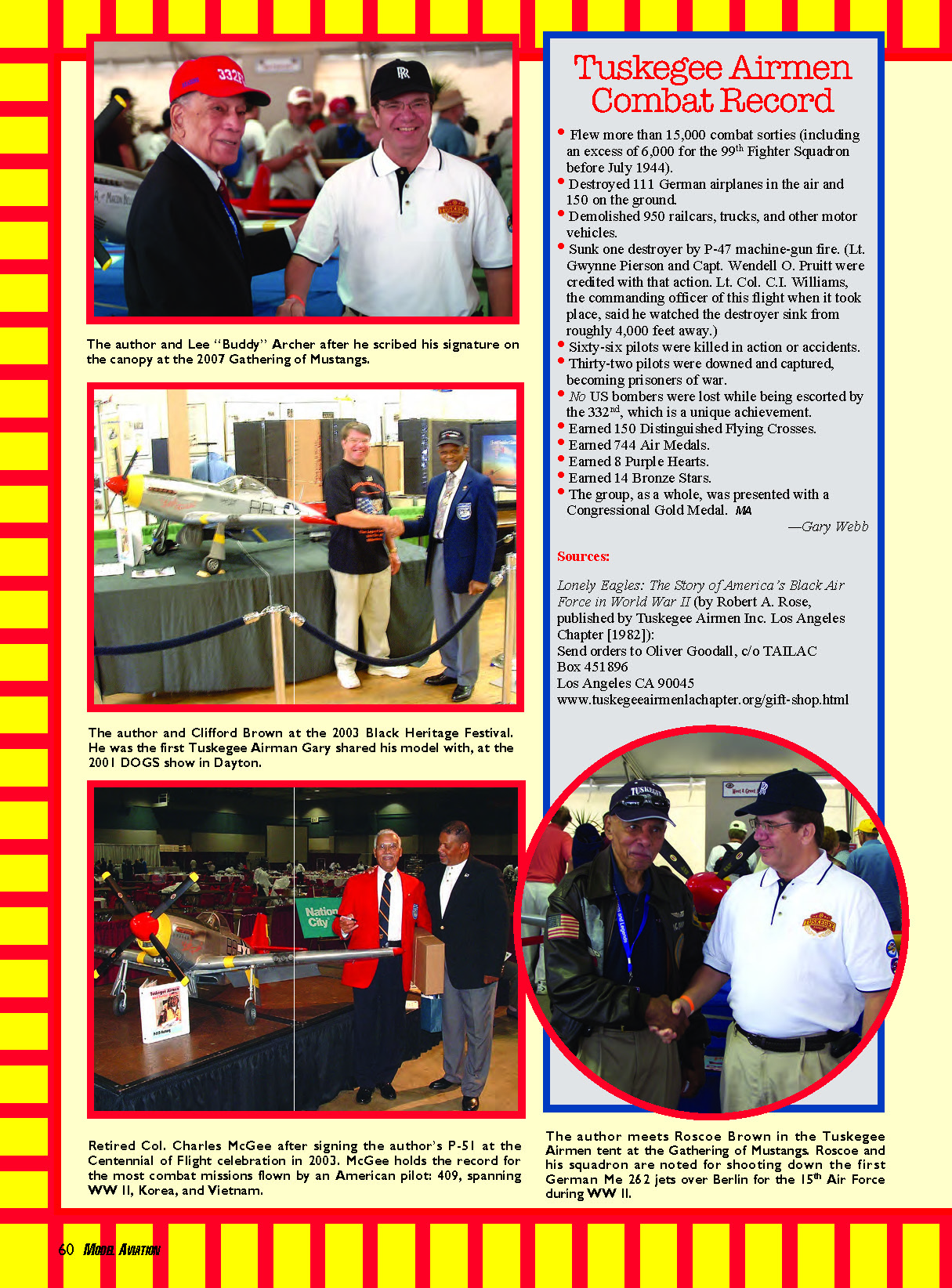
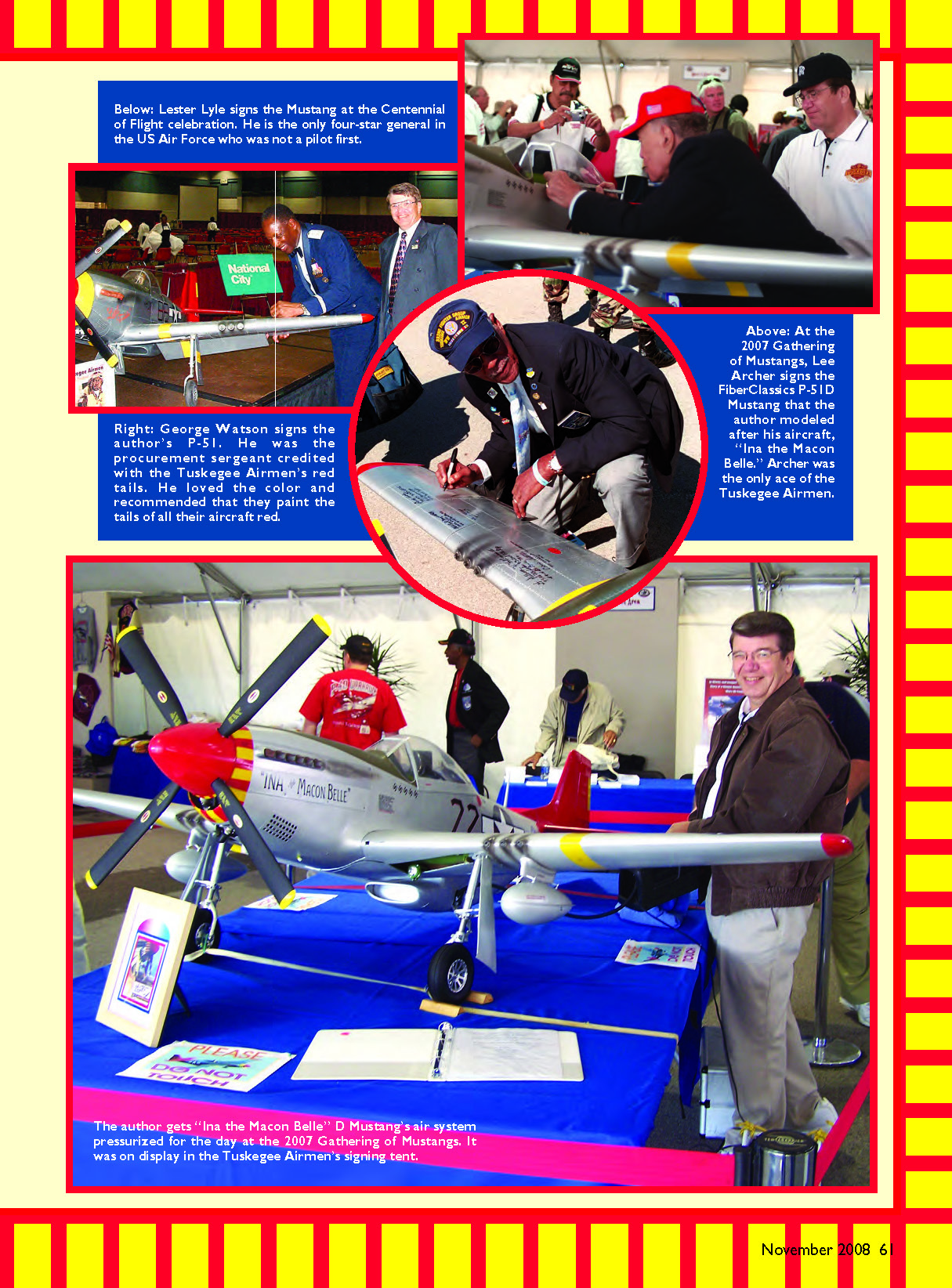
What Model Aviation Can Do
by Gary Webb
A MODEL AIRCRAFT caused me to learn about a much-neglected group from World War II: the Tuskegee Airmen. The story started when I was looking for color markings for a large-scale P-51D. I wanted something different from all the other covering schemes seen at fly-ins. A friend suggested using the Tuskegee Airmen colors.
“What is a Tuskegee Airman?” I asked. I had never heard of them!
He told me a little about the group that consisted of the first black military pilots, who flew with distinction during World War II, and it interested me. This was in mid-2000.
I started looking for information, without too much luck. I did find a book at the National Museum of the United States Air Force in Dayton, Ohio, that showed several markings on the Tuskegee P-51s. I tried to contact a few people who I was told had been Airmen, but none of them got back to me.
The model was almost ready for painting and still had no set markings, so I chose a scheme I liked in the book and had the markings cut to match it. I picked the P-51 of Lt. Freddie Hutchins of the 332nd Squadron, 15th Air Force.
I do volunteer work at the Air Force museum a couple times a month. When I reported for regular duty one day, an event called the Gathering of Eagles was taking place. It was honoring all the aces the Air Force had.
One of the attendees was retired Gen. Benjamin O. (B.O.) Davis Jr., the first commander of the Tuskegee Airmen. I spent 20-30 minutes talking with him about my project. That was roughly a year before his passing.
After getting the model painted, my wife loved the bright colors. I weathered it to look as it might have on the flightline in Italy in 1944. When she came to the workshop, she was shocked.
"You have ruined it!" she said.
I explained that this was how the full-scale P-51 would have looked during the war, but she was still upset for a time. I took it to a show near Columbus, Ohio, in the spring of 2001 for its first viewing. It didn't win, but it garnered much attention.
The airplane was first flown in August 2001 at the WORKS (Western Ohio Radio Kontrol Society) field in Dayton, Ohio, by the master himself: Frank Noll Jr. He is a renowned aerobatic contest and show pilot who is now the Futaba Team Leader at Hobbico.
Frank has a knack for getting a wounded or out-of-balance model back on the ground safe and sound, and he is one of the best test pilots to fly a Scale warbird on its first mission. Frank has been available to fly many of my new models, and he has aided in trimming and programming them to fly for many years to come.
Then the Mustang was flown in September 2001 at the DOGS (Dayton Ohio Giant Scalers) fly-in at the Air Force museum. I had hoped to meet an original Tuskegee Airman someday and share my P-51 with him. The Dayton Daily News published a story about my aircraft at the show, and I told the reporter that I wanted to show it to a Tuskegee Airman.
On the Sunday of the DOGS event, Lt. Clifford Brown—one of the original Tuskegee Airmen, who served in Italy at the end of World War II—came to the show and asked for me. What a thrill to meet him in person! After the show emcee told the audience that Brown was there, he signed autographs and posed with my model for hours.
By the way, the model flew like a dream.
Brown called me in the spring of 2002. He was working with a group to put together a program at the state capital building in Ohio to honor the Tuskegee Airmen. He asked me to bring my P-51 for the event. I took it in the hopes of meeting one or two of the pilots.
I was told that the get-together would be "small"; I didn't know that Brown had been in contact with the Ohio chapter of Tuskegee Airmen.
After I arrived at the gathering and found the place to unload, getting the model through some of the narrow passageways to the Capitol Atrium area without dinging it up was a real adventure. The small elevator made me nervous.
At the Atrium I learned that the "small" event was set up for approximately 900 people. I set the model in place and then found a place, near the back of the room, to sit and watch the event.
Several original Tuskegee Airmen were in attendance because they were stationed in Columbus after returning from Europe at the war's end and until the unit was disbanded in 1949. This was only the start of my learning about the Airmen. Getting to meet so many of them was a dream that was coming true, and it left me speechless.
One of the Airmen whom I now call a friend is retired Lt. Col. Charles Williams. He graduated with Freddie Hutchins at the Tuskegee Army Air Field in the same class and had run around with him.
C.I., as Williams likes to be called, went on to be a Fighter Squadron leader in P-39s, P-40s, P-47s, and P-51s during World War II. He was Gen. Daniel "Chappie" James' first commander. C.I. pinned on Chappie's second lieutenant bars and wings after he completed flight training. I have seen the black-and-white photo of the event.
Chappie became the first black four-star general in the Air Force. C.I. flew more than
Continued on page 66
Transcribed from original scans by AI. Minor OCR errors may remain.

