
Worth a Closer Look
“Monster” Airtronics Digital Servo
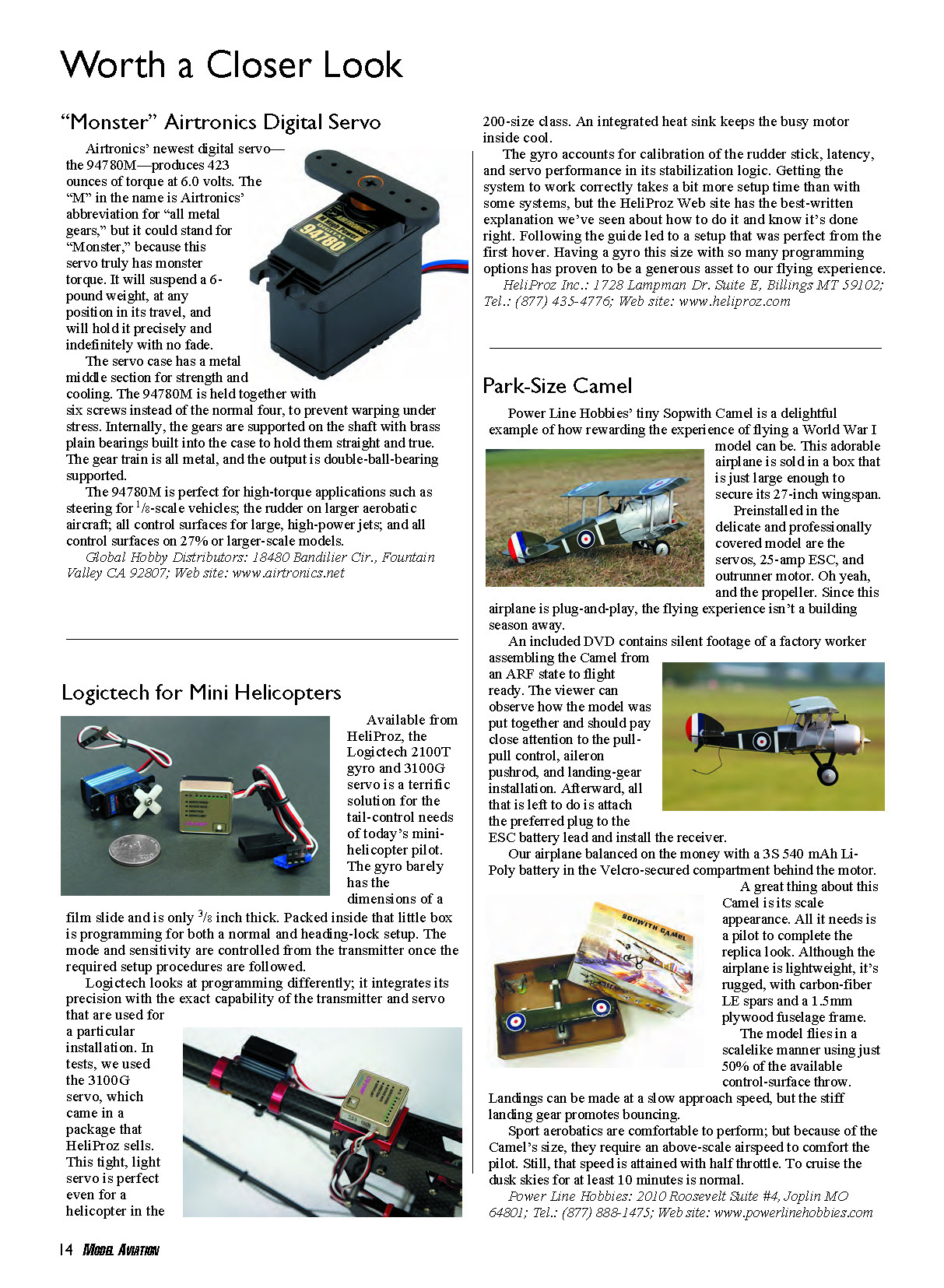
Airtronics’ newest digital servo—the 94780M—produces 423 ounces of torque at 6.0 volts. The “M” in the name is Airtronics’ abbreviation for “all metal gears,” but it could stand for “Monster,” because this servo truly has monster torque. It will suspend a 6‑pound weight, at any position in its travel, and will hold it precisely and indefinitely with no fade.
The servo case has a metal middle section for strength and cooling. The 94780M is held together with six screws instead of the normal four, to prevent warping under stress. Internally, the gears are supported on the shaft with brass plain bearings built into the case to hold them straight and true. The gear train is all metal, and the output is double‑ball‑bearing supported.
The 94780M is perfect for high‑torque applications such as steering for 1/8‑scale vehicles; the rudder on larger aerobatic aircraft; all control surfaces for large, high‑power jets; and all control surfaces on 27% or larger‑scale models.
Global Hobby Distributors; 18480 Bandilier Cir., Fountain Valley CA 92807; Web site: www.airtronics.net
Logitech for Mini Helicopters
Available from HeliProz, the Logitech 2100T gyro and 3100G servo is a terrific solution for the tail‑control needs of today’s mini‑helicopter pilot. The gyro barely has the dimensions of a film slide and is only 3/8 inch thick. Packed inside that little box is programming for both a normal and heading‑lock setup. The mode and sensitivity are controlled from the transmitter once the required setup procedures are followed.
Logitech looks at programming differently; it integrates its precision with the exact capability of the transmitter and servo that are used for a particular installation. In tests, we used the 3100G servo, which is similar in power to the popular HeliProz servo that many shops sell. This tight, light servo is perfect even for a helicopter in the 200‑size class. An integrated heat sink keeps the busy motor inside cool.
The gyro accounts for calibration of the rudder stick, latency, and servo performance in its stabilization logic. Getting the system to work correctly takes a bit more setup time than with some systems, but the HeliProz Web site has the best‑written explanation we’ve seen about how to do it and know it’s done right. Following the guide led to a setup that was perfect from the first hover. Having a gyro this size with so many programming options has proven to be a generous asset to our flying experience.
HeliProz Inc.; 1728 Lampman Dr., Suite E, Billings MT 59102; Tel.: (877) 435‑4776; Web site: www.heliproz.com
Park‑Size Camel
Power Line Hobbies’ tiny Sopwith Camel is a delightful example of how rewarding the experience of flying a World War I model can be. This adorable airplane is sold in a box that is just large enough to secure its 27‑inch wingspan.
Preinstalled in the delicate and professionally covered model are the servos, 25‑amp ESC, and outrunner motor. Oh yeah, and the propeller. Since this airplane is plug‑and‑play, the flying experience isn’t a building season away.
An included DVD contains silent footage of a factory worker assembling the Camel from an ARF state to flight ready. The viewer can observe how the model was put together and should pay close attention to the pull‑pull control, aileron pushrod, and landing‑gear installation. Afterward, all that is left to do is attach the preferred plug to the ESC battery lead and install the receiver.
Our airplane balanced on the money with a 3S 540 mAh Li‑Poly battery in the Velcro‑secured compartment behind the motor.
A great thing about this Camel is its scale appearance. All it needs is a pilot to complete the replica look. Although the airplane is lightweight, it’s rugged, with carbon‑fiber LE spars and a 1.5 mm plywood fuselage frame.
Landings can be made at a slow approach speed, but the stiff landing gear promotes bouncing.
Sport aerobatics are comfortable to perform; but because of the Camel’s size, they require an above‑scale airspeed to comfort the pilot. Still, that speed is attained with half throttle. To cruise the dusk skies for at least 10 minutes is normal.
Power Line Hobbies; 2010 Roosevelt Suite #4, Joplin MO 64801; Tel.: (877) 888‑1475; Web site: www.powerlinehobbies.com
Worth a Closer Look
Kit‑Building Made Easy
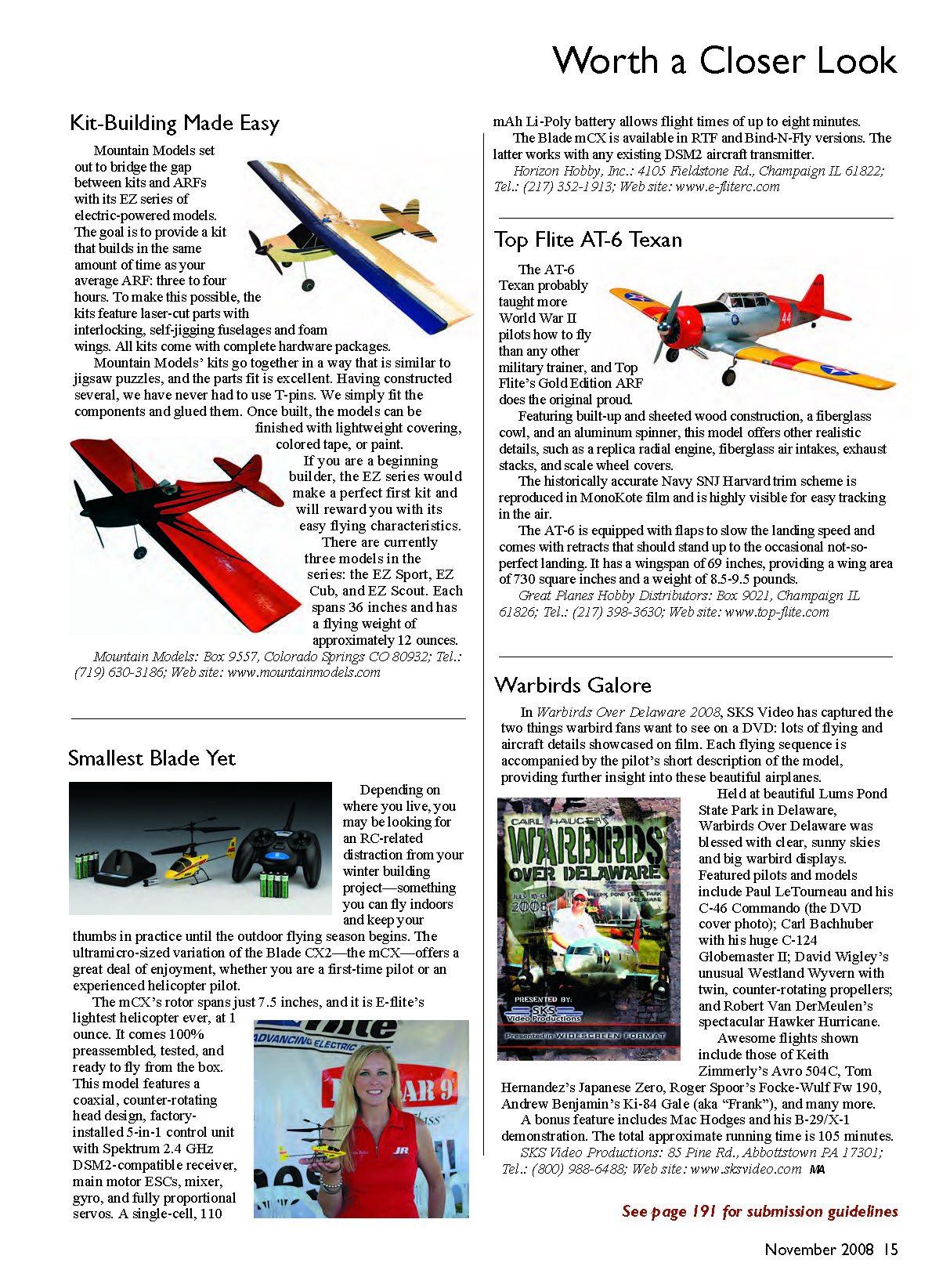
Mountain Models set out to bridge the gap between kits and ARFs with its EZ series of electric‑powered models. The goal is to provide a kit that builds in the same amount of time as your average ARF: three to four hours. To make this possible, the kits feature laser‑cut parts with interlocking, self‑jigging fuselages and foam wings. All kits come with complete hardware packages.
Mountain Models’ kits go together in a way that is similar to jigsaw puzzles, and the parts fit is excellent. Having constructed several, we have never had to use T‑pins. We simply fit the components and glued them. Once built, the models can be finished with lightweight covering, colored tape, or paint.
If you are a beginning builder, the EZ series would make a perfect first kit and will reward you with its easy flying characteristics.
There are currently three models in the series: the EZ Sport, EZ Cub, and EZ Scout. Each spans 36 inches and has a flying weight of approximately 12 ounces.
Mountain Models; Box 9557, Colorado Springs CO 80932; Tel.: (719) 630‑3186; Web site: www.mountainmodels.com
Smallest Blade Yet
Depending on where you live, you may be looking for an RC‑related distraction from your winter building projects—something you can fly indoors and keep your thumbs in practice until the outdoor flying season begins. The ultramicro‑sized variation of the Blade CX2—the mCX—offers a great deal of enjoyment, whether you are a first‑time pilot or an experienced helicopter pilot.
The mCX’s rotor spans just 7.5 inches, and it is E‑flite’s lightest helicopter ever, at 1 ounce. It comes 100% preassembled, tested, and ready to fly from the box. The model features a coaxial, counter‑rotating head design, factory‑installed 5‑in‑1 control unit with Spektrum 2.4 GHz DSM2‑compatible receiver, main motor ESCs, mixer, gyro, and fully proportional servos. A single‑cell, 110 mAh Li‑Poly battery allows flight times of up to eight minutes.
The Blade mCX is available in RTF and Bind‑N‑Fly versions. The latter works with any existing DSM2 aircraft transmitter.
Horizon Hobby, Inc.; 4105 Fieldstone Rd., Champaign IL 61822; Tel.: (217) 352‑1913; Web site: www.e‑fliterc.com
Top Flite AT‑6 Texan
The AT‑6 Texan probably taught more World War II pilots how to fly than any other military trainer, and Top Flite’s Gold Edition ARF does the original proud.
Featuring built‑up and sheeted wood construction, a fiberglass cowl, and an aluminum spinner, this model offers other realistic details, such as a replica radial engine, fiberglass air intakes, exhaust stacks, and scale wheel covers.
The historically accurate Navy SNJ Harvard trim scheme is reproduced in MonoKote film and is highly visible for easy tracking in the air.
The AT‑6 is equipped with flaps to slow the landing speed and comes with retracts that should stand up to the occasional not‑so‑perfect landing. It has a wingspan of 69 inches, providing a wing area of 730 square inches and a weight of 8.5‑9.5 pounds.
Great Planes Hobby Distributors; Box 9021, Champaign IL 61826; Tel.: (217) 398‑3630; Web site: www.top‑flite.com
Warbirds Galore
In Warbirds Over Delaware 2008, SKS Video has captured the two things warbird fans want to see on a DVD: lots of flying and aircraft details showcased on film. Each flying sequence is accompanied by the pilot’s short description of the model, providing further insight into these beautiful airplanes.
Held at beautiful Lums Pond State Park in Delaware, Warbirds Over Delaware was blessed with clear, sunny skies and big warbird displays. Featured pilots and models include Paul LeTourneau and his C‑46 Commando (the DVD cover photo); Carl Bachhuber with his huge C‑124 Globemaster II; David Wigley’s unusual Westland Wyvern with twin, counter‑rotating props; and Robert Van DerMeulen’s spectacular Hawker Hurricane.
Also featured are Michael Hughes’s Hurricane, Ernesto Hernandez’s Japanese Zero, Roger Spooner’s Focke‑Wulf Fw 190, Andrew Benjamin’s Ki‑84 Gale (aka “Frank”), and many more. A bonus feature includes Mac Hodges and his B‑29/X‑1 demonstration. The total approximate running time is 105 minutes.
SKS Video Productions; 85 Pine Rd., Abbottstown PA 17301; Tel.: (800) 988‑6488; Web site: www.sksvideo.com
Transcribed from original scans by AI. Minor OCR errors may remain.

