
Worth a Closer Look
Vinyl Markings
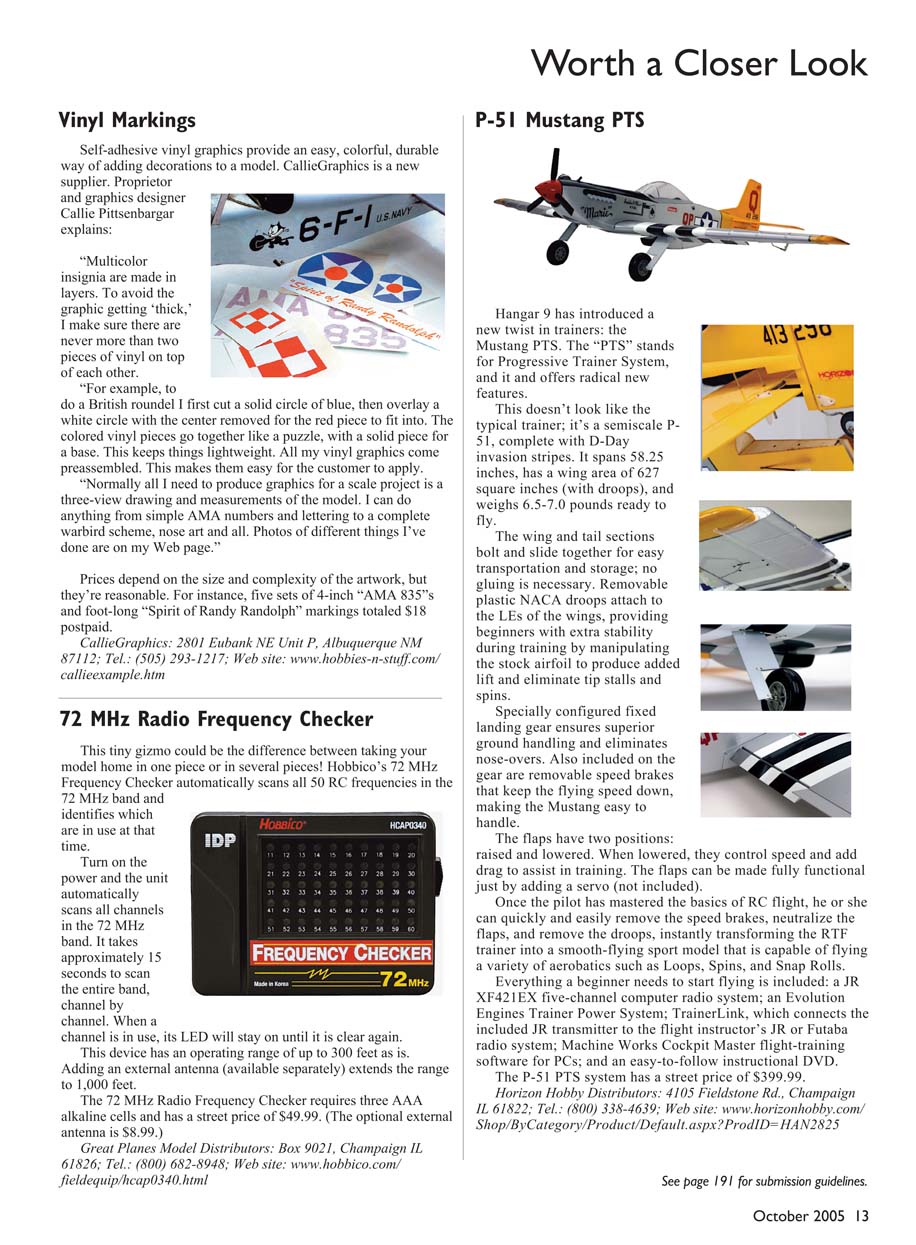
Self-adhesive vinyl graphics provide an easy, colorful, durable way of adding decorations to a model. CallieGraphics is a new supplier. Proprietor and graphics designer Callie Pittsenbarger explains:
“Multicolor insignia are made in layers. To avoid the graphic getting ‘thick,’ I make sure there are never more than two pieces of vinyl on top of each other.
“For example, to do a British roundel I first cut a solid circle of blue, then overlay a white circle with the center removed for the red piece to fit into. The colored vinyl pieces go together like a puzzle, with a solid piece for a base. This keeps things lightweight. All my vinyl graphics come preassembled. This makes them easy for the customer to apply.
“Normally all I need to produce graphics for a scale project is a three-view drawing and measurements of the model. I can do anything from simple AMA numbers and lettering to a complete warbird scheme, nose art and all. Photos of different things I’ve done are on my Web page.”
Prices depend on the size and complexity of the artwork, but they’re reasonable. For instance, five sets of 4-inch “AMA 835”s and foot-long “Spirit of Randy Randolph” markings totaled $18 postpaid.
CallieGraphics: 2801 Eubank NE Unit P, Albuquerque NM 87112; Tel.: (505) 293-1217; Web site: www.hobbies-n-stuff.com/callieexample.htm
72 MHz Radio Frequency Checker
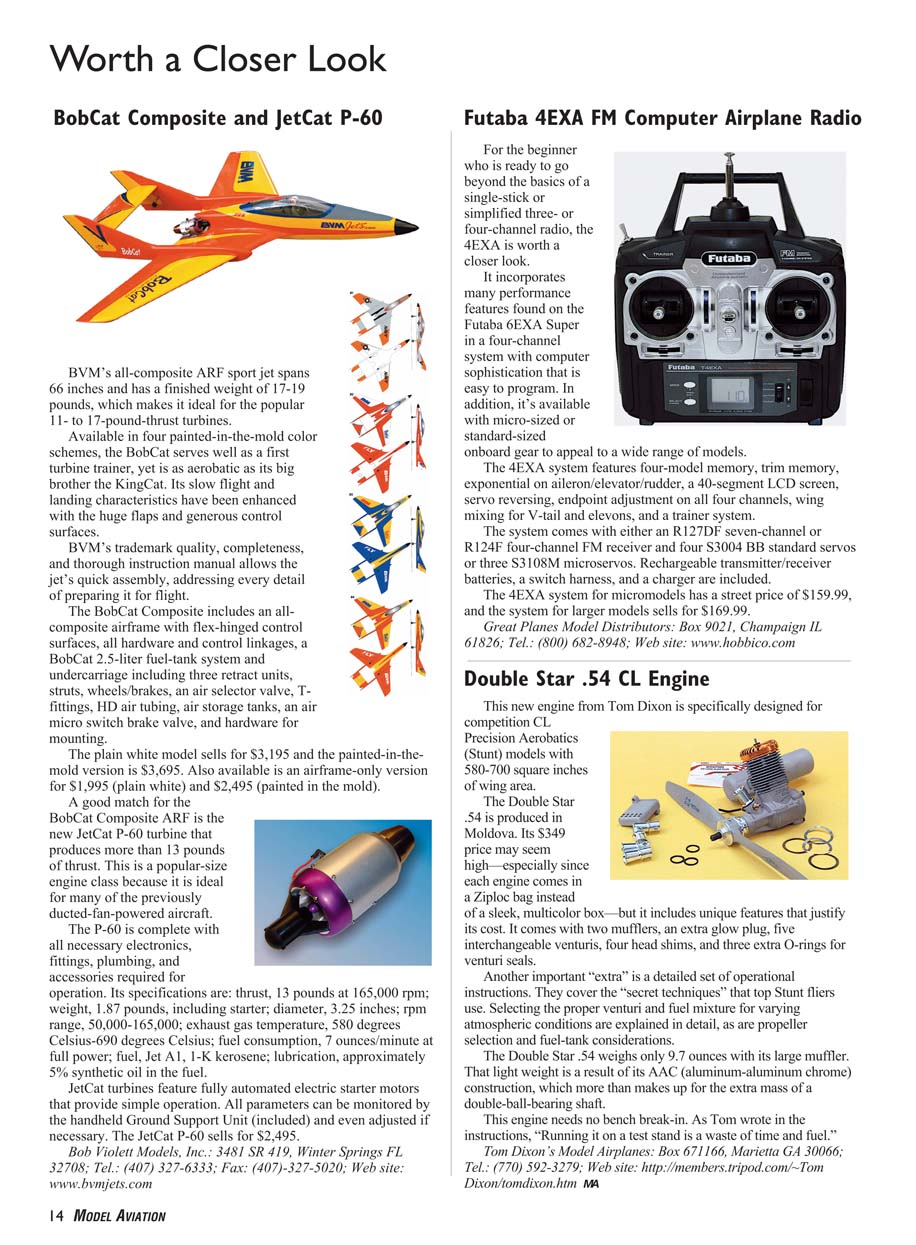
This tiny gizmo could be the difference between taking your model home in one piece or in several pieces! Hobbico’s 72 MHz Frequency Checker automatically scans all 50 RC frequencies in the 72 MHz band and identifies which are in use at that time.
Turn on the power and the unit automatically scans all channels in the 72 MHz band. It takes approximately 15 seconds to scan the entire band, channel by channel. When a channel is in use, its LED will stay on until it is clear again.
This device has an operating range of up to 300 feet as is. Adding an external antenna (available separately) extends the range to 1,000 feet.
The 72 MHz Radio Frequency Checker requires three AAA alkaline cells and has a street price of $49.99. (The optional external antenna is $8.99.)
Great Planes Model Distributors: Box 9021, Champaign IL 61826; Tel.: (800) 682-8948; Web site: www.hobbico.com/fieldequip/hcap0340.html
P-51 Mustang PTS
Hangar 9 has introduced a new twist in trainers: the Mustang PTS. The “PTS” stands for Progressive Trainer System, and it offers radical new features.
This doesn’t look like the typical trainer; it’s a semiscale P-51, complete with D-Day invasion stripes. It spans 58.25 inches, has a wing area of 627 square inches (with droops), and weighs 6.5–7.0 pounds ready to fly.
The wing and tail sections bolt and slide together for easy transportation and storage; no gluing is necessary. Removable plastic NACA droops attach to the LEs of the wings, providing beginners with extra stability during training by manipulating the stock airfoil to produce added lift and eliminate tip stalls and spins.
Specially configured fixed landing gear ensures superior ground handling and eliminates nose-overs. Also included on the gear are removable speed brakes that keep the flying speed down, making the Mustang easy to handle.
The flaps have two positions: raised and lowered. When lowered, they control speed and add drag to assist in training. The flaps can be made fully functional just by adding a servo (not included).
Once the pilot has mastered the basics of RC flight, he or she can quickly and easily remove the speed brakes, neutralize the flaps, and remove the droops, instantly transforming the RTF trainer into a smooth-flying sport model that is capable of flying a variety of aerobatics such as Loops, Spins, and Snap Rolls.
Everything a beginner needs to start flying is included: a JR XF421EX five-channel computer radio system; an Evolution Engines Trainer Power System; TrainerLink, which connects the included JR transmitter to the flight instructor’s JR or Futaba radio system; Machine Works Cockpit Master flight-training software for PCs; and an easy-to-follow instructional DVD. The P-51 PTS system has a street price of $399.99.
Horizon Hobby Distributors: 4105 Fieldstone Rd., Champaign IL 61822; Tel.: (800) 338-4639; Web site: www.horizonhobby.com/Shop/ByCategory/Product/Default.aspx?ProdID=HAN2825
Worth a Closer Look
BobCat Composite and JetCat P-60
BVM’s all-composite ARF sport jet spans 66 inches and has a finished weight of 17–19 pounds, which makes it ideal for the popular 11- to 17-pound-thrust turbines.
Available in four painted-in-the-mold color schemes, the BobCat serves well as a first turbine trainer, yet is as aerobatic as its big brother the KingCat. Its slow flight and landing characteristics have been enhanced with the huge flaps and generous control surfaces.
BVM’s trademark quality, completeness, and thorough instruction manual allows the jet’s quick assembly, addressing every detail of preparing it for flight.
The BobCat Composite includes an all-composite airframe with flex-hinged control surfaces, all hardware and control linkages, a BobCat 2.5-liter fuel-tank system and undercarriage including three retract units, struts, wheels/brakes, an air selector valve, T-fittings, HD air tubing, air storage tanks, an air micro switch brake valve, and hardware for mounting.
The plain white model sells for $3,195 and the painted-in-the-mold version is $3,695. Also available is an airframe-only version for $1,995 (plain white) and $2,495 (painted in the mold).
A good match for the BobCat Composite ARF is the new JetCat P-60 turbine that produces more than 13 pounds of thrust. This is a popular-size engine class because it is ideal for many of the previously ducted-fan-powered aircraft.
The P-60 is complete with all necessary electronics, fittings, plumbing, and accessories required for operation. Its specifications are: thrust, 13 pounds at 165,000 rpm; weight, 1.87 pounds, including starter; diameter, 3.25 inches; rpm range, 50,000–165,000; exhaust gas temperature, 580 degrees Celsius–690 degrees Celsius; fuel consumption, 7 ounces/minute at full power; fuel, Jet A1, 1-K kerosene; lubrication, approximately 5% synthetic oil in the fuel.
JetCat turbines feature fully automated electric starter motors that provide simple operation. All parameters can be monitored by the handheld Ground Support Unit (included) and even adjusted if necessary. The JetCat P-60 sells for $2,495.
Bob Violet Models, Inc.; 3481 SR 419, Winter Springs FL 32708; Tel.: (407) 327-6333; Fax: (407) 327-5020; Web site: www.bvmjets.com
Futaba 4EXA FM Computer Airplane Radio
For the beginner who is ready to go beyond the basics of a single-stick or simplified three- or four-channel radio, the 4EXA is worth a closer look.
It incorporates many performance features found on the Futaba 6EXA Super in a four-channel system with computer sophistication that is easy to program. In addition, it’s available with micro-sized or standard-sized onboard gear to appeal to a wide range of models.
The 4EXA system features four-model memory, trim memory, exponential on aileron/elevator/rudder, a 40-segment LCD screen, servo reversing, endpoint adjustment on all four channels, wing mixing for V-tail and elevons, and a trainer system.
The system comes with either an R127DF seven-channel or R124F four-channel FM receiver and four S3004 BB standard servos or three S3108M microservos. Rechargeable transmitter/receiver batteries, a switch harness, and a charger are included.
The 4EXA system for micro models has a street price of $159.99, and the system for larger models sells for $169.99.
Great Planes Model Distributors: Box 9021, Champaign IL 61826; Tel.: (800) 682-8948; Web site: www.hobbico.com
Double Star .54 CL Engine
This new engine from Tom Dixon is specifically designed for competition CL.
Precision Aerobatics (Stunt) models with 580–700 square inches of wing area.
The Double Star .54 is produced in Moldova. Its $349 price may seem high—especially since each engine comes in a Ziploc bag instead of a sleek, multicolor box—but it includes unique features that justify its cost. It comes with two mufflers, an extra glow plug, five interchangeable venturis, four head shims, and three extra O-rings for venturi seals.
Another important “extra” is a detailed set of operational instructions. They cover the “secret techniques” that top Stunt fliers use. Selecting the proper venturi and fuel mixture for varying atmospheric conditions is explained in detail, as are propeller selection and fuel-tank considerations.
The Double Star .54 weighs only 9.7 ounces with its large muffler. That light weight is a result of its AAC (aluminum-aluminum chrome) construction, which more than makes up for the extra mass of a double-ball-bearing shaft.
This engine needs no bench break-in. As Tom wrote in the instructions, “Running it on a test stand is a waste of time and fuel.”
Tom Dixon’s Model Airplanes: Box 671166, Marietta GA 30066; Tel.: (770) 592-3279; Web site: http://members.tripod.com/~TomDixon/tomdixon.htm MA
Transcribed from original scans by AI. Minor OCR errors may remain.

