
Viewfinder
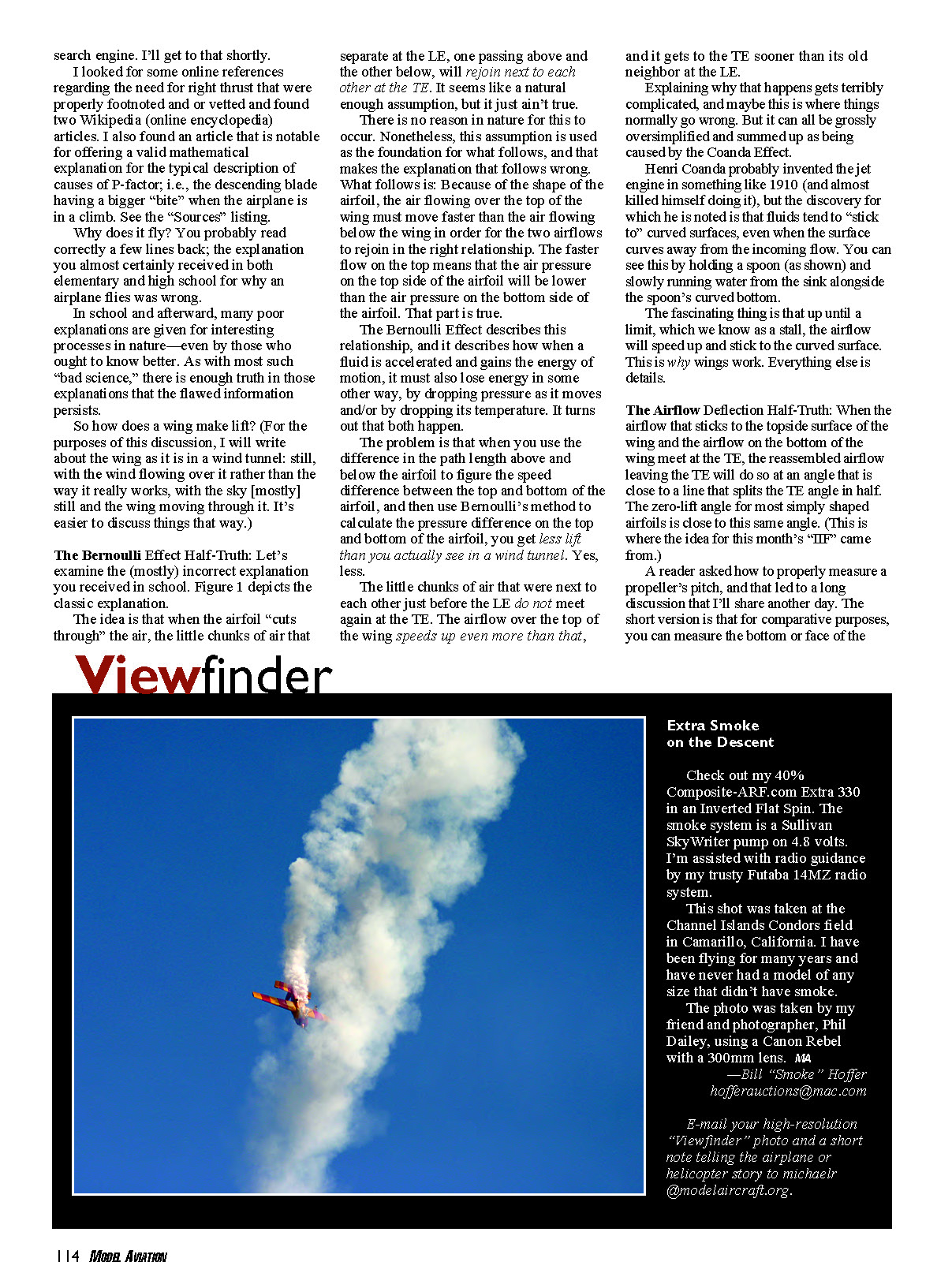
Extra Smoke on the Descent
Check out my 40% Composite-ARF.com Extra 330 in an inverted flat spin. The smoke system is a Sullivan SkyWriter pump on 4.8 volts. I’m assisted with radio guidance by my trusty Futaba 14MZ radio system.
This shot was taken at the Channel Islands Condors field in Camarillo, California. I have been flying for many years and have never had a model of any size that didn’t have smoke.
The photo was taken by my friend and photographer, Phil Dailey, using a Canon Rebel with a 300mm lens. MA
—Bill “Smoke” Hoffer hofferauctions@mac.com
E-mail your high-resolution “Viewfinder” photo and a short note telling the airplane and helicopter story to michaelr@modelaircraft.org.
propeller blade; but to really know how much air the propeller moves, start by measuring the pitch from the zero-lift line of the airfoil.
Airflow, Downwash, and Lift
Back to the airflow-deflection story. The airfoil, as you read in the preceding, “pushes down” on the air and you get a downwash from the trailing edge. If you measure the angle and the airflow of this downwash and calculate how much force would be needed to create it, you would underestimate the real-life lift of the wing, yet again.
Still, if I had to pick between the two explanations, I would probably go with the downwash because it highlights an important aspect of how a wing creates lift: the wing is not “sucked upward” by the low pressure on top of the wing, but rather the wing pushes down on the airflow or, more accurately, turns the oncoming airflow downward. If you push down on the air, the air will push back up. That’s Newton’s third law of motion.
So where do the half-truths meet? What do you tell your third-grader when he or she asks why an airplane flies?
To begin with, the airflow over an airfoil that is producing lift really does turn downward. It creates a downwash at the trailing edge as the air that flows under the wing joins the airflow over the top of the wing.
The interesting thing is that the airflow on top of the wing turns because it tends to “stick” to the top of the wing, even though the top of the airfoil curves away from it. This is called the Coanda effect.
It takes a college course in fluid dynamics to understand why that happens (so go to school, kid). As the airflow sticks to the curve around the top of the wing, it speeds up and the Bernoulli effect says that the air pressure on top of the wing will be lower than the pressure on the bottom of the wing. Put it all together—the Bernoulli effect and the bending of the airflow downward—and that’s why airplanes fly.
NASA (the National Aeronautics and Space Administration) has a great website with some excellent explanations and cool interactive tools, provided you have Internet access. I suggest a long but excellent discussion about this same subject. See the “Sources” listing for the Web address.
It always amused me that the explanation of why a wing makes lift that I received as a youngster in school didn’t work for a flat plate, and that meant that paper airplanes and half of the hand-launched gliders I made couldn’t fly. I’m glad I didn’t listen too carefully. Bumblebees aren’t supposed to be able to fly either, but they don’t go to school, do they?
Nonetheless, a burning desire to understand how things work and why airplanes fly the way they do was a big part of my reason for getting an education—and model aviation can still do that for kids.
See what you or your local club can do to bring aeromodeling to your local schools.
That’s it for now. Please let us know what you’d like to read about, and until next time we get together, have fun and take care of yourself. MA
Transcribed from original scans by AI. Minor OCR errors may remain.

