
Tether Your Airplane
Keep your model safely corralled with this simple device
The AMA Membership Manual contains a list of "good general safety practices" that, among other things, advises pilots to "stay clear of the propeller area while starting or running any engine or motor." Excellent advice. Our airplanes may be models, but the propeller bolted on the front of the engine is a potential hazard and should be treated with respect. When human tissue gets in the way of a spinning prop, it always comes out a loser.
One thing the Manual doesn't say is, "before starting an engine, the airplane should be restrained and made immovable." Resting the wheels against a 2 x 4, or bracing the wing against a flight box, or reaching over the prop and holding the fuselage with the left hand while the right hand applies the starter, just doesn't cut it.
The ideal restraint for RC pilots is a buddy kneeling down beside the airplane, holding the wing with one hand and the fuselage with the other. The pilot can talk to the holder and tell him when the engine will be revved up, and so on. Still, times do crop up when everyone is busy and assistance isn't available.
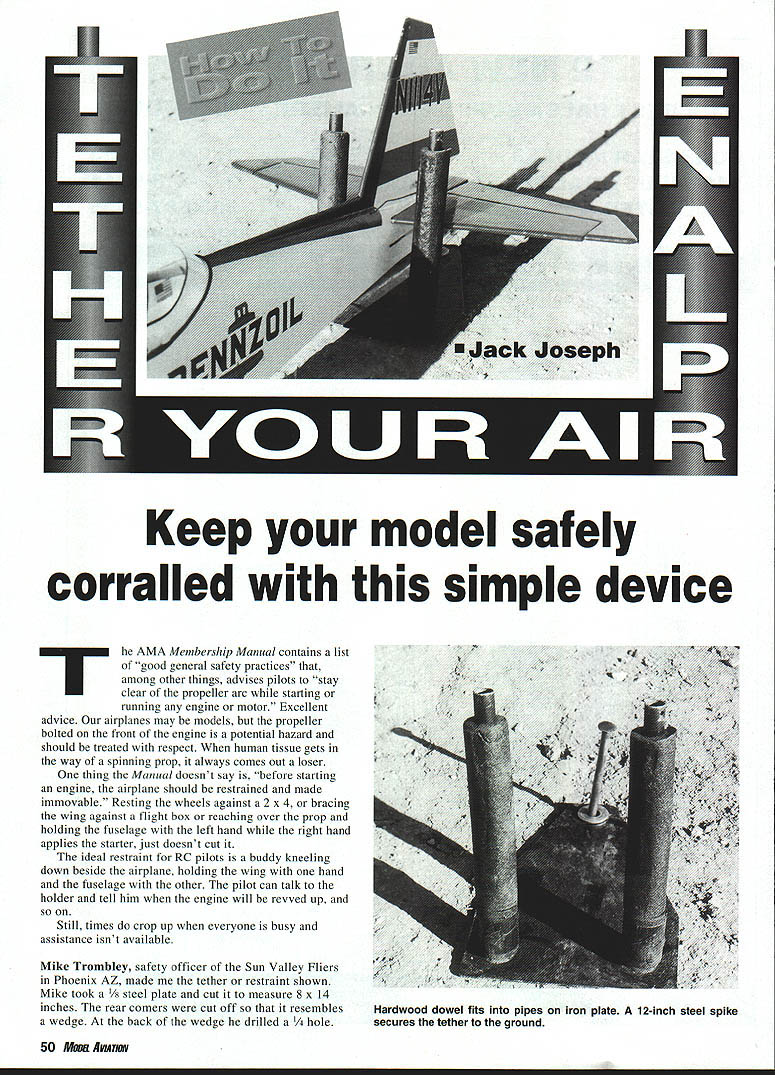
Simple steel tether (as made by Mike Trombley)
Mike Trombley, safety officer of the Sun Valley Fliers in Phoenix, AZ, made me the tether or restraint shown. His tether is constructed from steel plate, pipes and hardwood dowels. The following describes the device and how I use it.
- Materials and plate preparation
- Start with a 7/8-inch steel plate cut to measure 8 x 14 inches.
- Cut off the rear corners so the plate resembles a wedge.
- Drill a 1/4-inch hole at the back of the wedge.
- Upright pipes and dowels
- Weld two 10-inch-long steel pipes (inside diameter 5/8 inch) to the forward portion of the steel wedge so they slant slightly toward the rear. The pipes should be five inches apart—wide enough for the fuselages you use.
- Cut the pipes off 2 3/4 inches above the weld.
- Drive a 5/8-inch hardwood dowel into the remaining 7 1/4-inch pieces until about two inches of dowel protrude.
- Sand the dowels until they fit easily into the pipes attached to the plate.
- Fit the upright pipes with rubber insulation to prevent scratching the fuselage and stabilizer.
- Using the tether in the field
- At a dirt field: pound a 12-inch steel spike through the rear hole into the ground. Place the fuselage just forward of the stabilizer between the upright, cushioned pipes. The airplane is secure; you can start the engine and walk to the rear to disengage the glow driver without worry.
- To remove for flight: grasp the vertical stabilizer, pull the wooden dowels from their seats, back the airplane out, turn it, and taxi out to the runway.
- Using the tether on asphalt
- When flying from asphalt and no helper is available, secure the tether with very strong nylon cords.
- Pass a snap ring through the hole in the rear of the tether, tie the center of the cord to the ring, and attach the ends of the cord to a steel pipe on each side of the start-up pads.
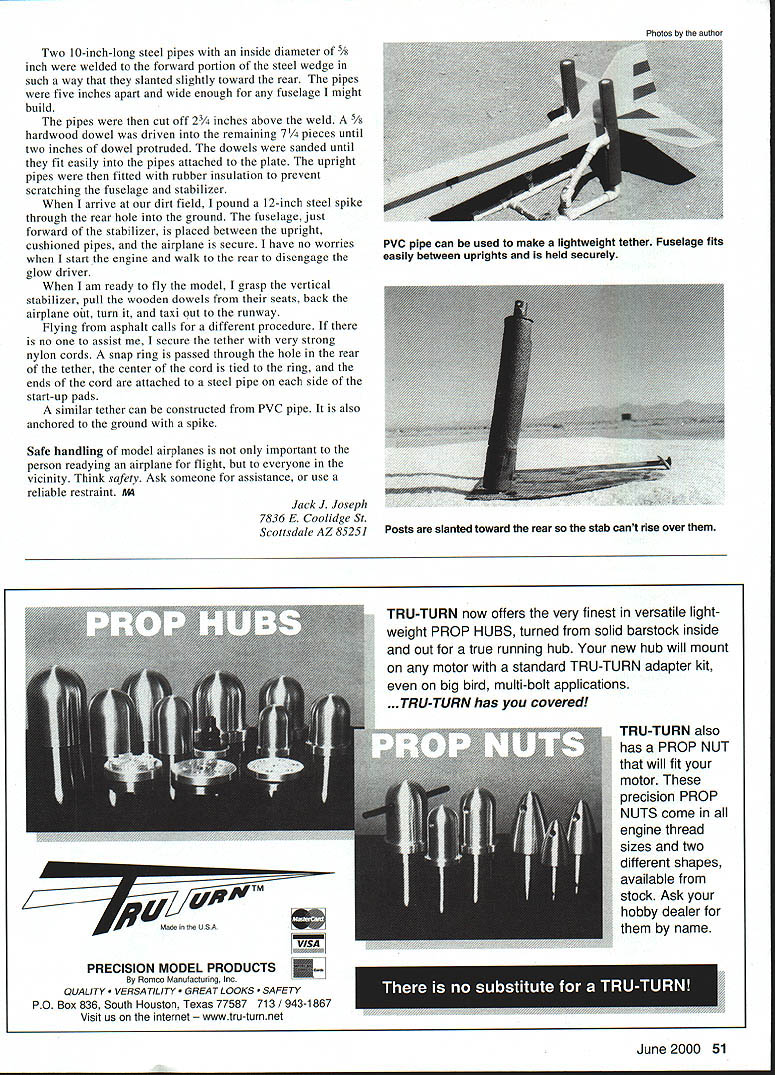
A similar tether can be constructed from PVC pipe. It is also anchored to the ground with a spike.
Safe handling of model airplanes is not only important to the person readying an airplane for flight, but to everyone in the vicinity. Think safety. Ask someone for assistance, or use a reliable restraint.
Jack J. Joseph 7836 E. Coolidge St. Scottsdale, AZ 85251
Transcribed from original scans by AI. Minor OCR errors may remain.

