
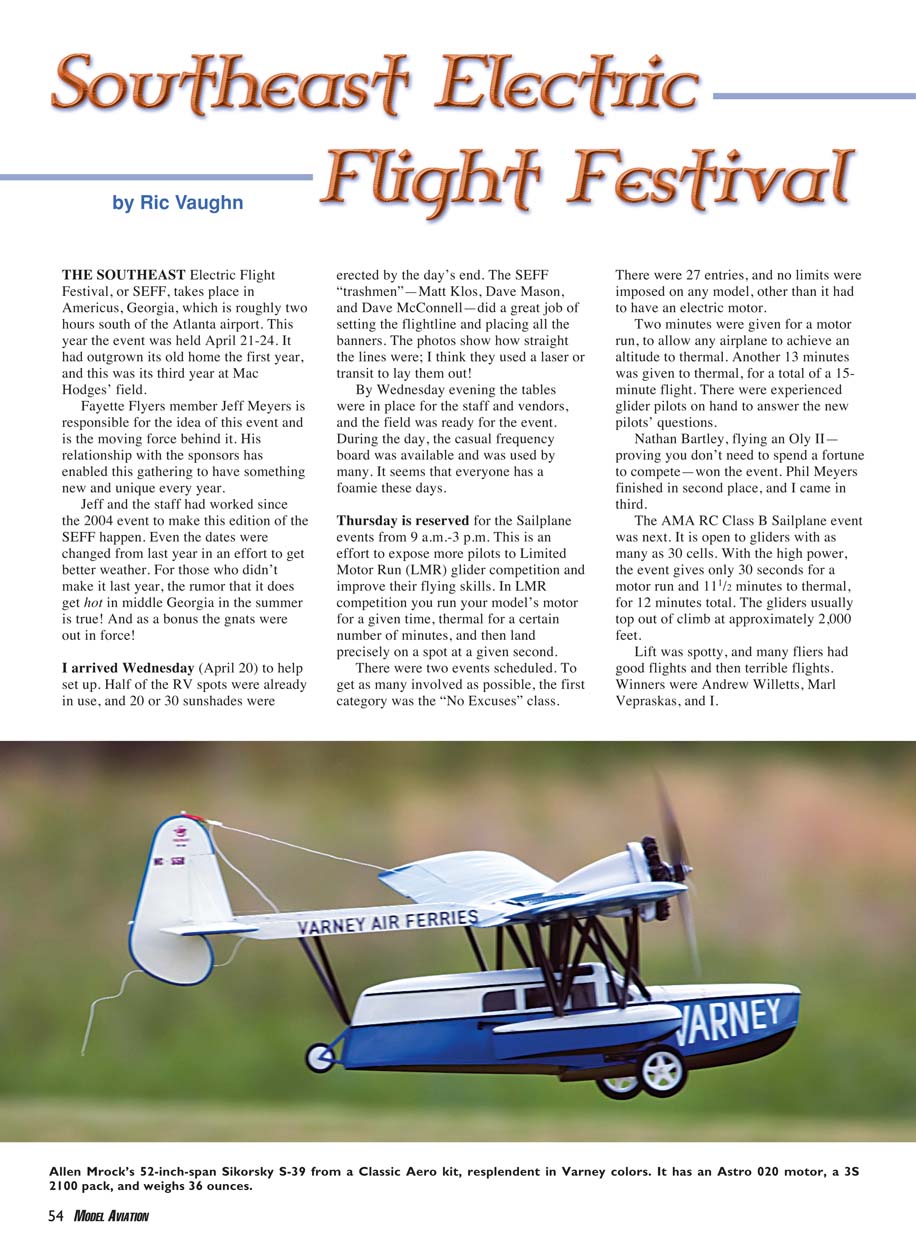
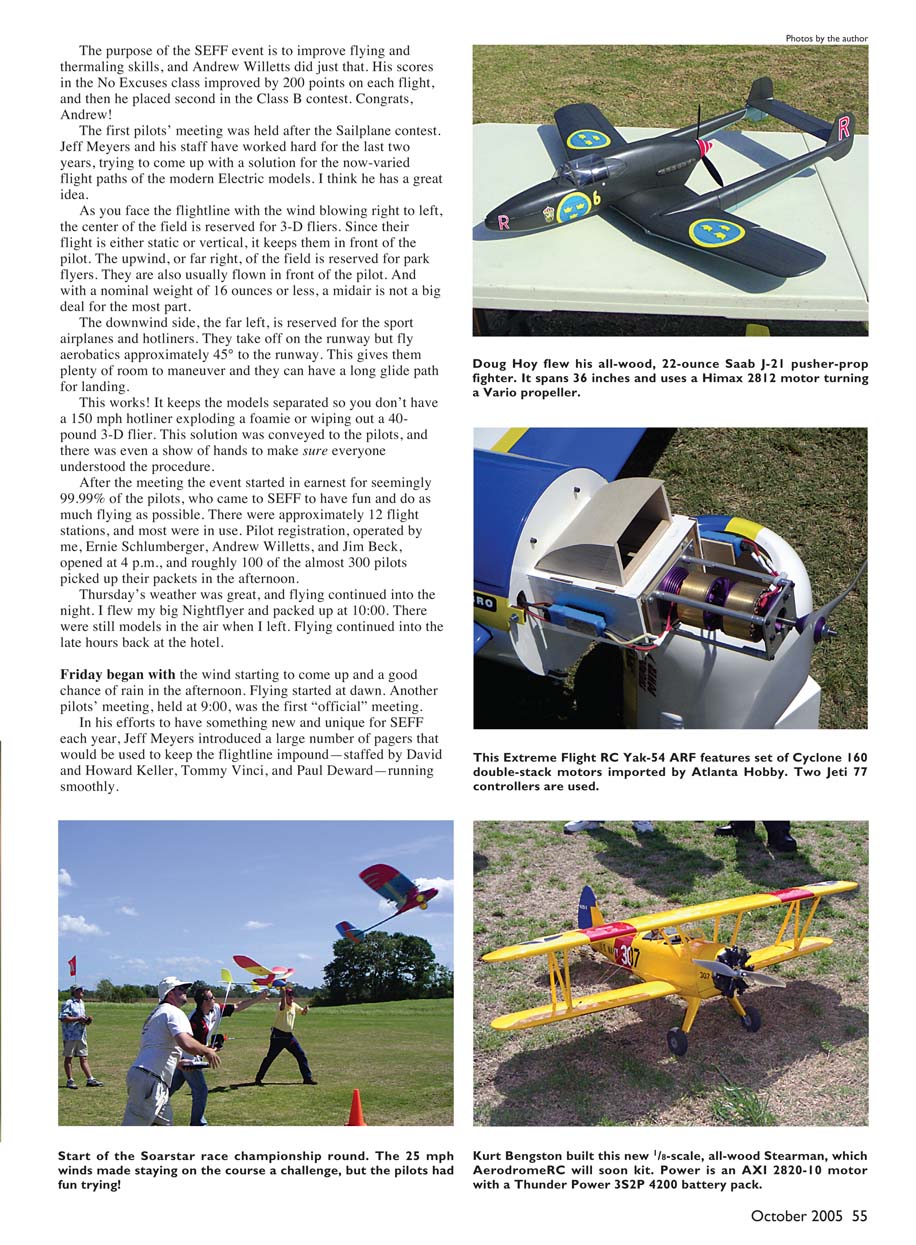
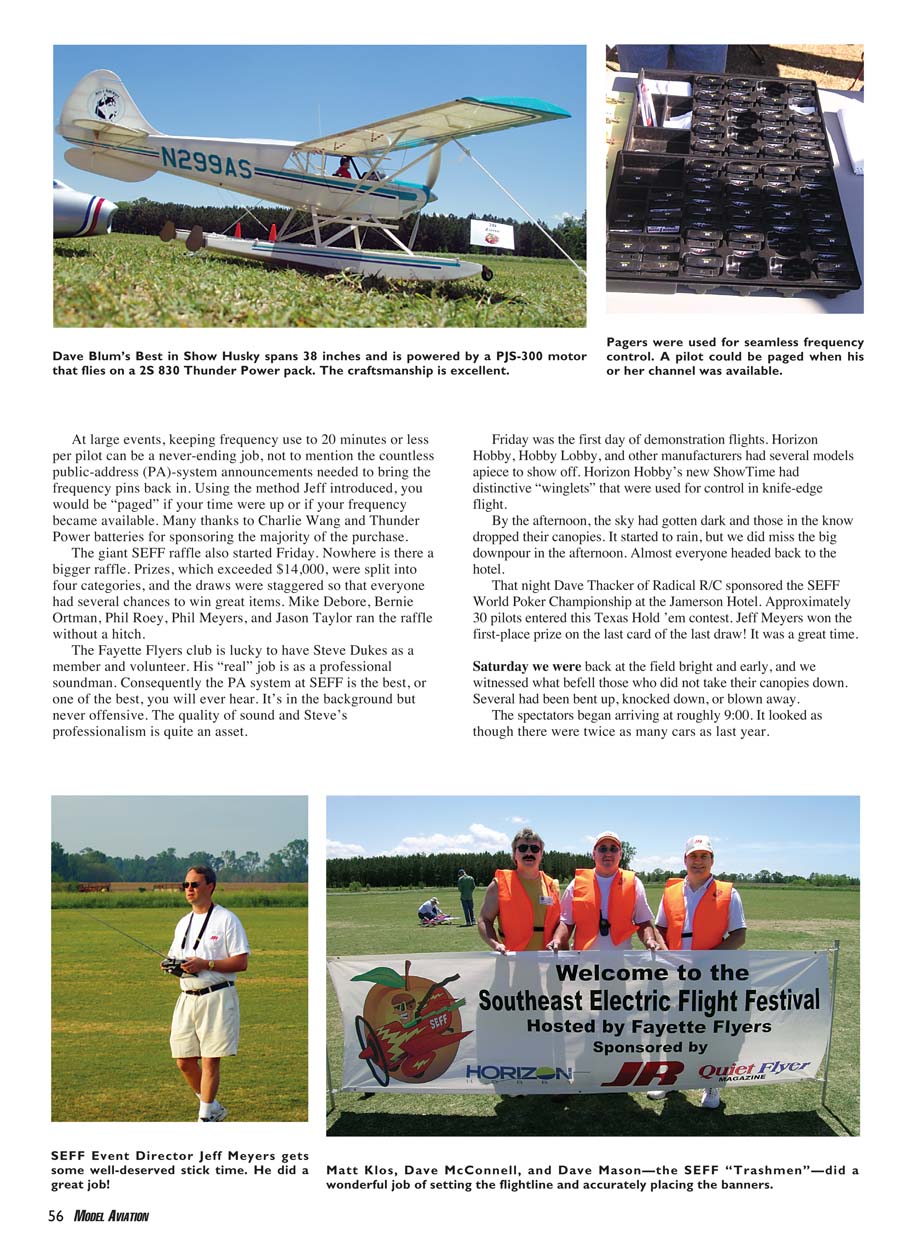
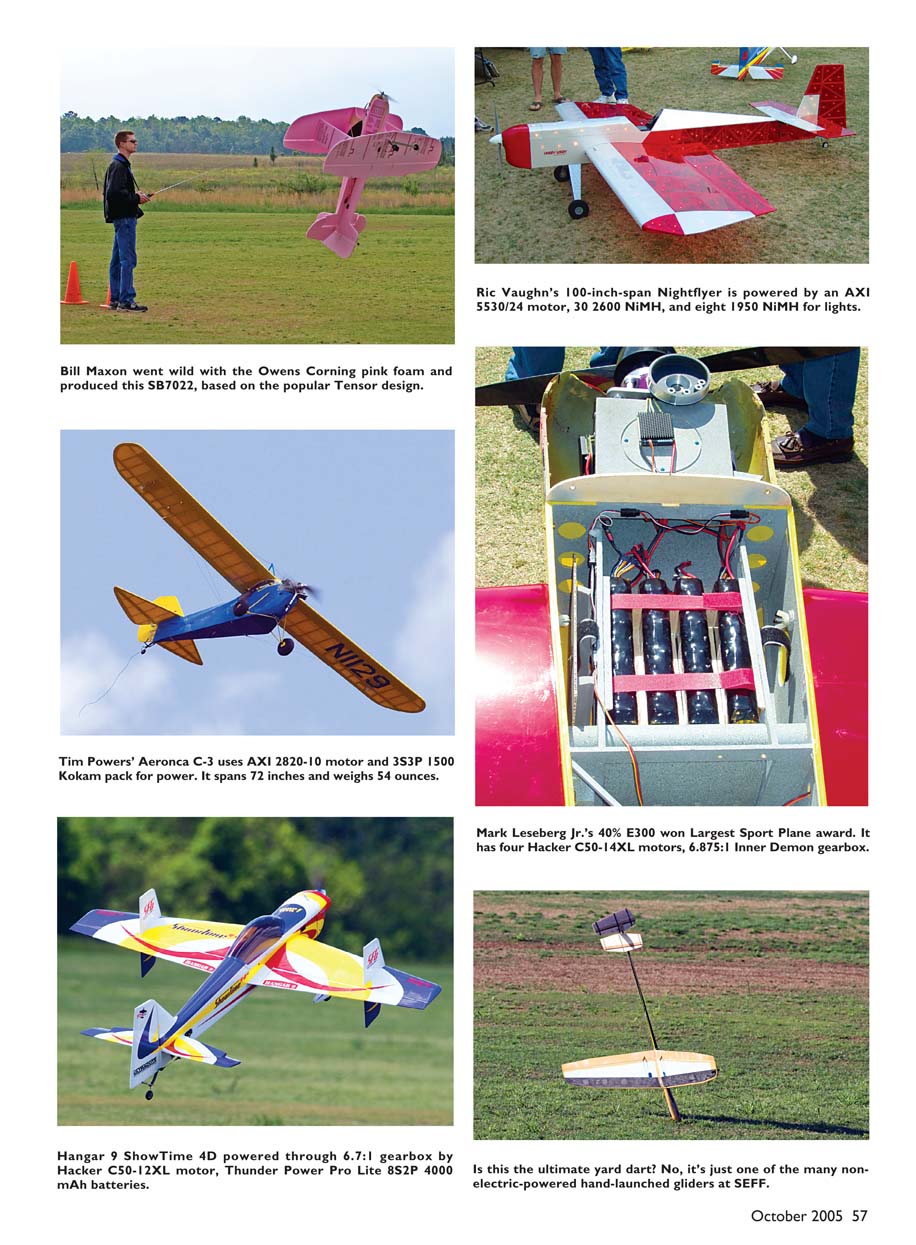
Southeast Electric Flight Festival
by Ric Vaughn
THE SOUTHEAST Electric Flight Festival, or SEFF, takes place in Americus, Georgia, which is roughly two hours south of the Atlanta airport. This year the event was held April 21-24. It had outgrown its old home the first year, and this was its third year at Mac Hodges' field.
Fayette Flyers member Jeff Meyers is responsible for the idea of this event and is the moving force behind it. His relationship with the sponsors has enabled this gathering to have something new and unique every year.
Jeff and the staff had worked since the 2004 event to make this edition of the SEFF happen. Even the dates were changed from last year in an effort to get better weather. For those who didn't make it last year, the rumor that it does get hot in middle Georgia in the summer is true! And as a bonus the gnats were out in force!
I arrived Wednesday (April 20) to help set up. Half of the RV spots were already in use, and 20 or 30 sunshades were erected by the day's end. The SEFF "trashmen"—Matt Klos, Dave Mason, and Dave McConnell—did a great job of setting the flightline and placing all the banners. The photos show how straight the lines were; I think they used a laser or transit to lay them out!
By Wednesday evening the tables were in place for the staff and vendors, and the field was ready for the event. During the day, the casual frequency board was available and was used by many. It seems that everyone has a foamie these days.
Thursday is reserved for the Sailplane events from 9 a.m.-3 p.m. This is an effort to expose more pilots to Limited Motor Run (LMR) glider competition and improve their flying skills. In LMR competition you run your model's motor for a given time, thermal for a certain number of minutes, and then land precisely on a spot at a given second.
There were two events scheduled. To get as many involved as possible, the first category was the "No Excuses" class.
There were 27 entries, and no limits were imposed on any model, other than it had to have an electric motor.
Two minutes were given for a motor run, to allow any airplane to achieve an altitude to thermal. Another 13 minutes was given to thermal, for a total of a 15-minute flight. There were experienced glider pilots on hand to answer the new pilots' questions.
Nathan Bartley, flying an Oly II—proving you don't need to spend a fortune to compete—won the event. Phil Meyers finished in second place, and I came in third.
The AMA RC Class B Sailplane event was next. It is open to gliders with as many as 30 cells. With the high power, the event gives only 30 seconds for a motor run and 11 1/2 minutes to thermal, for 12 minutes total. The gliders usually top out of climb at approximately 2,000 feet.
Lift was spotty, and many fliers had good flights and then terrible flights. Winners were Andrew Willetts, Marl Vepraskas, and I.
The purpose of the SEFF event is to improve flying and thermaling skills, and Andrew Willetts did just that. His scores in the No Excuses class improved by 200 points on each flight, and then he placed second in the Class B contest. Congrats, Andrew!
The first pilots' meeting was held after the Sailplane contest. Jeff Meyers and his staff have worked hard for the last two years, trying to come up with a solution for the now-varied flight paths of the modern Electric models. I think he has a great idea.
As you face the flightline with the wind blowing right to left, the center of the field is reserved for 3-D fliers. Since their flight is either static or vertical, it keeps them in front of the pilot. The upwind, or far right, of the field is reserved for park flyers. They are also usually flown in front of the pilot. With a nominal weight of 16 ounces or less, a midair is not a big deal for the most part.
The downwind side, the far left, is reserved for the sport airplanes and hotliners. They take off on the runway but fly aerobatics approximately 45° to the runway. This gives them plenty of room to maneuver and they can have a long glide path for landing.
This works! It keeps the models separated so you don't have a 150 mph hotliner exploding a foamie or wiping out a 40-pound 3-D flier. This solution was conveyed to the pilots, and there was even a show of hands to make sure everyone understood the procedure.
After the meeting the event started in earnest for seemingly 99.99% of the pilots, who came to SEFF to have fun and do as much flying as possible. There were approximately 12 flight stations, and most were in use. Pilot registration, operated by me, Ernie Schlumberger, Andrew Willetts, and Jim Beck, opened at 4 p.m., and roughly 100 of the almost 300 pilots picked up their packets in the afternoon.
Thursday's weather was great, and flying continued into the night. I flew my big Nightflyer and packed up at 10:00. There were still models in the air when I left. Flying continued into the late hours back at the hotel.
Friday began with the wind starting to come up and a good chance of rain in the afternoon. Flying started at dawn. Another pilots' meeting, held at 9:00, was the first "official" meeting.
In his efforts to have something new and unique for SEFF each year, Jeff Meyers introduced a large number of pagers that would be used to keep the flightline impound—staffed by David and Howard Keller, Tommy Vinci, and Paul Deward—running smoothly.
Southeast Electric Flight Festival
Ric Vaughn
The giant SEFF raffle also started Friday. Nowhere is there a bigger raffle. Prizes, which exceeded $14,000, were split into four categories, and the draws were staggered so that everyone had several chances to win great items. Mike Debore, Bernie Ortman, Phil Roey, Phil Meyers, and Jason Taylor ran the raffle without a hitch.
The Fayette Flyers club is lucky to have Steve Dukes as a member and volunteer. His "real" job is as a professional soundman. Consequently the PA system at SEFF is the best, or one of the best, you will ever hear. It's in the background but never offensive. The quality of sound and Steve's professionalism is quite an asset.
Friday was the first day of demonstration flights. Horizon Hobby, Hobby Lobby, and other manufacturers had several models apiece to show off. Horizon Hobby's new ShowTime had distinctive "winglets" that were used for control in knife-edge flight.
By the afternoon, the sky had gotten dark and those in the know dropped their canopies. It started to rain, but we did miss the big downpour in the afternoon. Almost everyone headed back to the hotel.
That night Dave Thacker of Radical R/C sponsored the SEFF World Poker Championship at the Jamerson Hotel. Approximately 30 pilots entered this Texas Hold 'em contest. Jeff Meyers won the first-place prize on the last card of the last draw! It was a great time.
Saturday we were back at the field bright and early, and we witnessed what befell those who did not take their canopies down. Several had been bent up, knocked down, or blown away.
The spectators began arriving at roughly 9:00. It looked as though there were twice as many cars as last year.
Bill Maxon went wild with the Owens Corning pink foam and produced this SB7022, based on the popular Tensor design.
Ric Vaughn's 100-inch-span Nightflyer is powered by an AXI 5530/24 motor, 3 2600 NiMH, and eight 1950 NiMH for lights.
Tim Powers' Aeronca C-3 uses AXI 2820-10 motor and 3S3P 1500 Kokam pack for power. It spans 72 inches and weighs 54 ounces.
Mark Leseberg Jr.'s 40% E300 won Largest Sport Plane award. It has four Hacker C50-14XL motors, 6.875:1 Inner Demon gearbox.
Hangar 9 ShowTime 4D powered through 6.7:1 gearbox by Hacker C50-12XL motor, Thunder Power Pro Lite 8S2P 4000 mAh batteries.
Is this the ultimate yard dart? No, it's just one of the many non-electric-powered hand-launched gliders at SEFF.
The field was soggy, but that didn't stop the pilots. It was dry by late morning, thanks to the wind, which came up and kept several of the airplanes on the ground. It didn't ground the foamies—nothing seems to stop them—but they did have to be chased downwind.
Noon brought the demo flights, which consisted of an hour of 3-D, ARFs, and a glider tow by the Hobby Horizon group.
At 3:00 the World Championship Soarstar Pylon Race was held at the park flyer end of the field. Approximately 200 people gathered for the event, and it was great! If you combine a light, draggy foamie with 25 mph winds, you have a recipe for excitement.
Two heats were scheduled, with a final flyoff for the winners. Just getting around the pylon in the wind was a major accomplishment!
Two models made it to the far pylon in the first heat, only to have a midair. The third airplane immediately started flying backward. It must have taken five minutes of full throttle to finish two laps. The second heat was just as exciting. Only three airplanes emerged flyable for the final. Winner Jason Cole, flying a Wingo, did all he could do just to finish eight laps.
The awards were given out at roughly 6 p.m. Ernie Schlumberger and I handed out the glider honors. Jeff Meyers handled out the award for Best New Product Released from a vendor, which went to Mountain Models for its ETana.
Mark Leseberg Jr. easily won the honor for the largest airplane with his 42.5-pound Godfrey 40% E300. It was powered by four Hacker C50 motors, an Inner Demon gear drive, and a few thousand dollars worth of batteries.
Best in Show was awarded to Dave Blum for his Husky on floats. This model was small, but the detail and craftsmanship were excellent.
Fred Francis—the "official" SEFF brew master—was also introduced to the crowd. He is responsible for this year's SEFF liquid bread and amber ale served with the barbecue, which nearly 260 pilots and friends enjoyed. The weather was cool, and many had to seek shelter rather than stay and chat.
The wind would not let up, and it kept many from an evening of night-flying. At this gathering you can arrive at dawn and leave at midnight, and there will be models in the air. With good weather, the flying never stops at this event.
Sunday was a blowout. The wind was brutal, and participants seemed frazzled from fighting it for two days along with the Friday rain. At this point people were in the going-home mode. The demo was canceled because of wind, and attendees took one last tour through the vendor area; you can't go home with money left in your pocket!
Those who stuck around gathered around the raffle area at noon, and numbers were called out as fast as possible. Most of the larger prizes had been given out Friday and Saturday, but there were plenty of nice smaller items. Those present seemed to have fun prodding the winners to get their prizes and move on. Everything was given out, and that marked the end of the event.
The 2004 gathering had 292 pilots registered, and nearly 700 spectators paid to come and see us fly. Most of the vendors had a terrific event. The raffle was spectacular as usual, thanks to vendor support.
Barbecue and SEFF ale went down smooth and cold Saturday. This year's new innovation—the pagers—worked better than expected, and the PA-system announcer was mellow. A slight date change is in the works for next year, to try to improve the weather for the event.
I apologize to those I missed mentioning for all the hard work they put in to make this event great. If you have even a slight interest in electric-powered airplanes, come to Georgia next year for four days of nonstop flying action. MA
Ric Vaughn 4022 Wesley Chapel Rd. Marietta GA 30062
Transcribed from original scans by AI. Minor OCR errors may remain.

