
Site Preservation and Recovery
by Frank Lewis
Lessons learned by the Miramar Radio Control Flyers
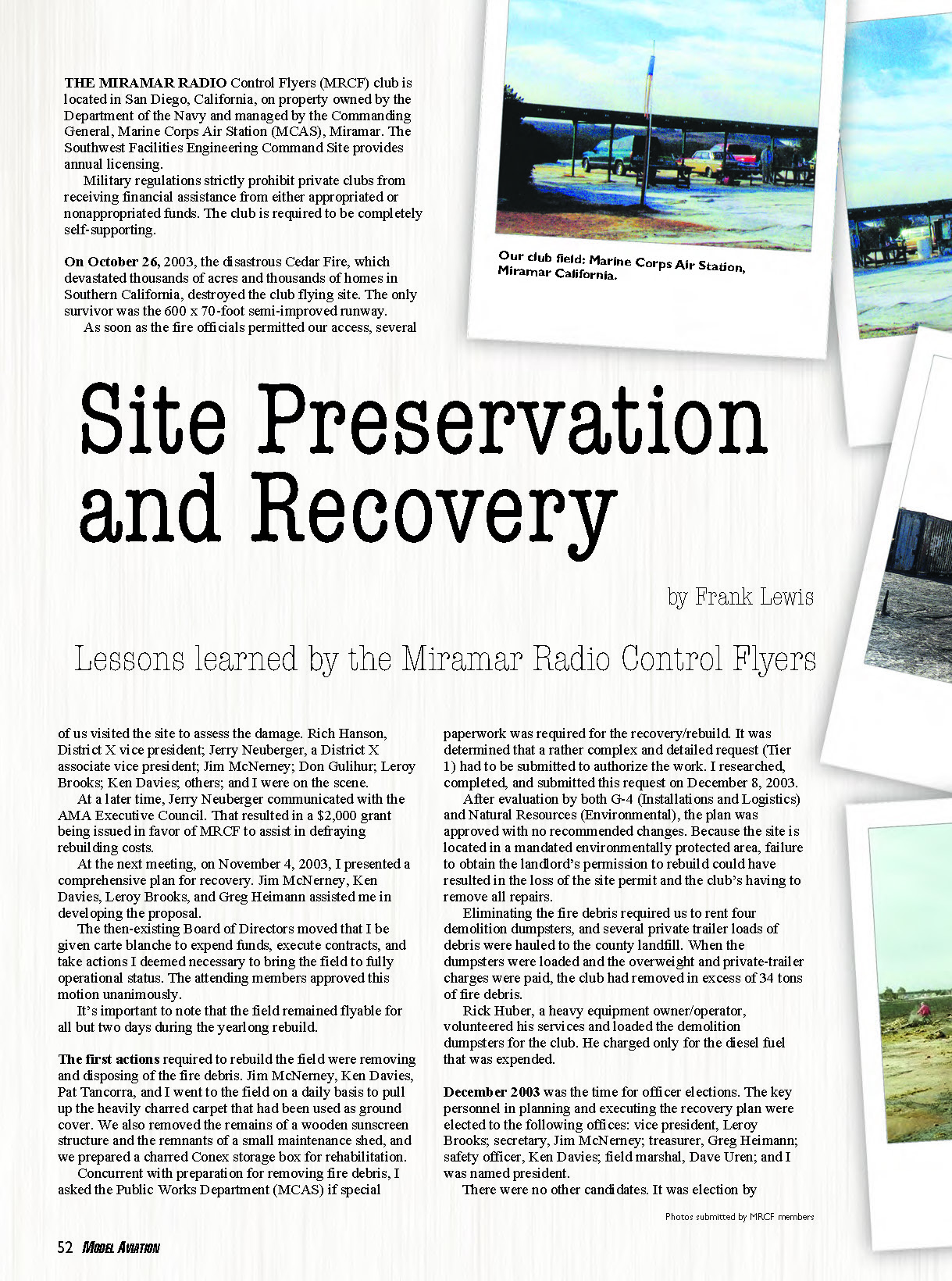
THE MIRAMAR RADIO Control Flyers (MRCF) club is located in San Diego, California, on property owned by the Department of the Navy and managed by the Commanding General, Marine Corps Air Station (MCAS), Miramar. The Southwest Facilities Engineering Command Site provides annual licensing.
Military regulations strictly prohibit private clubs from receiving financial assistance from either appropriated or nonappropriated funds. The club is required to be completely self-supporting.
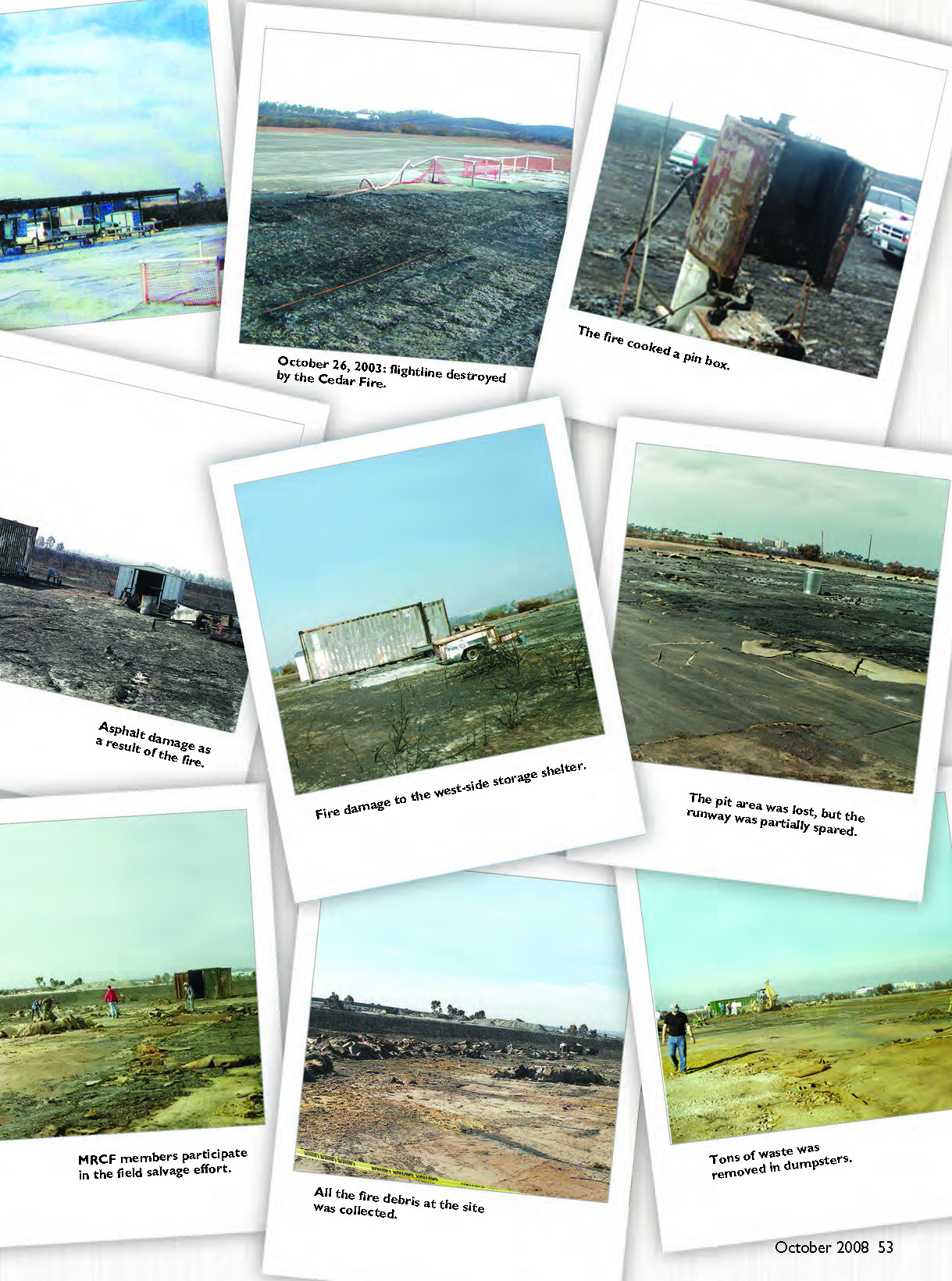
On October 26, 2003, the disastrous Cedar Fire, which devastated thousands of acres and thousands of homes in Southern California, destroyed the club flying site. The only survivor was the 600 x 70-foot semi-improved runway.
As soon as the fire officials permitted our access, several of us visited the site to assess the damage. Rich Hanson, District X vice president; Jerry Neuberger, a District X associate vice president; Jim McNerney; Don Gulihur; Leroy Brooks; Ken Davies; others; and I were on the scene.
At a later time, Jerry Neuberger communicated with the AMA Executive Council. That resulted in a $2,000 grant being issued in favor of MRCF to assist in defraying rebuilding costs.
At the next meeting, on November 4, 2003, I presented a comprehensive plan for recovery. Jim McNerney, Ken Davies, Leroy Brooks, and Greg Heimann assisted me in developing the proposal.
The then-existing Board of Directors moved that I be given carte blanche to expend funds, execute contracts, and take actions I deemed necessary to bring the field to fully operational status. The attending members approved this motion unanimously.
It's important to note that the field remained flyable for all but two days during the yearlong rebuild.
The first actions required to rebuild the field were removing and disposing of the fire debris. Jim McNerney, Ken Davies, Pat Tancrora, and I went to the field on a daily basis to pull up the heavily charred carpet that had been used as ground cover. We also removed the remains of a wooden sunscreen structure and the remnants of a small maintenance shed, and we prepared a charred Conex storage box for rehabilitation.
Concurrent with preparation for removing fire debris, I asked the Public Works Department (MCAS) if special paperwork was required for the recovery/rebuild. It was determined that a rather complex and detailed request (Tier 1) had to be submitted to authorize the work. I researched, completed, and submitted this request on December 8, 2003.
After evaluation by both G-4 (Installations and Logistics) and Natural Resources (Environmental), the plan was approved with no recommended changes. Because the site is located in a mandated environmentally protected area, failure to obtain the landlord's permission to rebuild could have resulted in the loss of the site permit and the club's having to remove all repairs.
Eliminating the fire debris required us to rent four demolition dumpsters, and several private trailer loads of debris were hauled to the county landfill. When the dumpsters were loaded and the overweight and private-trailer charges were paid, the club had removed in excess of 34 tons of fire debris.
Rick Huber, a heavy equipment owner/operator, volunteered his services and loaded the demolition dumpsters for the club. He charged only for the diesel fuel that was expended.
December 2003 was the time for officer elections. The key personnel in planning and executing the recovery plan were elected to the following offices: vice president, Leroy Brooks; secretary, Jim McNerney; treasurer, Greg Heimann; safety officer, Ken Davies; field marshal, Dave Uren; and I was named president.
There were no other candidates. It was election by acclamation.
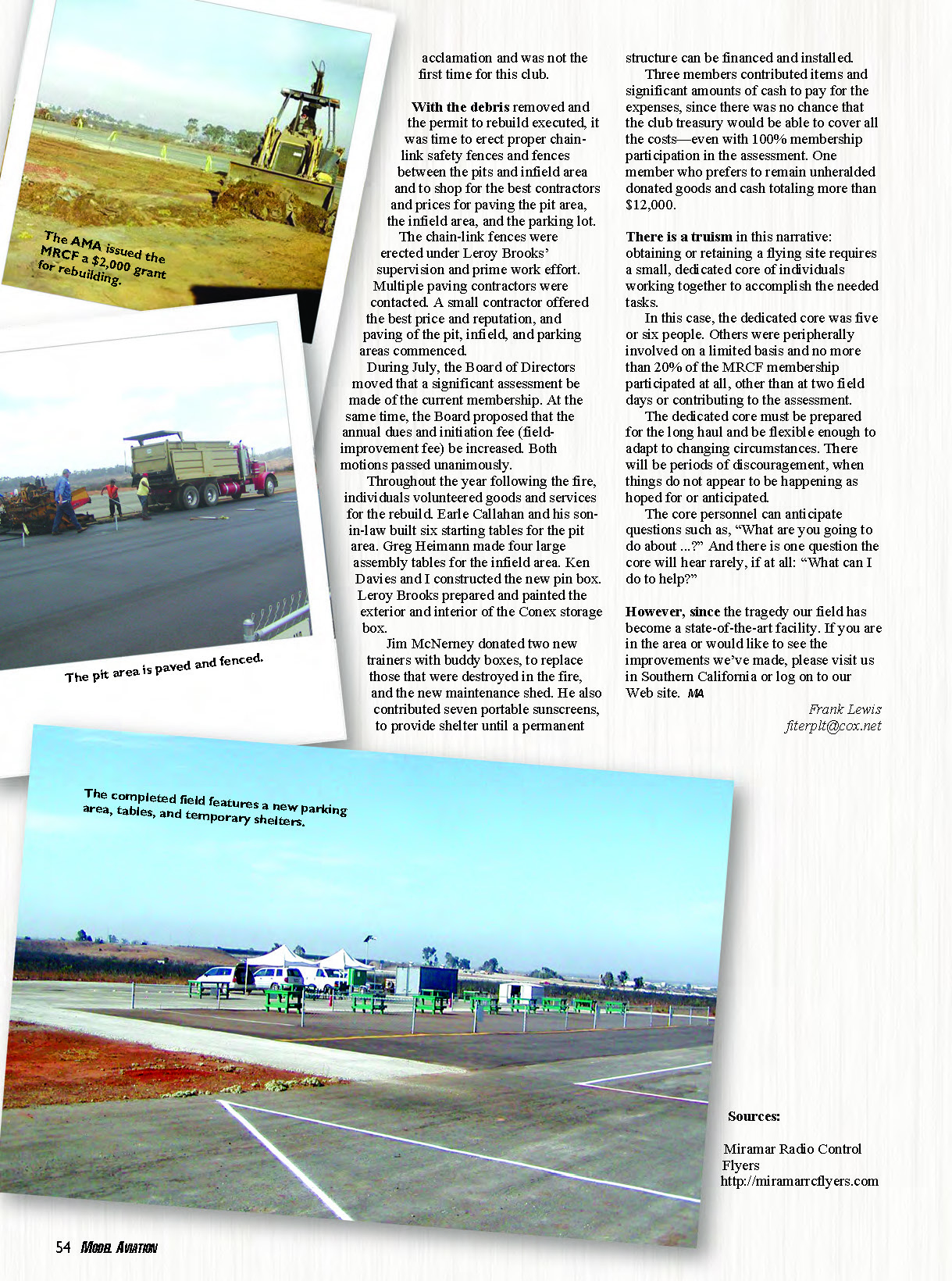
With the debris removed and the permit to rebuild executed, it was time to erect proper chain-link safety fences and fences between the pits and infield area and to shop for the best contractors and prices for paving the pit area, the infield area, and the parking lot.
The chain-link fences were erected under Leroy Brooks' supervision and prime work effort. Multiple paving contractors were contacted. A small contractor offered the best price and reputation, and paving of the pit, infield, and parking areas commenced.
During July, the Board of Directors moved that a significant assessment be made of the current membership. At the same time, the Board proposed that the annual dues and initiation fee (field-improvement fee) be increased. Both motions passed unanimously.
Throughout the year following the fire, individuals volunteered goods and services for the rebuild. Earle Callahan and his son-in-law built six starting tables for the pit area. Greg Heimann made four large assembly tables for the infield area. Ken Davies and I constructed the new pin box. Leroy Brooks prepared and painted the exterior and interior of the Conex storage box.
Jim McNerney donated two new trainers with buddy boxes, to replace those that were destroyed in the fire, and the new maintenance shed. He also contributed seven portable sunscreens, to provide shelter until a permanent structure can be financed and installed.
Three members contributed items and significant amounts of cash to pay for the expenses, since there was no chance that the club treasury would be able to cover all the costs—even with 100% membership participation in the assessment. One member who prefers to remain unheralded donated goods and cash totaling more than $12,000.
There is a truism in this narrative: obtaining or retaining a flying site requires a small, dedicated core of individuals working together to accomplish the needed tasks.
In this case, the dedicated core was five or six people. Others were peripherally involved on a limited basis and no more than 20% of the MRCF membership participated at all, other than at two field days or contributing to the assessment.
The dedicated core must be prepared for the long haul and be flexible enough to adapt to changing circumstances. There will be periods of discouragement, when things do not appear to be happening as hoped for or anticipated.
The core personnel can anticipate questions such as, "What are you going to do about...?" And there is one question the core will hear rarely, if at all: "What can I do to help?"
However, since the tragedy our field has become a state-of-the-art facility. If you are in the area or would like to see the improvements we've made, please visit us in Southern California or log on to our Web site. MA
Frank Lewis flterpt@cox.net
Transcribed from original scans by AI. Minor OCR errors may remain.

