
RC Soaring
Nationals — Scale Glider Event
The scale glider portion of the Nationals will be held Saturday, July 22 at the AMA flying site in Muncie. It is a great site, with smooth paved runways and grass to the horizon. AMA provides large shade tents, free cold water, and restrooms on site.
Even if you're not flying in the Nationals, this event is worth a weekend trip just to watch. Large radio-control (RC) power airplanes will be towing up large RC gliders.
The rules for scale gliders will be much more flexible this year than last year. Provisional rules will allow most any scale RC glider to enter; ARFs (Almost Ready to Fly), kits, and scratch-built airplanes will be allowed to compete.
A static score multiplier will give more points to those builders who did more work:
- Designer-built: 2.0
- Plan-built: 1.7
- Kit-built: 1.1
- ARF (purchased): 0.9
The weight limit for aerotowed airplanes was raised from 25 to 55 pounds. New airplanes, adequate to tow models as large as 55 pounds, will be provided.
No scoring downgrade will be given for dark wing undersides or reflective tape used to increase visibility. This rule was added primarily for safety concerns. Flying an all-white glider in haze or under white clouds is difficult; the visibility aids will help most when thermaling up high.
There are many more small rules changes related to scoring and flying. John Devine proposed that these changes be adopted as official AMA rules. Much thought and discussion was put into them, and they should increase the popularity of the event. Bob Harold, Scale Contest Director for the Nationals, had the foresight to adopt the rules as provisional.
Blu Dartar Hand-Launch Glider (Carl "Mac" McBurnett)
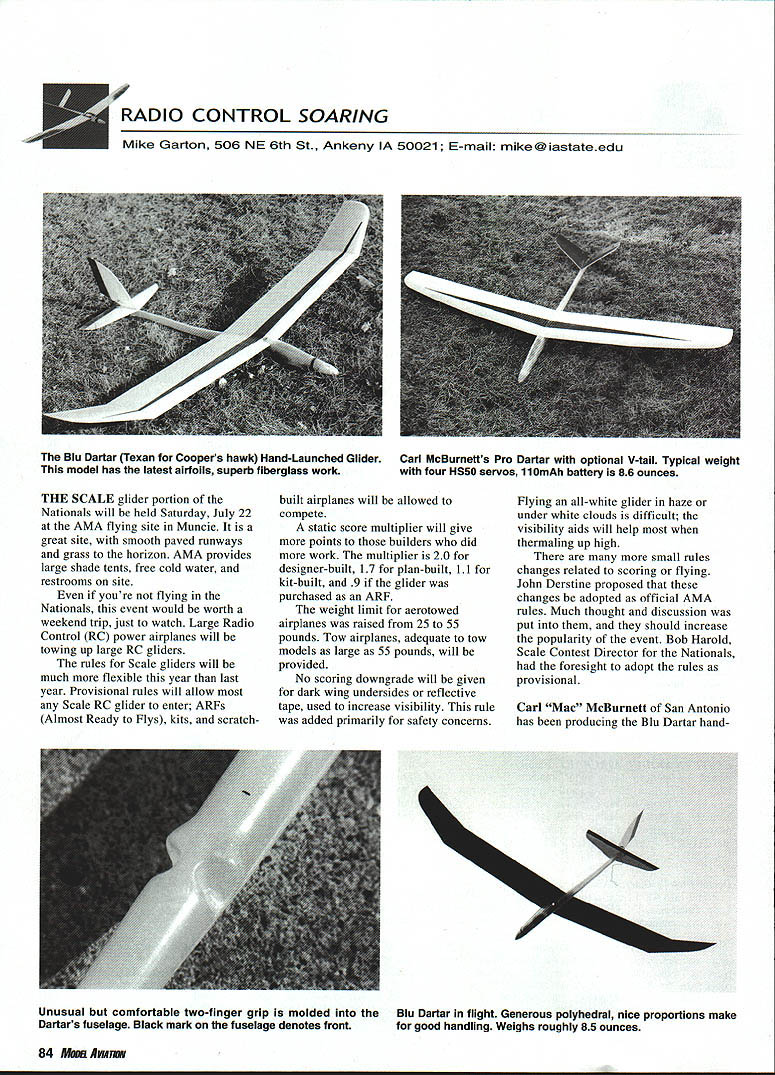
Carl "Mac" McBurnett of San Antonio has produced the Blu Dartar hand-launch glider for several years. The glider has undergone evolution to increase performance.
A trip to the International Hand Launch Glider Festival last summer motivated some changes to the wing. Mac now offers two versions, both using high-performance hand-launch airfoils. Both Dartars are intended for intermediate to expert pilots.
- Blu Dartar (standard)
- Double-taper polyhedral wing.
- Root airfoil: thinned 6.5% SA7035.
- Wingtip airfoils tweaked to eliminate tip-stalls.
- Good speed range and excellent climb in thermals.
- Typical weight: about 8.5 ounces with a 110 mAh battery and HS50 servos.
- Wings: vacuum-bagged fiberglass and carbon over foam. Panel joint angles are precut.
- Pro Dartar
- Triple-taper flaperon wing.
- Root airfoil: SD6063.
- Blended sections near the wingtips.
- Very fast airfoil with incredible speed range.
- Example: an 8.6-ounce Pro Dartar handled 20 mph winds without ballast and could still slow to a crawl; three-ounce-per-square-foot wing loading helps.
- Flaperons decrease turn radius while thermalling.
Both versions share:
- Fiberglass-and-Kevlar fuselage with a long nose to balance light radios.
- Servo placement considerations: with a 110 mAh battery, servos must be installed under the wing to avoid nose heaviness. Mounting servos under the nose hatch allows balancing with a 50 mAh battery. With the smaller battery and four HS50 servos, a full-house eight-ounce Pro Dartar is possible.
- Strong yet light fuselage construction: ample fiberglass fabric is used but kept light by wetting the fabric to avoid pools of epoxy.
- Tails: vacuum-bagged fiberglass over styrofoam; both conventional tail and V-tail options are offered.
- Dartar hand-grip: molded-in finger pads for a comfortable, effective grip; curves add strength to the fuselage.
Assembly of either airplane takes less than 10 hours; five hours is reasonable if you've assembled similar airplanes. The kit includes seven pages of text instructions and nearly 100 color photographs; additional text and photos are available on Mac's web site. The photos take you step-by-step through construction.
Mac provides testing and tuning data (CGs, throws, airfoil performance for various setups), which helps builders know what to expect and where to start.
Recommended setups:
- Novice thermal flyers: use the Blu Dartar with a larger tail and a conservative flap curve.
- Slope or high-wind flying: use the Pro Dartar and add ballast as needed.
Construction and Documentation Trends
Online instructions are a growing trend. They are inexpensive, colorful, and easy to update. The Blu Dartar kit materials and online resources emphasize thorough testing, tuning guidance, and step-by-step photographic instruction.
Aspire — Hangar 9 Two-Meter ARF
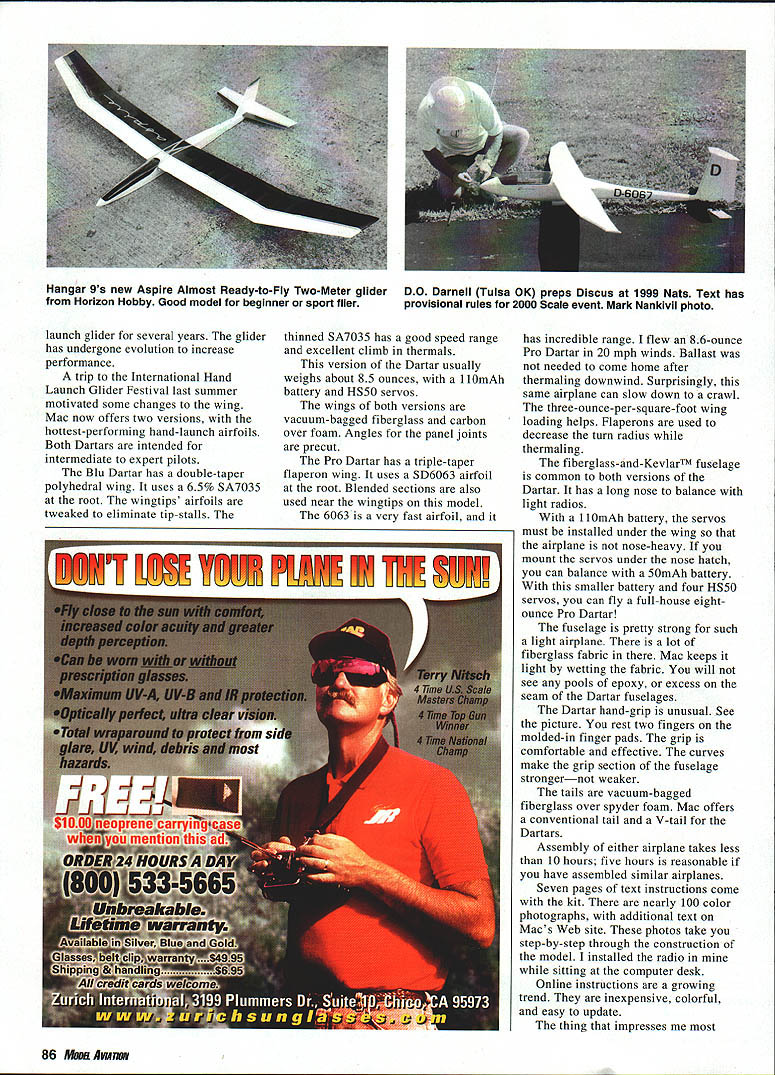
The Aspire from Hangar 9 (distributed through Horizon Hobby) is a nicely finished two-meter ARF aimed at beginners and sport fliers. It assembles quickly; a typical sample was ready in about three hours. Covering was tight and smooth; control throws were about right. The wing uses an S7055 airfoil and a one-piece spar for strength.
Flight-trim was easy. With a modest amount of expo the airplane handled well and thermaled surprisingly well for its weight class. It is stable and predictable, making it a good trainer for pilots moving up to hobby-scale RC soaring.
Features and construction details:
- SD7037 airfoil (noted elsewhere on the model).
- Wing construction visible through transparent covering: spruce spars with vertical-grain balsa shear webs.
- Prebuilt structure workmanship is better than most beginning builders can attain.
- Covering: precovered with Goldberg UltraCote. Some wrinkles may appear out of the box but can be removed with a travel iron.
- Box claims the glider is 90% prebuilt; that assessment is accurate:
- Polyhedral joints finished
- Tail surfaces hinged
- Fuselage slotted for tail
- Tow hook holes drilled
- Servo rails in place
- Slots precut for pushrods to exit the fuselage
Most difficult work is already done. The builder must join the wing halves, glue on the tail, and install the radio. The Aspire instructions are 36 pages long; some pages educate the builder on basic building and flying techniques, including flight-trimming and thermaling.
Some ARF gliders have poor flying qualities compared to kit-built models: higher wing loadings, crude airfoils, and overly-flat wings are common problems. An anecdote describes an ARF that glided poorly and required immediate landing pattern entry. The Aspire does not have these problems; it has a modern airfoil, moderate wing loading, and well-thought-out proportions. The large amount of polyhedral makes the Aspire turn well and increases spiral stability.
The Aspire competes head-to-head with the Spirit ARF offered by Great Planes. It comes in a large, colorful box and has a street price of about $100. The low cost, ample instructions, and solid design should give newcomers a pleasant first experience with gliders.
Recommendations
Both Mac's Dartars and the Aspire are good choices depending on needs:
- Mac's Dartars: lighter and more performance-oriented.
- Aspire: quick, durable, and forgiving ARF suitable for beginners and sport fliers.
Resources
Soaring Web Site of the Month:
AMA Nationals Information:
- www.modelaircraft.org/Homepage.htm
- Click on "General Information Area," then "Competitions/Technical Department," then "2000 Nats."
Soaring-Specific Nationals Information:
- Scale Contest Director: Bob Harold
- 519 North Youlon St.
- West Salem, WI 54669
- (608) 786-0856
- bobcarman@aol.com
BluDartar Manufacturer:
- Carl McBurnett
- 7506 Legend Point Dr.
- San Antonio, TX 78244
- (210) 662-9503
- www.bludartar.com/
Transcribed from original scans by AI. Minor OCR errors may remain.

