
RADIO CONTROL SOARING
Mike Garton 2733 NE 95th Ave., Ankeny IA 50021 E-mail: mike@iastate.edu
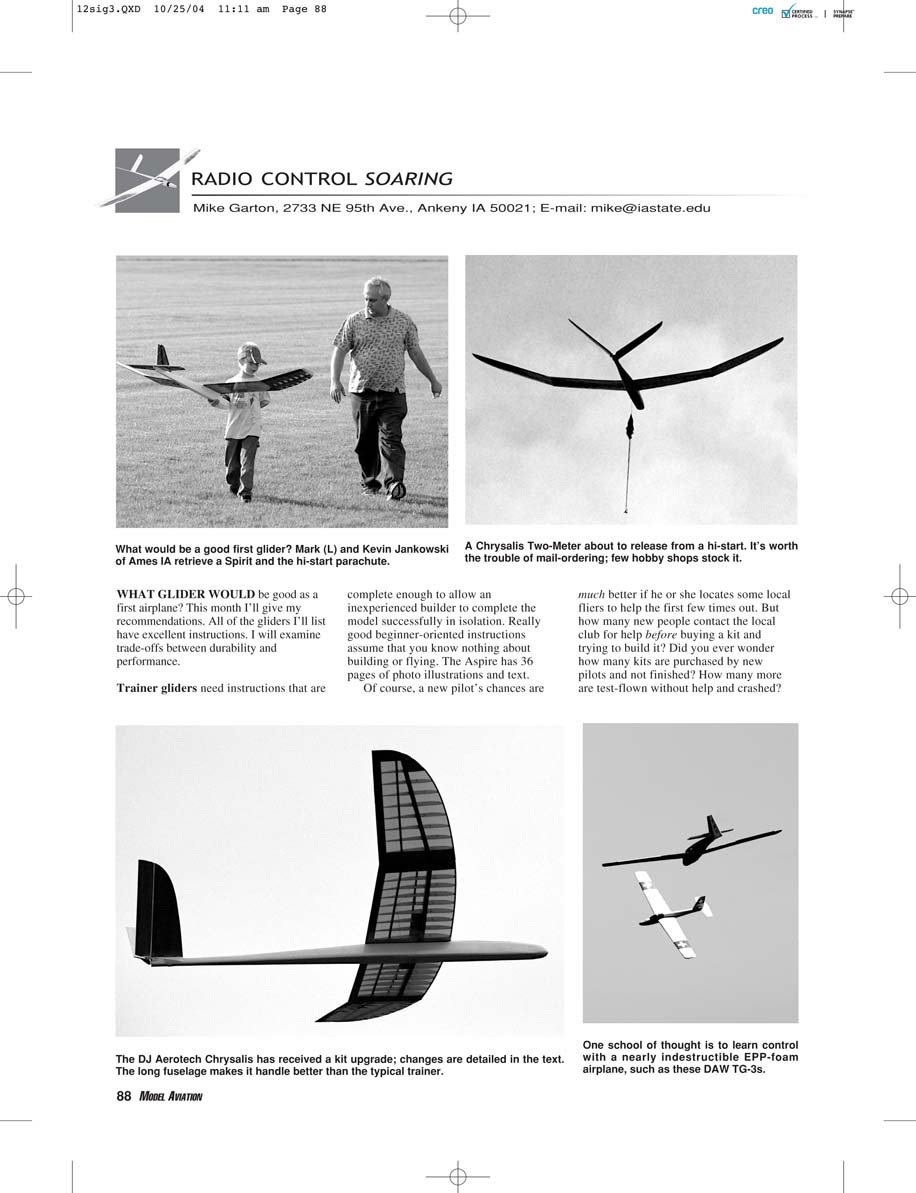
What glider would be good as a first airplane?
This month I'll give my recommendations for good first gliders. All of the gliders I list have excellent instructions. I'll examine trade-offs between durability and performance.
Trainer gliders need instructions that are complete enough to allow an inexperienced builder to complete the model successfully in isolation. Really good beginner-oriented instructions assume you know nothing about building or flying. The Hangar 9 Aspire, for example, has 36 pages of photo illustrations and text.
Of course, a new pilot's chances are much better if he or she locates some local fliers to help the first few times out. But how many new people contact the local club for help before buying a kit and trying to build it? How many kits are purchased by new pilots and not finished? How many more are test-flown without help and crashed?
Many new people build in isolation, fail, and subsequently quit this sport. The number of "isolation failures" is probably more than 50%. This is why instructions are especially critical in the first glider kit. When the glider is complete, it is critical that the new person find an experienced RC pilot. The hobby shop, Internet searches, and contacting the AMA are possible ways to find such a person in your proximity.
The experienced pilot can verify that the new glider is really ready for flight. Most crashes can be avoided with a thorough preflight inspection. Do the surfaces move the right direction in response to transmitter inputs? Does the glider balance in the right spot? The experienced pilot should test-fly the model and assist with flight training.
A first glider does not need to be high performance; it just needs to be strong enough (and repairable enough) to survive what I call "leftsie-rightsie training." When an airplane flies toward the pilot, controls are reversed compared to visual cues. If the first glider lasts long enough for the pilot to get past control-reversal mistakes, it has served its purpose. With the help of a more experienced pilot, a new pilot is likely to progress on to thermaling.
High glide ratio and responsive handling do not inherently make gliders hard to fly. Factors that make advanced gliders unsuitable for training include greater speed, lack of spiral stability, higher cost, and more complex linkages. Trainer gliders can have reasonable performance. The only performance penalties that should be built into a trainer glider are a slightly heavier structure for crash resistance and a forward CG for additional stability.
Recommended beginner gliders
#### Sig Riser My first glider was a Sig Riser. These were in every hobby shop during the 1980s and still are. The instructions are excellent. The strength-to-weight ratio, handling, and airfoil performance do not compare favorably with more modern gliders, but my Riser served its purpose. I repaired it again and again until I got past the left-right mistakes. Persistence was key.
#### Carl Goldberg Gentle Lady (GL) Carl Goldberg Models introduced the Gentle Lady in the early 1980s. Its instructions are detailed enough for it to be built in isolation. The late Carl Goldberg was a genius designer. The GL has a well-designed structure and great handling characteristics for a polyhedral glider. Many people find their first thermals with this model.
The GL's spar is a solid rectangle of basswood to simplify construction. Although it is extremely light—about 23 ounces ready to fly—the rubber-band-on wing prevents serious damage in most frontal and ground impacts. However, collisions with posts or trees are likely to warrant serious repair. If you like to build and only want to spend about $50 on an initial kit, I recommend the GL.
#### DJ Aerotech Chrysalis Two-Meter The Chrysalis Two-Meter is a more recent design. Don Stackhouse spent a great deal of time engineering the kit to ensure the first-time builder's success. Although it's more expensive than a GL at about $85, there is much more in the box. After buying MonoKote, glue, and a two-channel radio, the difference in kit prices is less significant.
Key points:
- Parts are mostly laser-cut for accuracy.
- A dowel makes a simple and durable wing leading edge.
- More durable, more fun to build, and higher performance than the GL.
- Sink rate is similar to the GL's, but glide ratio and speed range are better.
- Kits have materials to build either a V-tail or a conventional tail.
- Conventional tail option includes a normal-sized horizontal tail or an oversize tail for beginners wanting extra pitch stability.
- Designed so the wing and fuselage/tail plans and instructions are separate—useful for repairs and for building wings and multiple fuselages (e.g., electric + sailplane versions).
As of September 2004, Don Stackhouse completed an overhaul of the Chrysalis kit. Changes include:
- An optional kit for a three-piece wing.
- Miscellaneous clarifications and updates in the plans and instructions.
- Some diagonal stiffeners to give the wing more torsional rigidity.
- Spoilers now shown driven by two servos—one at each spoiler.
- More detailed instructions for how to optionally add carbon fiber to the inboard spar caps and across the center-section joint for winch launching.
- New electric options, showing a direct-drive Speed 600 and brushless outrunner motor.
#### Great Planes Spirit The Great Planes Spirit may be the best-selling trainer glider because of its availability. It has online instructions for those who want to see a well-written manual. The Aspire and Gentle Lady instructions are even better. One downside to the Spirit is its higher weight—do not expect it to float or thermal as well as the Chrysalis and GL designs.
#### Defiant (Northeast Sailplanes) — EPP foam The Defiant from Northeast Sailplanes (NSP) was the only EPP-foam thermal glider on the market when I wrote this column. EPP foam is the springy kind that flexes and bounces back without breaking. This has an obvious advantage for beginners who don't have access to a buddy-box trainer.
Dave's Aircraft Works (DAW) stopped producing EPP gliders. The DAW designs are now owned by SkyKing RC Products (http://skykingrcproducts.com).
Ed Berg has been working on an EPP thermal trainer. A prototype was shown in the magazine pictures. By the time you read this, he should have one on the market. Ed uses Drela airfoils for good performance.
Another place to look for new, durable trainer sailplanes that come with good instructions is http://upslopeairplanes.com.
ARF options
There are several good options in the ARF category of beginner gliders. Examples include:
- Great Planes Spirit ARF
- Hangar 9 Aspire ARF
- Goldberg Gentle Lady ARF
The Aspire is slightly lighter than a Spirit but otherwise similar. The GL ARF is much lighter than both.
These ARF sailplanes can be purchased for less than $100, already built and covered. Typical buyer tasks:
- Join the wings
- Glue on the tail
- Install the radio
- Hook up the pushrods
These tasks take approximately two evenings. Each model is available in electric (self-launch with folding propeller) versions as well.
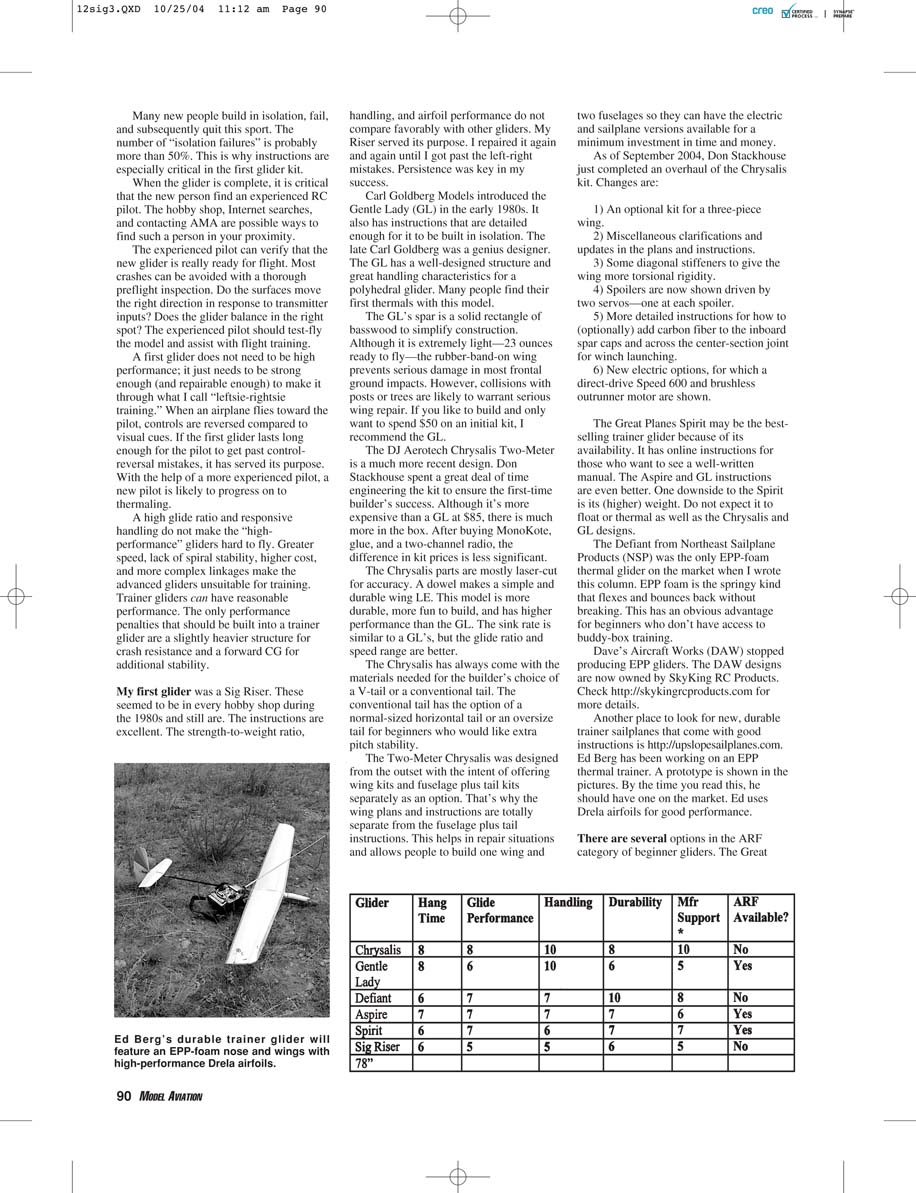
Manufacturer support and notes
The accompanying table in the original article showed my opinionated ratings of the available beginner-oriented gliders in the order I recommend them. Each category was rated on a scale of one to 10.
The "Mfr Support" column indicates how actively the manufacturer supports the product: Does it have beginning-soaring-oriented information on its website? Does it list a telephone number? Do the designers answer the phone? Are phone-support people expert glider fliers? Are you likely to see the designers at major glider events?
I contacted many more manufacturers than I listed here. Most had no gliders with instructions complete enough to meet my definition of a good first model. There are many polyhedral glider designs on the market with more complex structures and/or less-detailed instructions. Because of the more difficult build, those designs would make fine second gliders.
Sources:
- Chrysalis: www.djaerotech.com/
- Gentle Lady: www.carlgoldbergproducts.com/
- Defiant: www.nesail.com/
- Aspire, Aspire EP: www.horizonhobby.com/
- Spirit: www.greatplanes.com/
- Riser: www.sigmfg.com/
Transcribed from original scans by AI. Minor OCR errors may remain.

