
RADIO CONTROL HELICOPTERS
Paul Tradelius, 6704 Santiago, Ft. Worth, TX 76133
Introduction
In the last issue I presented some safety checks for your helicopter after a winter's rest. However, one area I didn't discuss in detail is the proper care and feeding of Ni-Cd batteries, which continue to be the weak link in our radio systems.
Battery technology has been virtually unchanged for the past several years, and there continue to be different points of view on battery care, even among experts. Since I am not a battery expert, I asked two people to help with this article so we could all learn more. Mike Mahoney of Double M Electronics responded with several pages of information, and I talked at length with Larry Sribnick of SR Batteries to get his opinions and ideas. This article could not have been written without their help.
Battery basics
The basic Ni-Cd battery is referred to as a "cell" and has a nominal working voltage under load—such as when running our servos or transmitter—of 1.2 volts. Most radio systems have four such Ni-Cd cells in series for an airborne power supply of 4.8 volts, and eight Ni-Cd cells in the transmitter for 9.6 volts.
Although these are nominal voltages, a fully charged battery will read higher than these figures, with the voltage obviously dropping over time as the battery delivers power.
Discharge curve
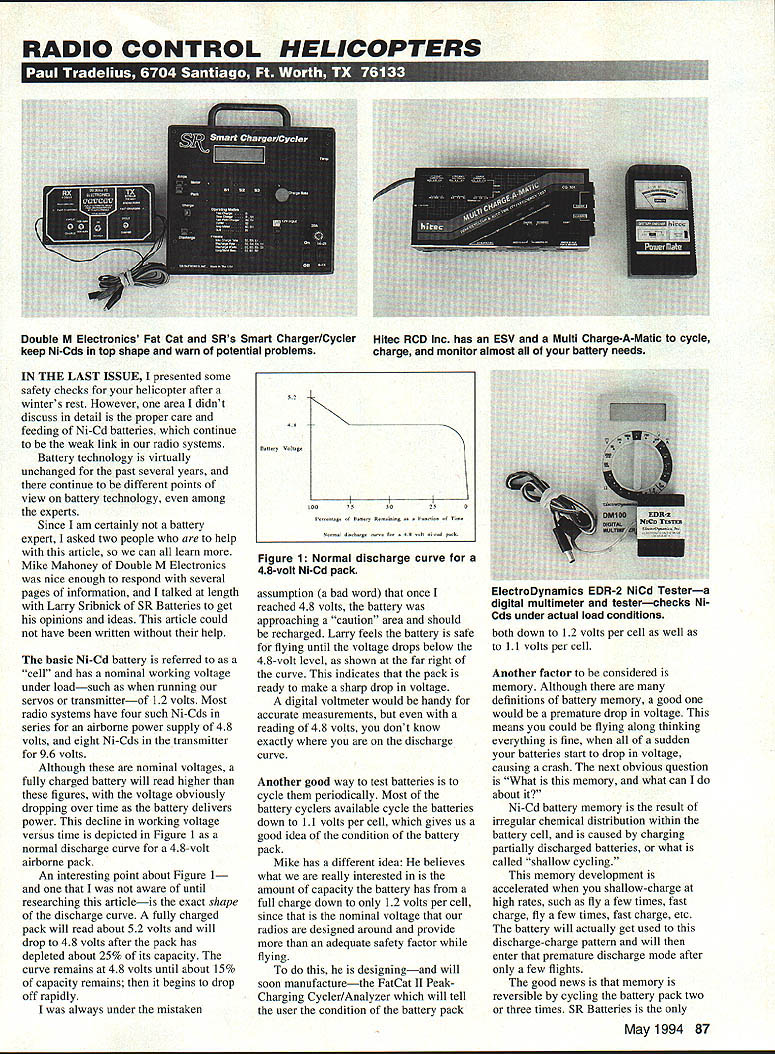
The decline in working voltage versus time is depicted in Figure 1 as a normal discharge curve for a 4.8-volt airborne pack. An interesting point—and one I was not aware of until researching this article—is the exact shape of the discharge curve:
- A fully charged 4.8V pack will read about 5.2 volts.
- It will drop to 4.8 volts after the pack has depleted about 25% of its capacity.
- The curve remains near 4.8 volts until about 15% of capacity remains; then it begins to drop off rapidly.
I had wrongly assumed that once the pack reached 4.8 volts the battery was in a "caution" area and should be recharged. Larry feels the battery is safe for flying until the voltage drops below the 4.8-volt level shown at the far right of the curve, which indicates the pack is about to make the sharp voltage drop. A digital voltmeter is handy for accurate measurements, but even with a reading of 4.8 volts you don't know exactly where you are on the discharge curve.
Measuring capacity and cyclers
Another good way to test batteries is to cycle them periodically. Most battery cyclers available cycle the batteries down to 1.1 volts per cell, which gives a good idea of the condition of the battery pack.
Mike has a different perspective: he believes what we're really interested in is the amount of capacity the battery has from a full charge down to 1.2 volts per cell, since that is the nominal voltage our radios are designed around and provides more than an adequate safety factor while flying. To do this, he is designing—and will soon manufacture—the FatCat II Peak-Charging Cycler/Analyzer, which will tell the user the condition of the battery pack both down to 1.2 volts per cell as well as to 1.1 volts per cell.
Memory
Battery "memory" can be defined as a premature drop in voltage. This means you could be flying along thinking everything is fine when all of a sudden the batteries start to drop in voltage, causing a crash.
Ni-Cd battery memory is the result of irregular chemical distribution within the cell and is caused by charging partially discharged batteries, or what is called "shallow cycling." Memory development is accelerated when you shallow-charge at high rates—fly a few times, fast charge, fly a few times, fast charge, etc. The battery will actually get used to this shallow-charge pattern and then enter that premature discharge mode after only a few flights.
The good news is memory is reversible by cycling the battery pack two or three times. SR Batteries is the only manufacturer I know of that guarantees their batteries will not develop a memory.
Dendrites and pack life
Another phenomenon associated with Ni-Cds is dendrites: thin, whisker-like growths inside a cell that eventually short out the positive and negative plates.
There is no real way to determine exactly how long a pack will last before dendrites appear, but Ni-Cds do have a finite life of about 300 to 500 cycles, with better packs lasting up to 1,000 cycles. To check a pack for dendrites:
- Give the pack a full charge and then cycle it to determine its capacity.
- Assuming you have a good pack to start with, charge it again and then let it sit for four or five days before cycling it.
- A good pack will only lose about 1% to 2% of its capacity per day. If it loses substantially more, you likely have dendrites shorting out one or more cells.
You can either find and replace the bad cells with exact duplicates or buy a new battery pack. My choice has always been to buy a new pack, because if it has been charged enough times to cause one cell to fail, the others may not be far behind.
Storage recommendations
There is a difference of opinion about how to care for batteries during long-term storage. Mike advises that batteries should be "topped off" every month or so. Larry believes batteries should be fully charged before storage and then left alone at room temperature—the idea being that leaving them alone reduces the number of charge cycles and therefore lengthens battery life. Since even experts don't agree on this point, the choice of charging or not during storage is left up to you.
Wiring and connectors
Wiring and connectors tend to be heavily used (and abused) during the flying season when people pull the connector out of the receiver by the wire instead of holding the connector body. I recommend using a magnifying glass to inspect the wires going into each connector to make sure they are in secure, like-new condition.
Recommended products
- Double M Electronics — FatCat Charger/Cycler and upcoming FatCat II Peak-Charging Cycler/Analyzer
- Double M Electronics, P.O. Box 159, Glen Dale, Maryland 20769-0159.
- The FatCat uses 12 VDC to automatically discharge a pack, fast-charges to about 95%, and then automatically reverts to a trickle charge. Transmitter and receiver batteries can be independently cycled or charged, with progress monitored by several LEDs.
- SR Batteries — SR Smart Charger/Cycler
- SR Batteries, Box 287, Bellport, NY 11713.
- Operates from 12 VDC to peak, slow charge, and cycle battery packs. It is fully adjustable in all modes, has an LCD, monitors battery temperature while charging, and provides an audible alarm.
- Hitec RCD Inc. — Multi Charge-A-Matic and Powermate ESV
- Hitec RCD Inc., 10729 Wheatlands Ave., Suite C, Santee, CA 92071.
- The Charge-A-Matic operates from a 12-volt power source with selectable voltage and current. It will peak charge any Ni-Cd pack from 270 mA up to 1800 mA, then automatically revert to a trickle charge. The battery tracer and display give battery readings on an LED.
- ElectroDynamics, Inc. — EDR-2 NiCd Tester
- ElectroDynamics, Inc., 9557 Crosley, Redford, MI 48239.
- The EDR-2 uses a constant-current, voltage-independent, short-circuit-proof load to check both transmitter and receiver Ni-Cds under load and display the results on a digital multimeter. It can also be used to cycle batteries and spot weak or bad cells in a pack. By using the EDR-2 and a watch, you can make a discharge curve for each of your packs and spot a weak one before it causes a crash.
Conclusion
I hope this has added to your understanding of Ni-Cd batteries and how to take care of them a little better. It certainly has for me.
Transcribed from original scans by AI. Minor OCR errors may remain.

