
Radio Control Giants
Sal Calvagna [ncalvagn@suffolk.lib.ny.us]
Models of the 2009 Rhinebeck Jamboree
A very happy and healthy new year to all AMA members and their families. Wow! It seems like yesterday when the Western world reached the second millennium (year 2000) and, right before our eyes, another decade has slipped by.
During this time, great strides have been made in RC. Radio-control models have greatly increased in size and—at the same time—shrunk to minuscule proportions. 2.4 GHz digital spread-spectrum technology is fast replacing 72 MHz as the system of choice, and new motor/battery technology has vastly expanded electric-flight capabilities.
What do these next 10 years hold for us? I'm not sure, but like most, I'll ride the wave because I'm in it for the long haul.
If you're a fan of early aviation, like to fly World War I/Golden Age–era models, want to visit a museum that is dedicated exclusively to these years, and would like to see full-scale aircraft take to the sky just a stone's throw from your seat, only one place and time during the year offers all this. It's at the Old Rhinebeck Aerodrome in Rhinebeck, New York, during the Mid-Hudson Radio Control Society's (MHRCS's) Rhinebeck Jamboree.
This event is held each year during the second weekend in September; in 2009, the 43rd edition of the Jamboree took place September 11–13. The weekend started with a constant downpour Friday and sporadic rainfall during the full-scale air show on Saturday. However, there was a lot of model flying Saturday morning and throughout the beautiful day on Sunday. The MHRCS staff did a great job of hosting the gathering. Flight-station management was excellent. Like a smooth-running assembly line, pilots who were waiting to fly were invited to the next open station; those who wanted to land their aircraft were announced clearly and given top priority.
The club worked especially hard to prepare the field that is typically used year-round for full-scale airplanes for their smaller cousins. The grass field was closely cropped, flight stations were installed, and registration and transmitter-impound tents were erected.
There is so much going on at the Jamboree that it takes several volunteers from the MHRCS to make this event the success that it is. Although there were many excellent replicas of early aircraft at the fly-in, with more than 100 WWI types and a mix of earlier and later models, I could select only a few to highlight in this column because of space limitations.
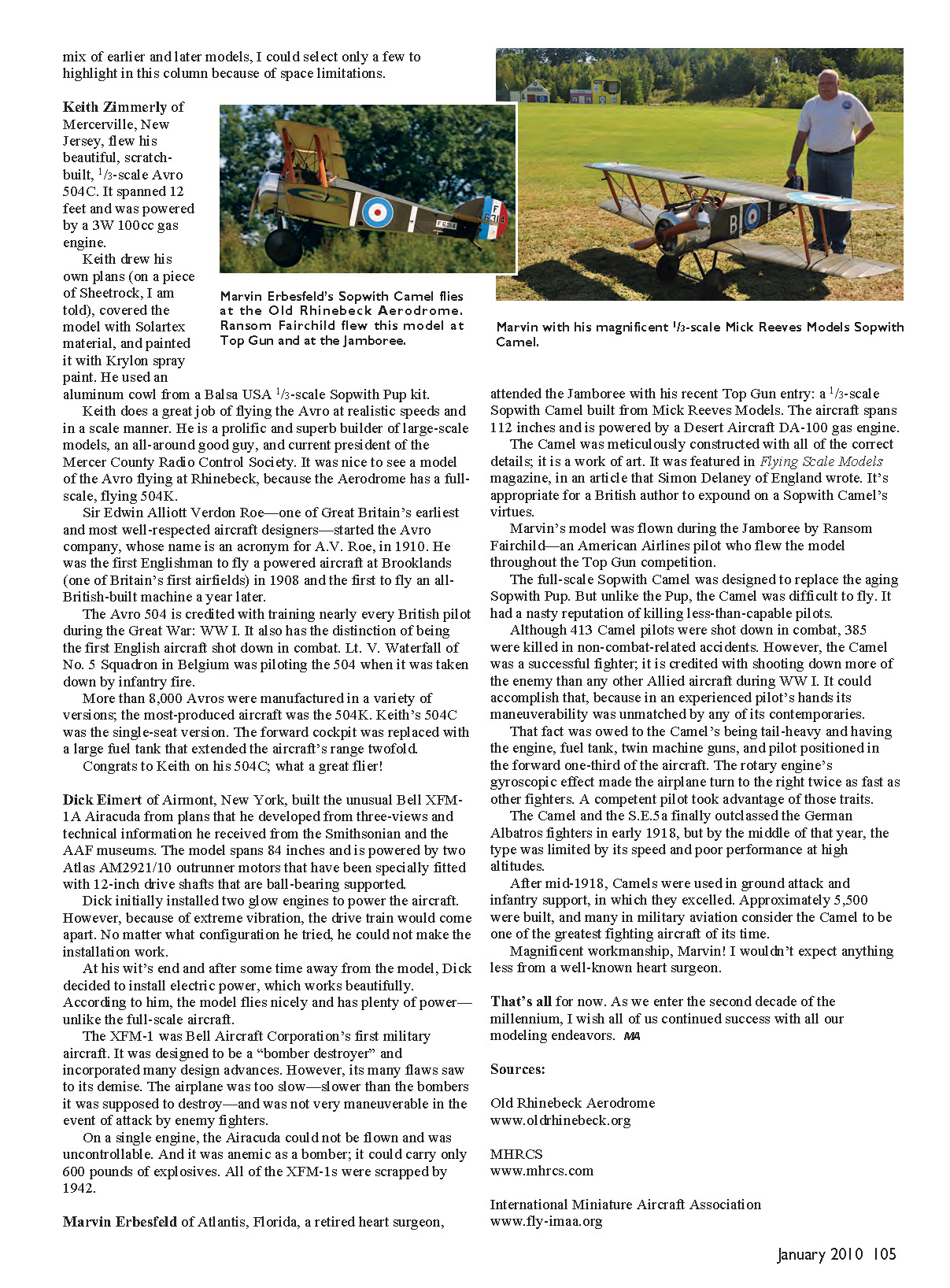
Keith Zimmerly of Mercerville, New Jersey, flew his beautiful, scratch-built, 1/3-scale Avro 504C. It spans 12 feet and is powered by a 3W 100cc gas engine. Keith drew his own plans (on a piece of Sheetrock, I am told), covered the model with Solartex material, and painted it with Krylon spray paint. He used an aluminum cowl from a Balsa USA 1/3-scale Sopwith Pup kit. Keith does a great job of flying the Avro at realistic speeds and in a scale manner. He is a prolific and superb builder of large-scale models, an all-around good guy, and current president of the Mercer County Radio Control Society. It was nice to see a model of the Avro flying at Rhinebeck, because the Aerodrome has a full-scale, flying 504K.
Sir Edwin Alliott Verdon Roe—one of Great Britain's earliest and most well-respected aircraft designers—started the Avro company, whose name is an acronym for A.V. Roe, in 1910. He was the first Englishman to fly a powered aircraft at Brooklands (one of Britain's first airfields) in 1908 and the first to fly an all-British-built machine a year later.
The Avro 504 is credited with training nearly every British pilot during the Great War (WWI). It also has the distinction of being the first English aircraft shot down in combat. Lt. V. Waterfall of No. 5 Squadron in Belgium was piloting the 504 when it was taken down by infantry fire.
More than 8,000 Avros were manufactured in a variety of versions; the most-produced aircraft was the 504K. Keith's 504C was the single-seat version. The forward cockpit was replaced with a large fuel tank that extended the aircraft's range twofold.
Congrats to Keith on his 504C; what a great flier!
Dick Eimert of Airmont, New York, built the unusual Bell XFM-1A Airacuda from plans that he developed from three-views and technical information he received from the Smithsonian and the AAF museums. The model spans 84 inches and is powered by two Atlas AM2921/10 outrunner motors that have been specially fitted with 12-inch drive shafts that are ball-bearing supported.
Dick initially installed two glow engines to power the aircraft. However, because of extreme vibration, the drive train would come apart. No matter what configuration he tried, he could not make the installation work.
At his wit's end and after some time away from the model, Dick decided to install electric power, which works beautifully. According to him, the model flies nicely and has plenty of power—unlike the full-scale aircraft.
The XFM-1 was Bell Aircraft Corporation's first military aircraft. It was designed to be a "bomber destroyer" and incorporated many design advances. However, its many flaws saw it to its demise. The airplane was too slow—slower than the bombers it was supposed to destroy—and was not very maneuverable in the event of an attack by enemy fighters.
On a single engine, the Airacuda could not be flown and was uncontrollable. And it was anemic as a bomber; it could only carry 460 pounds of explosives. All of the XFM-1s were scrapped by 1942.
Marvin Erbesfeld of Atlantis, Florida, a retired heart surgeon, attended the Jamboree with his recent Top Gun entry: a 1/3-scale Sopwith Camel built from Mick Reeves Models. The aircraft spans 112 inches and is powered by a Desert Aircraft DA-100 gas engine.
The Camel was meticulously constructed with all of the correct details; it is a work of art. It was featured in Flying Scale Models magazine, in an article that Simon Delaney of England wrote. It's appropriate for a British author to expound on a Sopwith Camel's virtues.
Marvin's model was flown during the Jamboree by Ransom Fairchild—an American Airlines pilot who flew the model throughout the Top Gun competition.
The full-scale Sopwith Camel was designed to replace the aging Sopwith Pup. But unlike the Pup, the Camel was difficult to fly. It had a nasty reputation for killing less-than-capable pilots.
Although 413 Camel pilots were shot down in combat, 385 were killed in non-combat-related accidents. However, the Camel was a successful fighter; it is credited with shooting down more of the enemy than any other Allied aircraft during WWI. It could accomplish that because, in an experienced pilot's hands, its maneuverability was unmatched by any of its contemporaries.
That fact was owed to the Camel's being tail-heavy and having the engine, fuel tank, twin machine guns, and pilot positioned in the forward one-third of the aircraft. The rotary engine's gyroscopic effect made the airplane turn to the right twice as fast as other fighters. A competent pilot took advantage of those traits.
The Camel and the S.E.5a finally outclassed the German Albatros fighters in early 1918, but by the middle of that year, the type was limited by its speed and poor performance at high altitudes.
After mid-1918, Camels were used in ground attack and infantry support, in which they excelled. Approximately 5,500 were built, and many in military aviation consider the Camel to be one of the greatest fighting aircraft of its time.
Magnificent workmanship, Marvin! I wouldn't expect anything less from a well-known heart surgeon.
That's all for now. As we enter the second decade of the millennium, I wish all of us continued success with all our modeling endeavors.
MA
Sources
- Old Rhinebeck Aerodrome — www.oldrhinebeck.org
- MHRCS — www.mhrcs.com
- International Miniature Aircraft Association — www.fly-imaa.org
Transcribed from original scans by AI. Minor OCR errors may remain.

