
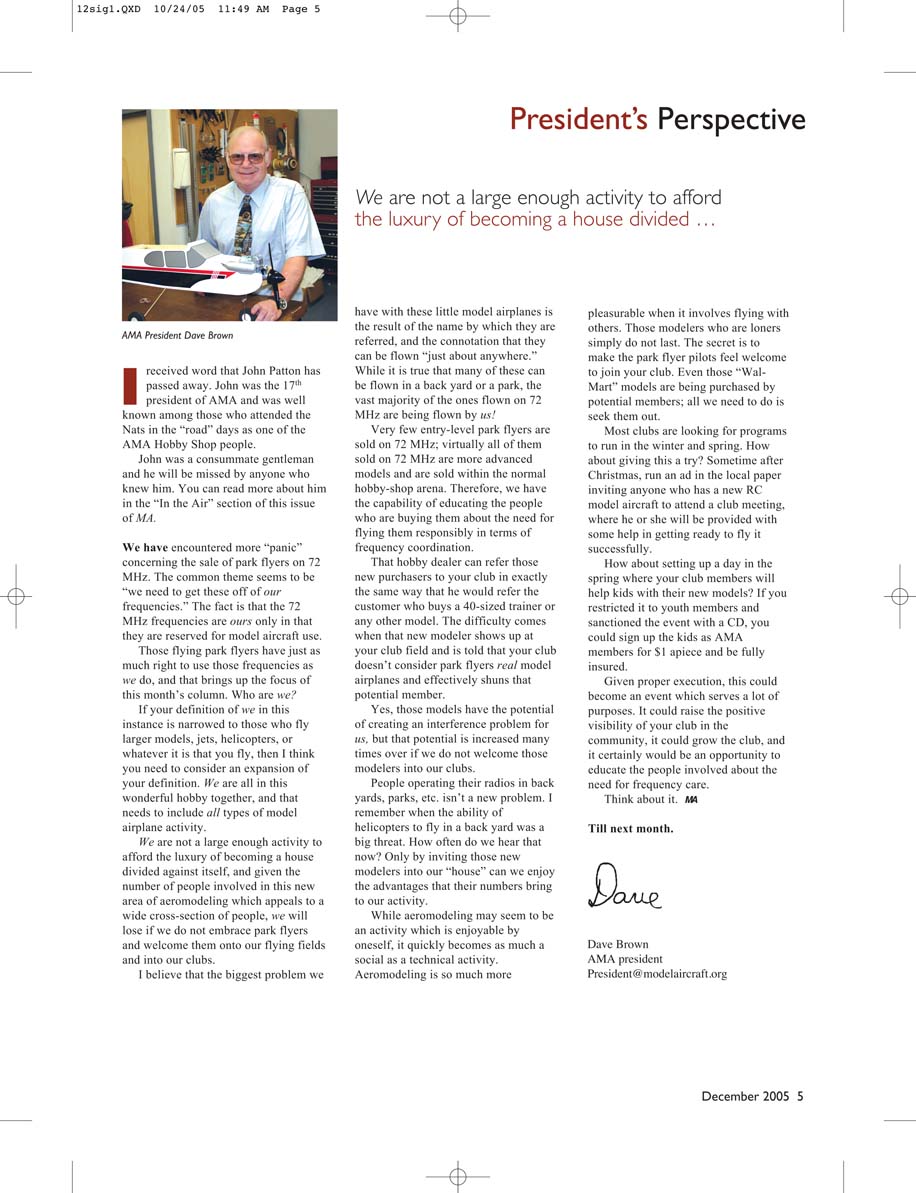
President’s Perspective
We are not a large enough activity to afford the luxury of becoming a house divided ...
I received word that John Patton has passed away. John was the 17th president of AMA and was well known among those who attended the Nats in the "road" days as one of the AMA Hobby Shop people.
John was a consummate gentleman and he will be missed by anyone who knew him. You can read more about him in the "In the Air" section of this issue of MA.
We have encountered more "panic" concerning the sale of park flyers on 72 MHz. The common theme seems to be "we need to get these off our frequencies." The fact is that the 72 MHz frequencies are ours only in that they are reserved for model aircraft use.
Those flying park flyers have just as much right to use those frequencies as we do, and that brings up the focus of this month's column. Who are we?
If your definition of we in this instance is narrowed to those who fly larger models, jets, helicopters, or whatever it is that you fly, then I think you need to consider an expansion of your definition. We are all in this wonderful hobby together, and that needs to include all types of model airplane activity.
We are not a large enough activity to afford the luxury of becoming a house divided against itself, and given the number of people involved in this new area of aeromodeling which appeals to a wide cross-section of people, we will lose if we do not embrace park flyers and welcome them onto our flying fields and into our clubs.
I believe that the biggest problem we have with these little model airplanes is the result of the name by which they are referred, and the connotation that they can be flown "just about anywhere." While it is true that many of these can be flown in a back yard or a park, the vast majority of the ones flown on 72 MHz are being flown by us!
Very few entry-level park flyers are sold on 72 MHz; virtually all of them sold on 72 MHz are more advanced models and are sold within the normal hobby-shop arena. Therefore, we have the capability of educating the people who are buying them about the need for flying them responsibly in terms of frequency coordination.
That hobby dealer can refer those new purchasers to your club in exactly the same way that he would refer the customer who buys a 40-sized trainer or any other model. The difficulty comes when that new modeler shows up at your club field and is told that your club doesn’t consider park flyers real model airplanes and effectively shuns that potential member.
Yes, those models have the potential of creating an interference problem for us, but that potential is increased many times over if we do not welcome those modelers into our clubs.
People operating their radios in back yards, parks, etc. isn’t a new problem. I remember when the ability of helicopters to fly in a back yard was a big threat. How often do we hear that now? Only by inviting those new modelers into our "house" can we enjoy the advantages that their numbers bring to our activity.
While aeromodeling may seem to be an activity which is enjoyable by oneself, it quickly becomes as much a social as a technical activity. Aeromodeling is so much more pleasurable when it involves flying with others. Those modelers who are loners simply do not last. The secret is to make the park flyer pilots feel welcome to join your club. Even those "Wal-Mart" models are being purchased by potential members; all we need to do is seek them out.
Most clubs are looking for programs to run in the winter and spring. How about giving this a try? Sometime after Christmas, run an ad in the local paper inviting anyone who has a new RC model aircraft to attend a club meeting, where he or she will be provided with some help in getting ready to fly it successfully.
How about setting up a day in the spring where your club members will help kids with their new models? If you restricted it to youth members and sanctioned the event with a CD, you could sign up the kids as AMA members for $1 apiece and be fully insured.
Given proper execution, this could become an event which serves a lot of purposes. It could raise the positive visibility of your club in the community, it could grow the club, and it certainly would be an opportunity to educate the people involved about the need for frequency care.
Think about it. MA
Till next month,
Dave
Dave Brown AMA president President@modelaircraft.org
Transcribed from original scans by AI. Minor OCR errors may remain.

