
The Paper Airplane Grows Up
If your last attempt was a schoolboy's paper dart, you've got some catching up to do.
Keith Gebers
THE PAPER airplane has been around as long as aviation, and even preceded flight by man-carrying planes. If surveys were taken they would probably show that there are more paper airplane enthusiasts than any other type of modeler, if you count those paper planes flying around the schoolroom. These enthusiasts are rarely as avid as other model buffs, but year-after-year people, all the way from school kids to business executives, continue building paper airplanes. There is true fascination with this little craft, as evidenced by The Scientific American Great Paper Airplane Contest a decade ago.
That contest, which drew entries from throughout the world (Editor's Note: Our own Bob Meuser took a first), did much to sophisticate the paper airplane. Designs ranging from annular cones to laminated structures resembling supersonic fighter planes were entered. In addition to the original Scientific American contest, colleges throughout the country organized their own paper airplane contests. Many of these colleges still conduct these contests annually and on at least one occasion an entrant has flown over 133 feet.
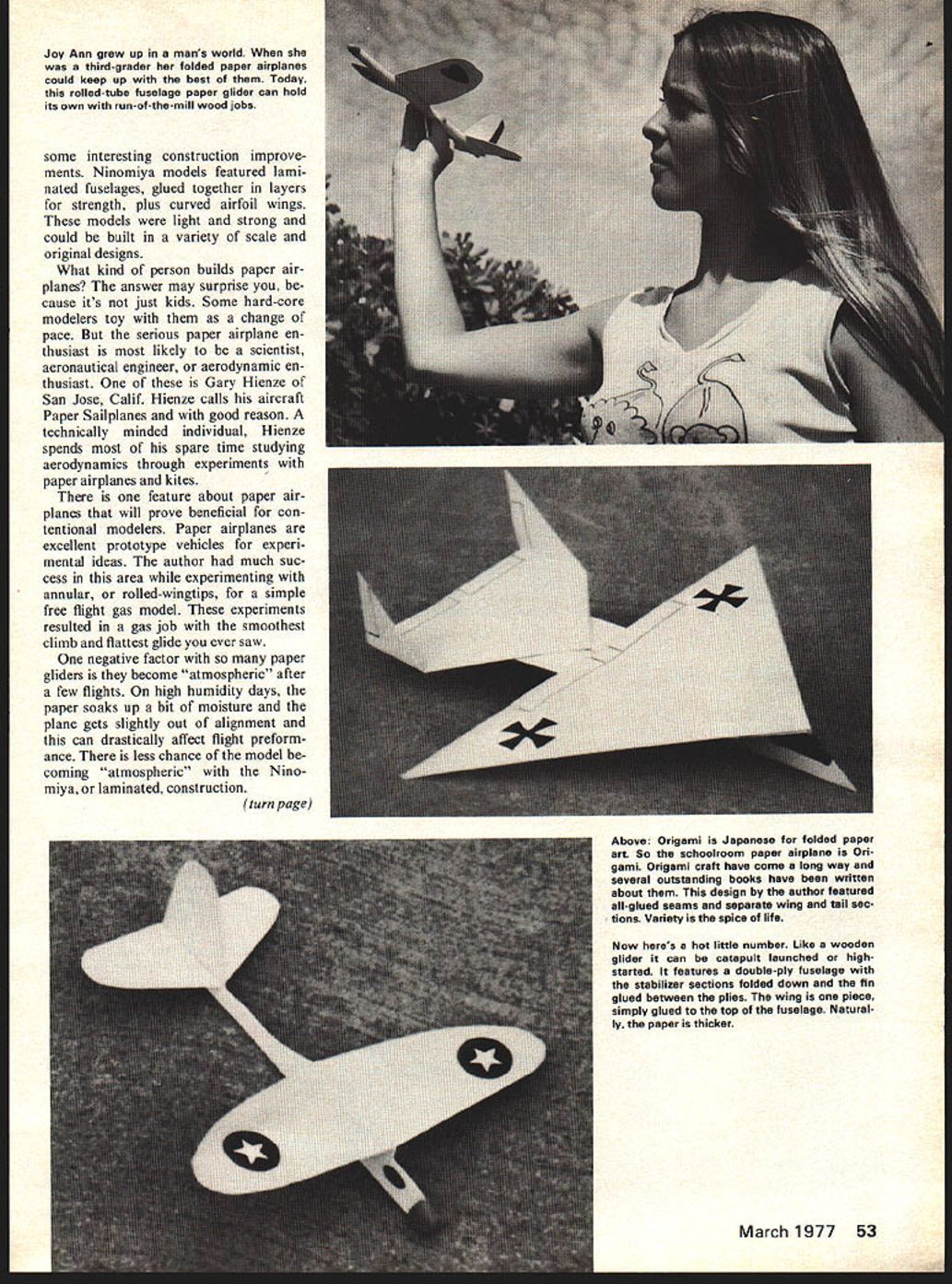
There are several types of paper airplanes. The pioneer origami craft has been flying over the heads of school children for generations. Origami is Japanese for folded paper art, and these little planes can follow several configurations, all good fliers. But sophistication of the paper airplane has now gone far beyond the origami stage.
Wallace Rigby, a colorful Englishman, is generally given credit as the pioneer artist of the built-up paper airplane. Rigby for years built conventional model planes and was an international championship contest modeler. But in the 1930's he wanted a new challenge so turned to paper and scissors. Rigby designed and produced both paper flying and display models. He moved his design studios to the United States for several years and his paper planes (as well as cars, railroad equipment, and military hardware) were produced and sold by the hundreds-of-thousands. Most Rigby designs were three-dimensional models. However, he included some simple single-plane-surface gliders that fly quite well indoors.
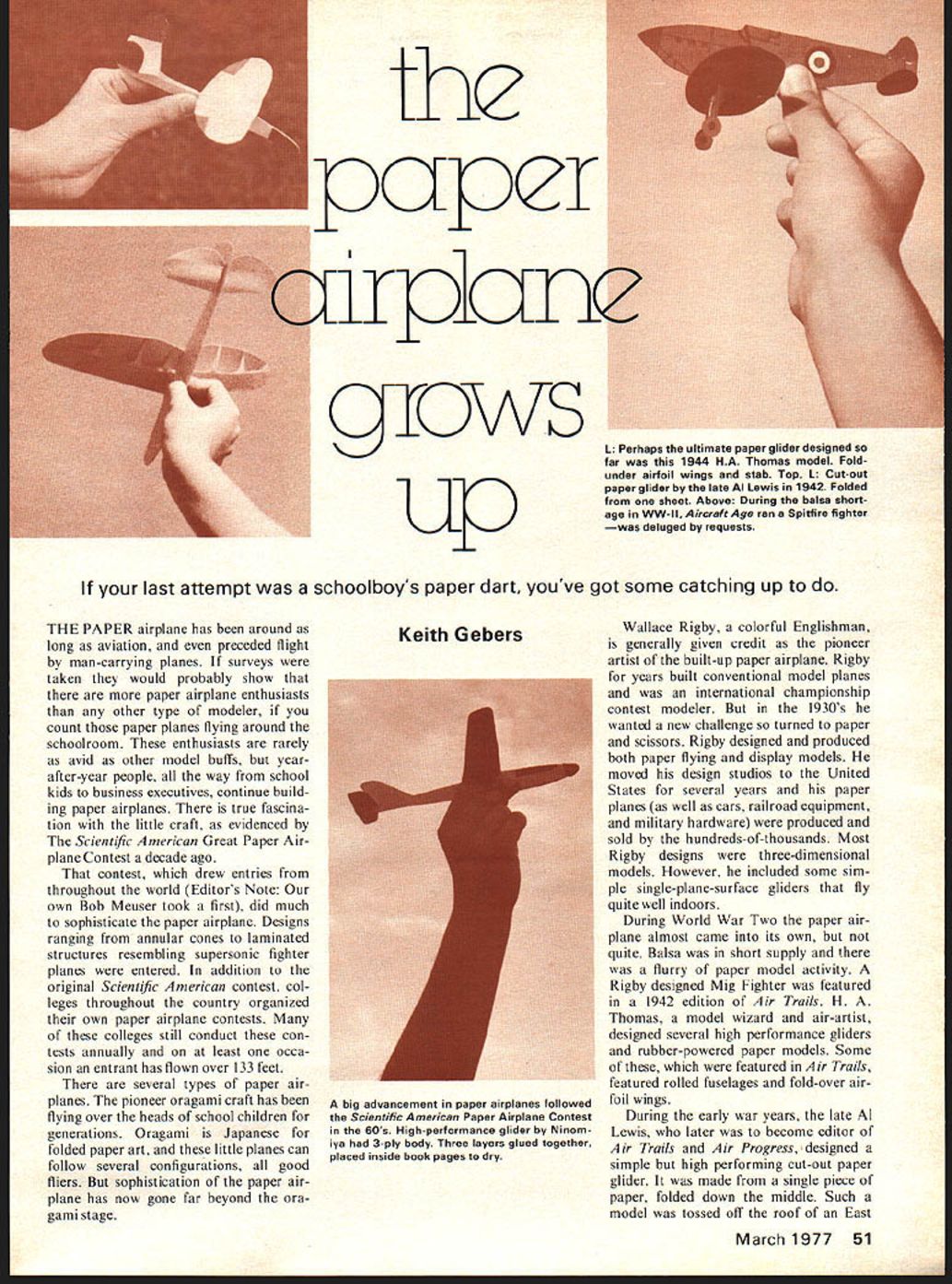
During World War Two the paper airplane almost came into its own, but not quite. Balsa was in short supply and there was a flurry of paper model activity. A Rigby designed Mig Fighter was featured in a 1942 edition of Air Trails. H. A. Thomas, a model wizard and air-artist, designed several high performance gliders and rubber-powered paper models. Some of these, which were featured in Air Trails, featured rolled fuselages and fold-over airfoil wings.
During the early war years, the late Al Lewis, who later was to become editor of Air Trails and Air Progress, designed a simple but high performing cut-out paper glider. It was made from a single piece of paper, folded down the middle. Such a model was tossed off the roof of an East Coast hotel, and flew for over five minutes.
To this day, simple cut-out models hold their own with any other type of paper airplane. They can be designed in many different configurations. They are built by folding stiff paper in-half, drawing your design on one side, and cutting. The wing and tail surfaces are folded down, the rudders are either built by folding the elevator ends upward or inserting a single rudder between the fuselage halves. The wings are usually braced with strips glued to the upper portion.
During the war years, numerous teenagers experimented with their own designs, some very promising. An East Coast modeler created a paper glider constructed entirely from school notebook paper. This small advanced model even had a pylon-mounted airfoil wing. In Winter, 1944, Aircraft Age magazine presented a novel paper glider of the British Spitfire. It was a simple cutout model constructed from a folded sheet of Kent Paper, but when finished it was an appealing model and capable of outstanding flights, especially when tossed outside of tall buildings, like schools of the time. The magazine was deluged with requests for additional designs, but only one was ever offered. Before war's end balsa again became available, along with new engines, and the paper airplane was again relegated to its lowly place in the classroom—until the Scientific American contest.
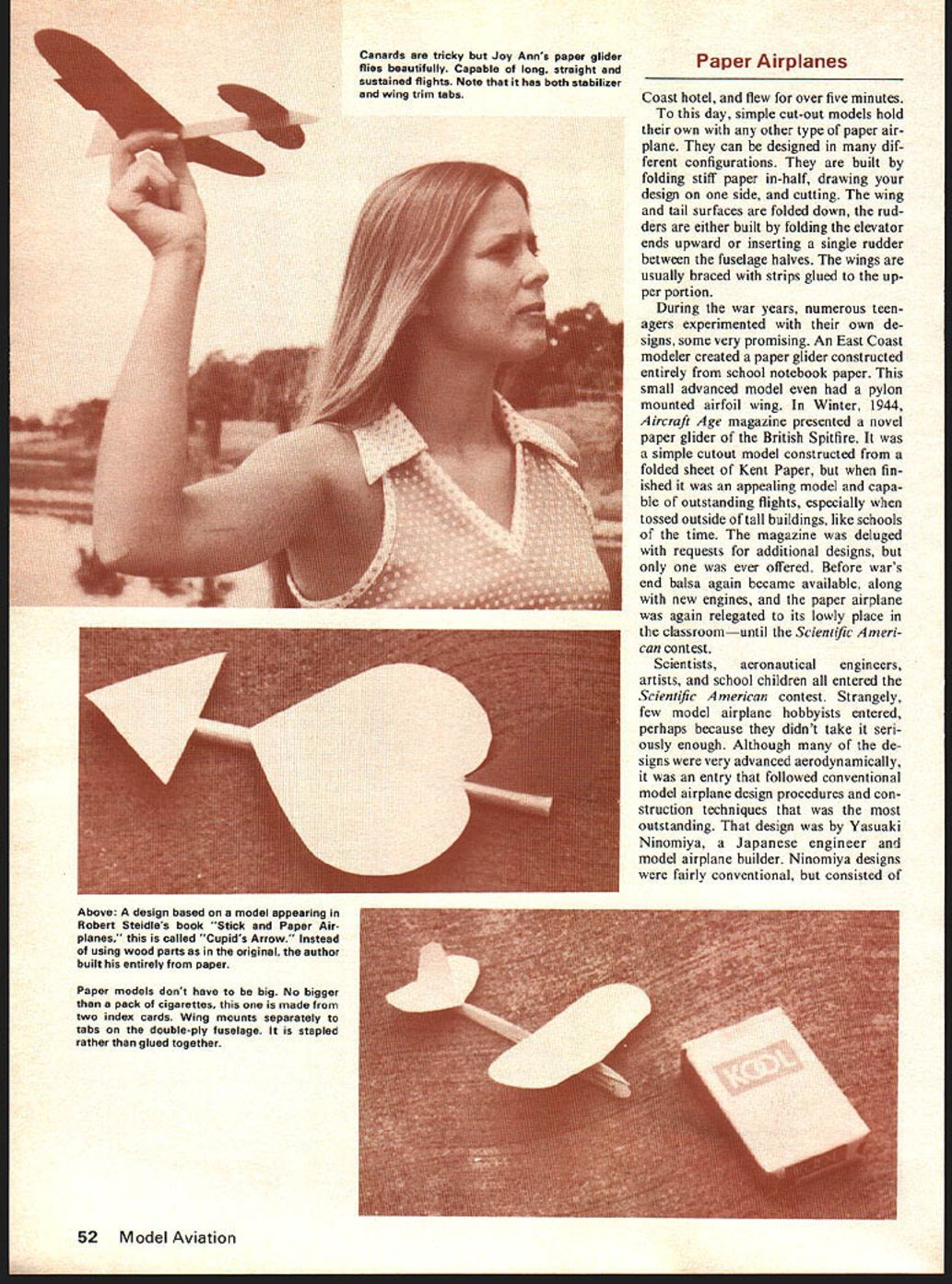
Scientists, aeronautical engineers, artists, and school children all entered the Scientific American contest. Strangely, few model airplane hobbyists entered, perhaps because they didn't take it seriously enough. Although many of the designs were very advanced aerodynamically, it was an entry that followed conventional model airplane design procedures and construction techniques that was the most outstanding. That design was by Yasuaki Ninomiya, a Japanese engineer and model airplane builder. Ninomiya's designs were fairly conventional, but consisted of a 3-ply body made from three layers glued together and placed inside book pages to dry.
Simple cut-out models continue to hold their own against other types of paper airplanes. They can be designed in different configurations, built by folding stiff paper in half, drawing a design on one side, and cutting wing and tail surfaces that are folded down as rudders, either built by folding elevator ends upward or inserting a single rudder between fuselage halves. some interesting construction improvements. Ninomiya models featured laminated fuselages, glued together in layers for strength, plus curved airfoil wings. These models were light and strong and could be built in a variety of scale and original designs.
What kind of person builds paper airplanes? The answer may surprise you, because it's not just kids. Some hard-core modelers toy with them as a change of pace. But the serious paper airplane enthusiast is most likely to be a scientist, aeronautical engineer, or aerodynamic enthusiast. One of these is Gary Hienze of San Jose, Calif. Hienze calls his aircraft Paper Sailplanes and with good reason. A technically minded individual, Hienze spends most of his spare time studying aerodynamics through experiments with paper airplanes and kites.
There is one feature about paper airplanes that will prove beneficial for conventional modelers. Paper airplanes are excellent prototype vehicles for experimental ideas. The author had much success in this area while experimenting with annular, or rolled-wingtips, for a simple free flight gas model. These experiments resulted in a gas job with the smoothest climb and flattest glide you ever saw.
One negative factor with so many paper gliders is they become "atmospheric" after a few flights. On high humidity days, the paper soaks up a bit of moisture and the plane gets slightly out of alignment and this can drastically affect flight performance. There is less chance of the model becoming "atmospheric" with the Ninomiya, or laminated, construction. Another factor to look for is careful rudder and stabilizer alignment. A beautiful flight can be ruined if rudders get slightly twisted. On the plus side, paper airplanes are easy to trim, and flight patterns can be easily adjusted by a twist of the rudder to the right or left.
Building paper airplanes is a wonderful change of pace. The work is very pleasant and with a piece of stiff paper and a pair of scissors your imagination can soar to new heights. Sure paper airplanes are considered old-hat. Some builders even scoff at them. But go ahead, give them a try. You might even find them addictive.
Books on Paper Airplanes:
- Jerry Mander, George Dippel and Howard Gossage, The Great International Paper Airplane Book, 1967, Simon and Schuster, N.Y. $2.95.
- Yasuaki Ninomiya, Jet Age Jamboree, Complete Collection of Paper Airplanes, 1968, Japan Publications, San Francisco, CA. $3.25.
- Yasuaki Ninomiya, Airborne All Stars, Paper Flying Models of Famous Aircraft, 1969, Japan Publications, San Francisco, CA. $3.25.
- Ralph Barnaby, How to Make and Fly Paper Airplanes, 1968–1969, Four Winds Press, N.Y. $3.50.
- Robert Sterle, Stick and Paper Airplanes, 1971, Abelard-Schuman, N.Y. $4.95.
- Eiji Nakamura, Flying Origami, Origami from Pure Fun to True Science, 1972, Japan Publications, San Francisco, CA. $4.95.
- Marc Arceneaux, Paper Airplanes, 1974, Troubador Press, San Francisco, CA. $1.68.
Transcribed from original scans by AI. Minor OCR errors may remain.

