
Model Aviation Hall of Fame
Class of 2009
Established in 1969, the Model Aviation Hall of Fame honors those men and women who have made significant contributions to the sport of aeromodeling.
The list of members is long and distinguished. These people have made contributions to model aviation through volunteer or administrative activities, product development, competition performance, or a variety or combination of activities.
The Hall of Fame Selection Committee is composed of past AMA presidents and one Hall of Fame member selected from each of the 11 districts by the respective vice presidents.
Each year a new class is inducted into the Model Aviation Hall of Fame and the winners are announced in MA. Anyone may submit a Hall of Fame nomination form.
For a nomination form or further information, contact Erin Dobbs at (765) 287-1256, ext. 272, or find the current form online at www.modelaircraft.org, document 152.
The committee has selected the following people for the 2009 Model Aviation Hall of Fame.
Don Anderson
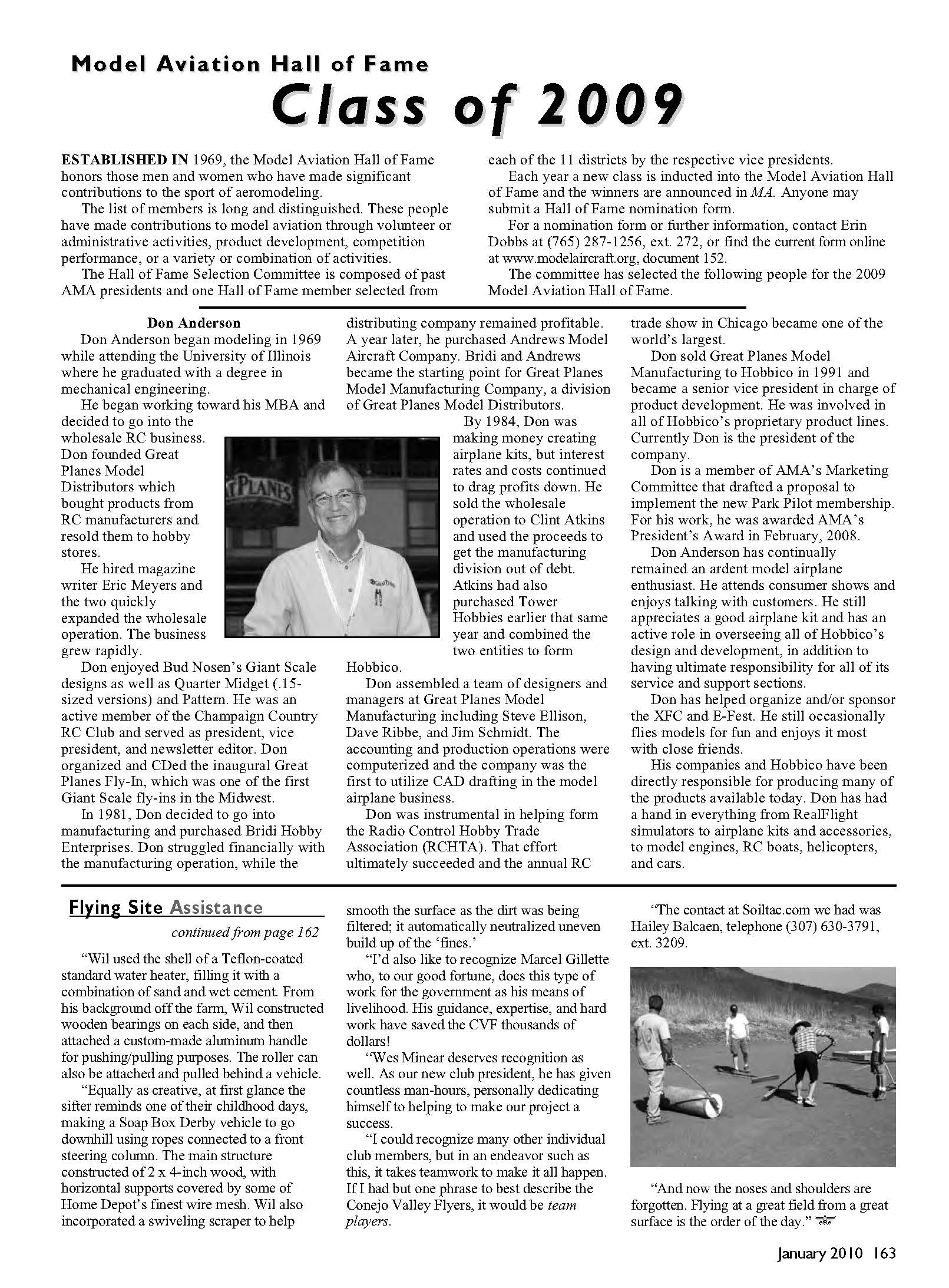
Don Anderson began modeling in 1969 while attending the University of Illinois where he graduated with a degree in mechanical engineering. He began working toward his MBA and decided to go into the wholesale RC business.
Don founded Great Planes Model Distributors, which bought products from RC manufacturers and resold them to hobby stores. He hired magazine writer Eric Meyers and the two quickly expanded the wholesale operation. The business grew rapidly.
Don enjoyed Bud Nosen’s Giant Scale designs as well as Quarter Midget (.15-sized versions) and Pattern. He was an active member of the Champaign County RC Club and served as president, vice president, and newsletter editor. Don organized and CDed the inaugural Great Planes Fly-In, which was one of the first giant-scale fly‑ins in the Midwest.
In 1981, Don decided to go into manufacturing and purchased Bridi Hobby Enterprises. Don struggled financially with the manufacturing operation, while the distributing company remained profitable. A year later, he purchased Andrews Model Aircraft Company. Bridi and Andrews became the starting point for Great Planes Model Manufacturing Company, a division of Great Planes Model Distributors.
By 1984, Don was making money creating airplane kits, but interest rates and costs continued to drag profits down. He sold the wholesale operation to Clint Atkins and used the proceeds to get the manufacturing division out of debt. Atkins had also purchased Tower Hobbies earlier that same year and combined the two entities to form Hobbico.
Don assembled a team of designers and managers at Great Planes Model Manufacturing including Steve Ellison, Dave Ribbe, and Jim Schmidt. The accounting and production operations were computerized and the company was the first to utilize CAD drafting in the model airplane business.
Don was instrumental in helping form the Radio Control Hobby Trade Association (RCHTA). That effort ultimately succeeded and the annual RC trade show in Chicago became one of the world’s largest.
Don sold Great Planes Model Manufacturing to Hobbico in 1991 and became a senior vice president in charge of product development. He was involved in all of Hobbico’s proprietary product lines. Currently Don is the president of the company.
Don is a member of AMA’s Marketing Committee that drafted a proposal to implement the new Park Pilot membership. For his work, he was awarded AMA’s President’s Award in February 2008.
Don Anderson has continually remained an ardent model airplane enthusiast. He attends consumer shows and enjoys talking with customers. He still appreciates a good airplane kit and has an active role in overseeing all of Hobbico’s design and development, in addition to having ultimate responsibility for all of its service and support sections.
Don has helped organize and/or sponsor the XFC and E-Fest. He still occasionally flies models for fun and enjoys it most with close friends.
His companies and Hobbico have been directly responsible for producing many of the products available today. Don has had a hand in everything from RealFlight simulators to airplane kits and accessories, to model engines, RC boats, helicopters, and cars.
Don has been married to his wife, Paula, for 38 years. His family includes their three daughters, two sons-in-law, and two grandchildren.
Don’s support of and involvement in model aviation, the hobby industry, and AMA continues to be a constant in his life.
Charles Brebeck
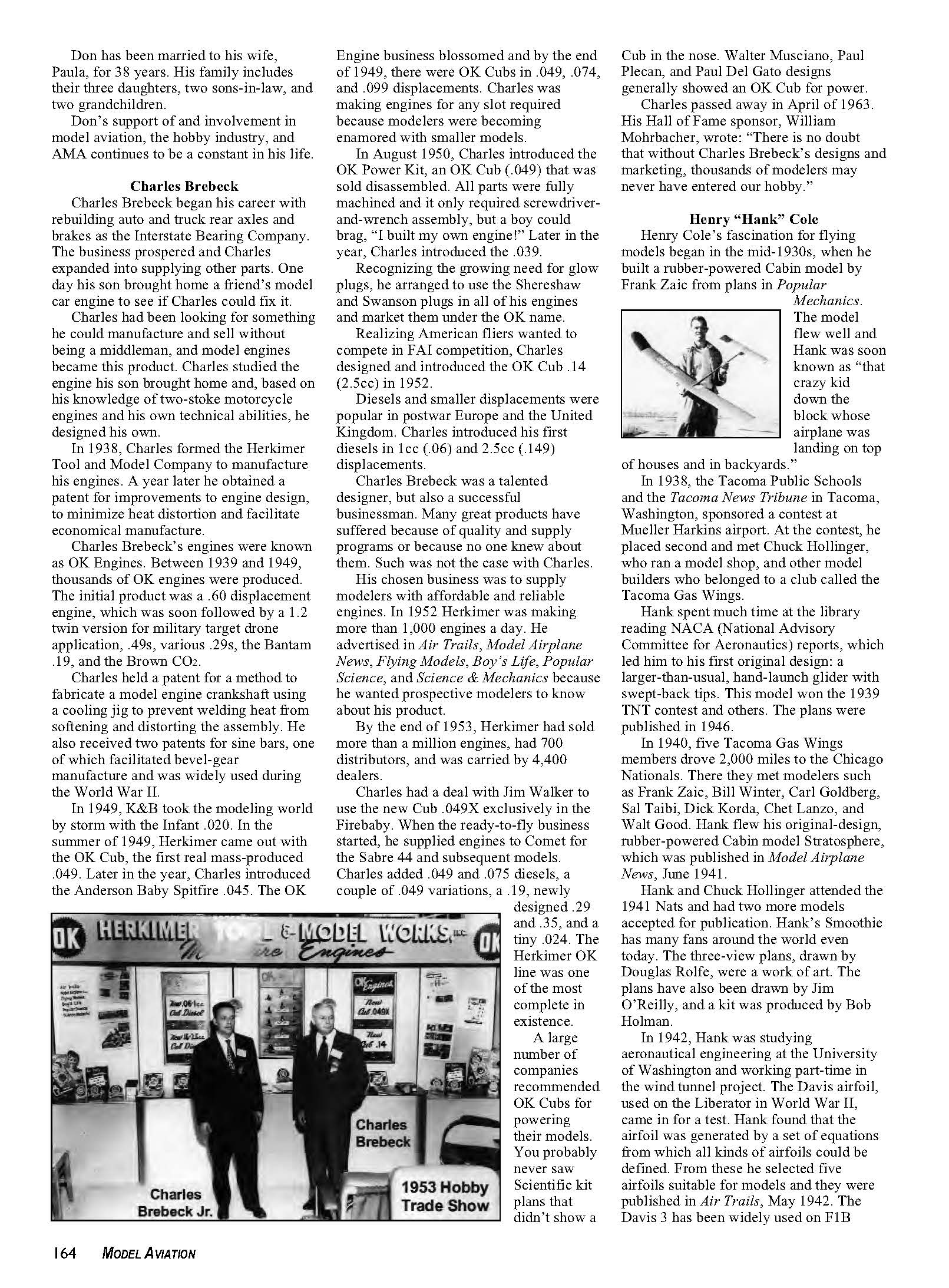
Charles Brebeck began his career rebuilding auto and truck rear axles and brakes as the Interstate Bearing Company. The business prospered and Charles expanded into supplying other parts. One day his son brought home a friend’s model car engine to see if Charles could fix it.
Charles had been looking for something he could manufacture and sell without being a middleman, and model engines became this product. Charles studied the engine his son brought home and, based on his knowledge of two-stroke motorcycle engines and his own technical abilities, he designed his own.
In 1938, Charles formed the Herkimer Tool and Model Company to manufacture his engines. A year later he obtained a patent for improvements to engine design, to minimize heat distortion and facilitate economical manufacture.
Charles Brebeck’s engines were known as OK Engines. Between 1939 and 1949, thousands of OK engines were produced. The initial product was a .60 displacement engine, which was soon followed by a 1.2 twin version for military target drone application, .49s, various .29s, the Bantam .19, and the Brown CO2.
Charles held a patent for a method to fabricate a model engine crankshaft using a cooling jig to prevent welding heat from softening and distorting the assembly. He also received two patents for sine bars, one of which facilitated bevel-gear manufacture and was widely used during World War II.
In 1949, K&B took the modeling world by storm with the Infant .020. In the summer of 1949, Herkimer came out with the OK Cub, the first real mass-produced .049. Later in the year, Charles introduced the Anderson Baby Spitfire .045. The OK Engine business blossomed and by the end of 1949, there were OK Cubs in .049, .074, and .099 displacements. Charles was making engines for any slot required because modelers were becoming enamored with smaller models.
In August 1950, Charles introduced the OK Power Kit, an OK Cub (.049) that was sold disassembled. All parts were fully machined and it only required screwdriver-and-wrench assembly, but a boy could brag, "I built my own engine!" Later in the year, Charles introduced the .039.
Recognizing the growing need for glow plugs, he arranged to use the Shereshaw and Swanson plugs in all of his engines and market them under the OK name.
Realizing American fliers wanted to compete in FAI competition, Charles designed and introduced the OK Cub .14 (2.5cc) in 1952.
Diesels and smaller displacements were popular in postwar Europe and the United Kingdom. Charles introduced his first diesels in 1cc (.06) and 2.5cc (.149) displacements.
Charles Brebeck was a talented designer, but also a successful businessman. Many great products have suffered because of quality and supply programs or because no one knew about them. Such was not the case with Charles.
His chosen business was to supply modelers with affordable and reliable engines. In 1952 Herkimer was making more than 1,000 engines a day. He advertised in Air Trails, Model Airplane News, Flying Models, Boys' Life, Popular Science, and Science & Mechanics because he wanted prospective modelers to know about his product.
By the end of 1953, Herkimer had sold more than a million engines, had 700 distributors, and was carried by 4,400 dealers.
Charles had a deal with Jim Walker to use the new Cub .049X exclusively in the Firebaby. When the ready-to-fly business started, he supplied engines to Comet for the Sabre 44 and subsequent models. Charles added .049 and .075 diesels, a couple of .049 variations, a .19, newly designed .29 and .35, and a tiny .024. The Herkimer OK line was one of the most complete in existence.
A large number of companies recommended OK Cubs for powering their models. You probably never saw Scientific kit plans that didn’t show a Cub in the nose. Walter Musciano, Paul Plecan, and Paul Del Gato designs generally showed an OK Cub for power.
Charles passed away in April 1963. His Hall of Fame sponsor, William Mohrbacher, wrote: "There is no doubt that without Charles Brebeck’s designs and marketing, thousands of modelers may never have entered our hobby."
Henry "Hank" Cole
Henry Cole’s fascination for flying models began in the mid-1930s, when he built a rubber-powered Cabin model by Frank Zaic from plans in Popular Mechanics. The model flew well and Hank was soon known as "that crazy kid down the block whose airplane was landing on top of houses and in backyards."
In 1938, the Tacoma Public Schools and the Tacoma News Tribune in Tacoma, Washington, sponsored a contest at Mueller Harkins airport. At the contest, he placed second and met Chuck Hollinger, who ran a model shop, and other model builders who belonged to a club called the Tacoma Gas Wings.
Hank spent much time at the library reading NACA (National Advisory Committee for Aeronautics) reports, which led him to his first original design: a larger-than-usual, hand-launch glider with swept-back tips. This model won the 1939 TNT contest and others. The plans were published in 1946.
In 1940, five Tacoma Gas Wings members drove 2,000 miles to the Chicago Nationals. There they met modelers such as Frank Zaic, Bill Winter, Carl Goldberg, Sal Taibi, Dick Korda, Chet Lanza, and Walt Good. Hank flew his original-design, rubber-powered Cabin model Stratosphere, which was published in Model Airplane News, June 1941.
Hank and Chuck Hollinger attended the 1941 Nats and had two more models accepted for publication. Hank’s Smoothie has many fans around the world even today. The three-view plans, drawn by Douglas Rolfe, were a work of art. The plans have also been drawn by Jim O’Reilly, and a kit was produced by Bob Holman.
In 1942, Hank was studying aeronautical engineering at the University of Washington and working part-time in the wind tunnel project. The Davis airfoil, used on the Liberator in World War II, came in for a test. Hank found that the airfoil was generated by a set of equations from which all kinds of airfoils could be defined. From these he selected five airfoils suitable for models and they were published in Air Trails, May 1942. The Davis 3 has been widely used on F1B aircraft and the Davis 5 on gas models.
Hank started experimenting with flying wings and used equations to generate a stable airfoil that worked well on a hi-start model. He designed and flew an Ohlsson .23-powered pusher gas model called the Dry Duck. The engine could not be dunked even when it flipped upside down.
World War II suspended Hank's free flight activities, but the Navy allowed him to complete his degree before sending him to the South Pacific on an aircraft carrier. The work Henry did in 1942 was published in Air Trails and Air Trails Model Annual in 1944.
While Hank was on the aircraft carrier, he built an Elf-powered flying wing control-line model. As construction progressed, the pilots on the ship were divided about whether or not it would fly. When it was finished Hank and some of the pilots took it out on one of the islands and cranked it up. It took about a half circle to get off, but it did fly. When he landed it, Hank noticed that money was changing hands among the pilots.
After the war Hank was assigned to Alameda Naval Air Station. He joined the East Bay Aeroneers and became friends with Don Foote and Bud Romak. Hank built a gas model, the Asymmetrical Pusher, which he flew in a contest and came in second to Don's Westerner. Meanwhile, Chuck Hollinger was getting a model shop going in Seattle, which he and Henry planned to run upon Hank's release from the Navy.
While still in the Bay Area, Hank bought kits from distributors in San Francisco for the shop. On May 1, 1946, he headed to Seattle but stayed in contact with Don Foote for many years.
Hank and Chuck opened Aero-Craft Model Shop in Seattle. The pair custom-cut balsa and helped customers start engines and fly their airplanes. As the aircraft industry started to recover following the war, they closed the shop and moved on to better opportunities. Hank returned to college to obtain a master's degree in aeronautical engineering.
Hank reported many memorable moments during his model aviation career including his first Nationals win in Dallas where Arthur Godfrey presented him with the Mulvihill trophy. Another unforgettable experience was in 1955 when he made the U.S. Nordic Team and traveled to Germany.
Hank held records in A Speed, Nordic, and Wakefield. He was elevated to AMA Fellow in 1959 and inducted into the National Free Flight Society and Society of Antique Modelers halls of fame.
Joseph H. Ehrhardt
"Joseph Henry Ehrhardt is an enigma to model aviation historians. Twice National Champion, and twice Wakefield Champion, 'Joe who?'" wrote Charles Rushing, Hall of Fame sponsor.
Joe, from St. Louis, Missouri, won the AMLA-NAA (Airplane Model League of America–National Aeronautic Association) National Outdoor Championships in 1930 and 1931, including the grand prize: a one-month trip to Europe given by the American Boy magazine to all winners of Scale, Indoor, and Outdoor national championships. While in England, Joe, Bill Chaffee, and Ray Thompson entered and flew in the Society of Model Aeronautical Engineers Wakefield International Trophy model airplane meet. The Americans flew all-balsa airplanes — a type unheard of in England.
Their 4-ounce aircraft competed against the British Wakefield team's models built from hardwood, wire, and silk, and weighing as much as 12 ounces.
The contest was held at Halton Airdrome on July 19, 1930, during a storm with wind gusts up to 30 miles per hour. Alex Imrie and Denis Fairlie, English historians for Aeromodeller, recalled in a letter dated February 23, 1997:
"Furthermore, according to eyewitness B.K. Johnson, this Ehrhardt model didn't really fly 'properly,' it blew along tumbling in the stiff wind." Yet Joe's Wakefield had the highest time of the day at Halton — 259 seconds to win the Wakefield Trophy for the USA.
The following year, the Wakefield International Trophy contest was held on June 30, 1931, at the US Army Air Corps' Wright-Patterson Field, near Dayton, Ohio, following the National Model Airplane meet sponsored by the NAA and AMLA. This was the first time that the Wakefield contest was held outside of England. Joe qualified for the first US Wakefield Team Trials. With a flight of 264.8 seconds, he won the Wakefield Trophy to become the first two-time winner and the first American to win the Wakefield International Trophy.
Today as we look at Joe Ehrhardt's record of modeling achievements, it is hard to imagine that his memory has been swept into the dustbin of time. He was inducted into the National Free Flight Society's (NFFS) Hall of Fame through the efforts of Jim Bennett in 1991, but all traces of him seem to vanish after he competed in the 1932 Wakefield contest.
Before writing this biography, Charles Rushing called the NFFS, the Society of Antique Modelers (SAM), and the AMA libraries in search of background information about Joe, but it was to no avail.
Jim Bennett, who nominated Joe for the NFFS Hall of Fame in 1991, and Ernst Johnson, who gave Charles the astonishing photograph of Joe at Halton in 1930, have helped to clear up part of this mystery. Charles' only other resource was the 1982 Frank Zaic copy of the publication Model Airplane and the American Boy 1927–1934. From here the trail of history concerning Joseph Henry Ehrhardt seems to vanish.
"As caretakers of aeromodelling history in the United States, we have this opportunity to keep Joseph Henry Ehrhardt's memory alive, by bestowing our medal of honor upon him and inducting him into the Model Aviation Hall of Fame," Charles wrote.
"Joe Ehrhardt was as much a leading pioneer of model aviation as were Gordon Light, James Cahill, Dick Korda, George Reich, and Bob White. I know that each of these past great American Wakefield Champions would have wondered why Joseph Henry Ehrhardt wasn't standing ahead of them! Please give this forgotten American Wakefield International Trophy and National Champion 'All American Boy' his just honor."
William O. Hershberger
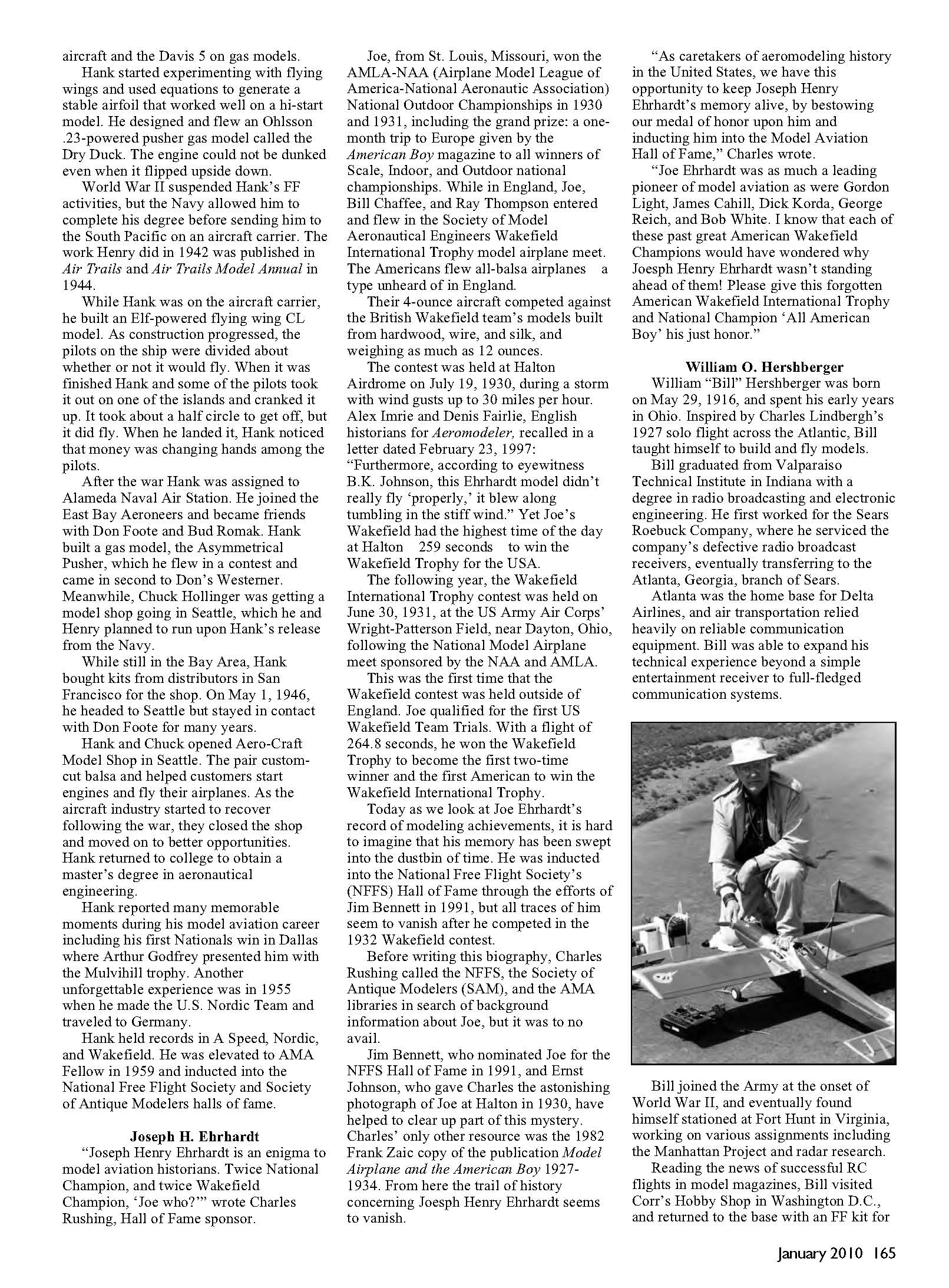
William "Bill" Hershberger was born on May 29, 1916, and spent his early years in Ohio. Inspired by Charles Lindbergh's 1927 solo flight across the Atlantic, Bill taught himself to build and fly models.
Bill graduated from Valparaiso Technical Institute in Indiana with a degree in radio broadcasting and electronic engineering. He first worked for the Sears Roebuck Company, where he serviced the company's defective radio broadcast receivers, eventually transferring to the Atlanta, Georgia, branch of Sears.
Atlanta was the home base for Delta Airlines, and air transportation relied heavily on reliable communication equipment. Bill was able to expand his technical experience beyond a simple entertainment receiver to full-fledged communication systems.
Bill joined the Army at the onset of World War II, and eventually found himself stationed at Fort Hunt in Virginia, working on various assignments including the Manhattan Project and radar research.
Reading the news of successful RC flights in model magazines, Bill visited Corr's Hobby Shop in Washington D.C., and returned to the base with an FF kit for a five-foot-span Standard Buccaneer, and determined that the aircraft would no longer be flying free. He designed and constructed a lightweight, single-tube receiver and a transmitter that successfully controlled the Buccaneer. The year was 1944 and the Buccaneer is still in his stable of models and has served as a test bed for many of Bill's original RC systems.
After the war, he became a technical officer with the Voice of America (VOA) in its high-powered broadcast stations in Africa, the Middle East, and Europe.
Upon returning from Europe in 1955, he was stationed near Washington D.C. where he joined the newly formed District of Columbia Radio Control Club (DCRC). Other members included RC innovators Walt Good and Maynard Hill. Bill was welcomed as a contributor to the relatively new RC hobby.
In 1984, at the request of AMA Frequency Committee Chairman Fred Marks, Bill joined the committee. The committee's main focus at that time was the transition of the old wideband RC frequencies to the 80 newly acquired narrowband frequencies.
Bill spent many hours defining a relatively easy procedure to evaluate the performance of RC transmitters according to AMA guidelines. Independent conversion verification became necessary when the FCC agreed to permit conversion of old transmitters to the new frequencies.
Bill's work was the foundation of AMA's Gold Sticker Program that was implemented nationwide. Bill and other Frequency Committee members evaluated transmitters and isolated unacceptable ones from those that met the guidelines.
The FCC staff was acquainted with Bill from when he represented the VOA. A visit with old friends alerted Bill to FCC Notice of Proposed Rule Making (NRPM) 92-235. The FCC proposed to split the 72-76 channels to establish 200 new 72-76 MHz channels for low-power mobile use in the general category pool. Many of these new land mobile frequencies would be only 2.5 kHz removed from the RC frequencies. Bill's analysis of the potential interference to RC made it clear that the AMA needed to take immediate action to oppose this NRPM.
The committee initiated a multipronged effort to address this potential threat to RC flying safety. The FCC invited the AMA to conduct testing to provide empirical data on the impact of the proposed land-mobile operation on RC. The committee asked Bill, George Steiner, and Warren Plohr to conduct flight tests at the AMA's International Aeromodeling Center in Muncie, Indiana.
A report of the flight tests, "Experimental Evaluation of 72 MHz Land Mobile Operation on Radio Control Model Aircraft," by William O. Hershberger, George Steiner, and Warren Plohr, was released as an AMA technical report in May 1993. The reported flight-test data confirmed earlier analyses that a 10 kHz separation between land-mobile and RC frequencies was necessary to avoid harm to the RC hobby and public safety. The FCC retained the 10 kHz separation as requested by the AMA.
Bill is still actively pursuing the model aviation hobby. His curiosity has led him to flight-test the limitations of 2.4 GHz equipment. His latest interest is in the technology of small unmanned aircraft systems.
David Johnson
David Johnson began modeling in the 1930s, building solid models, then stick-and-paper flying scale models, followed by rubber-powered and gas-powered free flight models, leading to RC in the 1960s.
He did not record his competition activities in the early days, but remembers his first trophy, for building the Megow Gulf Hawk, complete with detailed engine, and the controls working from the cockpit. He puts more emphasis on meeting fellow modelers and making new friends.
In 1972, with three years of experience in RC piloting, Dave began instructing beginner pilots in California. To date, he estimates that he successfully soloed more than 100 students, who have continued to participate.
David is particularly proud to have developed a method to instruct hearing-impaired pilots. Using an assistant on the buddy box, Dave stands behind the student and lightly presses on his or her shoulders to indicate the direction and amount of control needed. The method is highly successful.
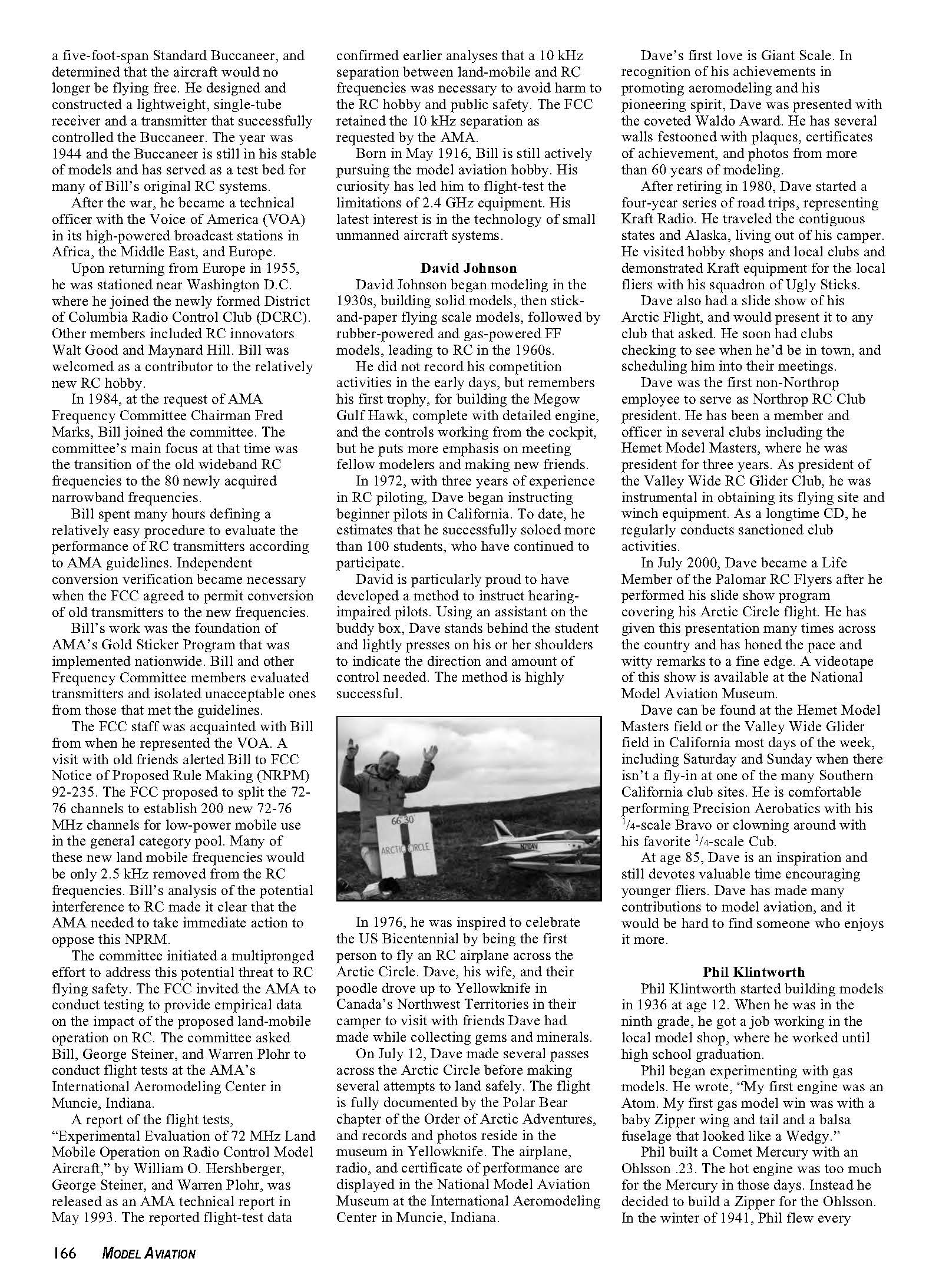
In 1976, he was inspired to celebrate the US Bicentennial by being the first person to fly an RC airplane across the Arctic Circle. Dave, his wife, and their poodle drove up to Yellowknife in Canada's Northwest Territories in their camper to visit with friends Dave had made while collecting gems and minerals.
On July 12, Dave made several passes across the Arctic Circle before making several attempts to land safely. The flight is fully documented by the Polar Bear chapter of the Order of Arctic Adventures, and records and photos reside in the museum in Yellowknife. The airplane, radio, and certificate of performance are displayed in the National Model Aviation Museum at the International Aeromodeling Center in Muncie, Indiana.
Dave's first love is Giant Scale. In recognition of his achievements in promoting aeromodeling and his pioneering spirit, Dave was presented with the coveted Waldo Award. He has several walls festooned with plaques, certificates of achievement, and photos from more than 60 years of modeling.
After retiring in 1980, Dave started a four-year series of road trips, representing Kraft Radio. He traveled the contiguous states and Alaska, living out of his camper. He visited hobby shops and local clubs and demonstrated Kraft equipment for the local fliers with his squadron of Ugly Sticks.
Dave also had a slide show of his Arctic Flight, and would present it to any club that asked. He soon had clubs checking to see when he'd be in town, and scheduling him into their meetings.
Dave was the first non-Northrop employee to serve as Northrop RC Club president. He has been a member and officer in several clubs including the Hemet Model Masters, where he was president for three years. As president of the Valley Wide RC Glider Club, he was instrumental in obtaining its flying site and winch equipment. As a longtime CD, he regularly conducts sanctioned club activities.
In July 2000, Dave became a Life Member of the Palomar RC Flyers after he performed his slide show program covering his Arctic Circle flight. He has given this presentation many times across the country and has honed the pace and witty remarks to a fine edge. A videotape of this show is available at the National Model Aviation Museum.
Dave can be found at the Hemet Model Masters field or the Valley Wide Glider field in California most days of the week, including weekends when there isn't a fly-in at one of the many Southern California club sites. He is comfortable performing precision aerobatics with his 3/4-scale Bravo or clowning around with his favorite 1/4-scale Cub.
At age 85, Dave is an inspiration and still devotes valuable time encouraging younger fliers. Dave has made many contributions to model aviation, and it would be hard to find someone who enjoys it more.
Phil Klintworth
Phil Klintworth started building models in 1936 at age 12. When he was in the ninth grade, he got a job working in the local model shop, where he worked until high school graduation.
Phil began experimenting with gas models. He wrote, "My first engine was an Atom. My first gas model win was with a baby Zipper wing and tail and a balsa fuselage that looked like a Wedgy."
Phil built a Comet Mercury with an Ohlsson .23. The hot engine was too much for the Mercury in those days. Instead he decided to build a Zipper for the Ohlsson.
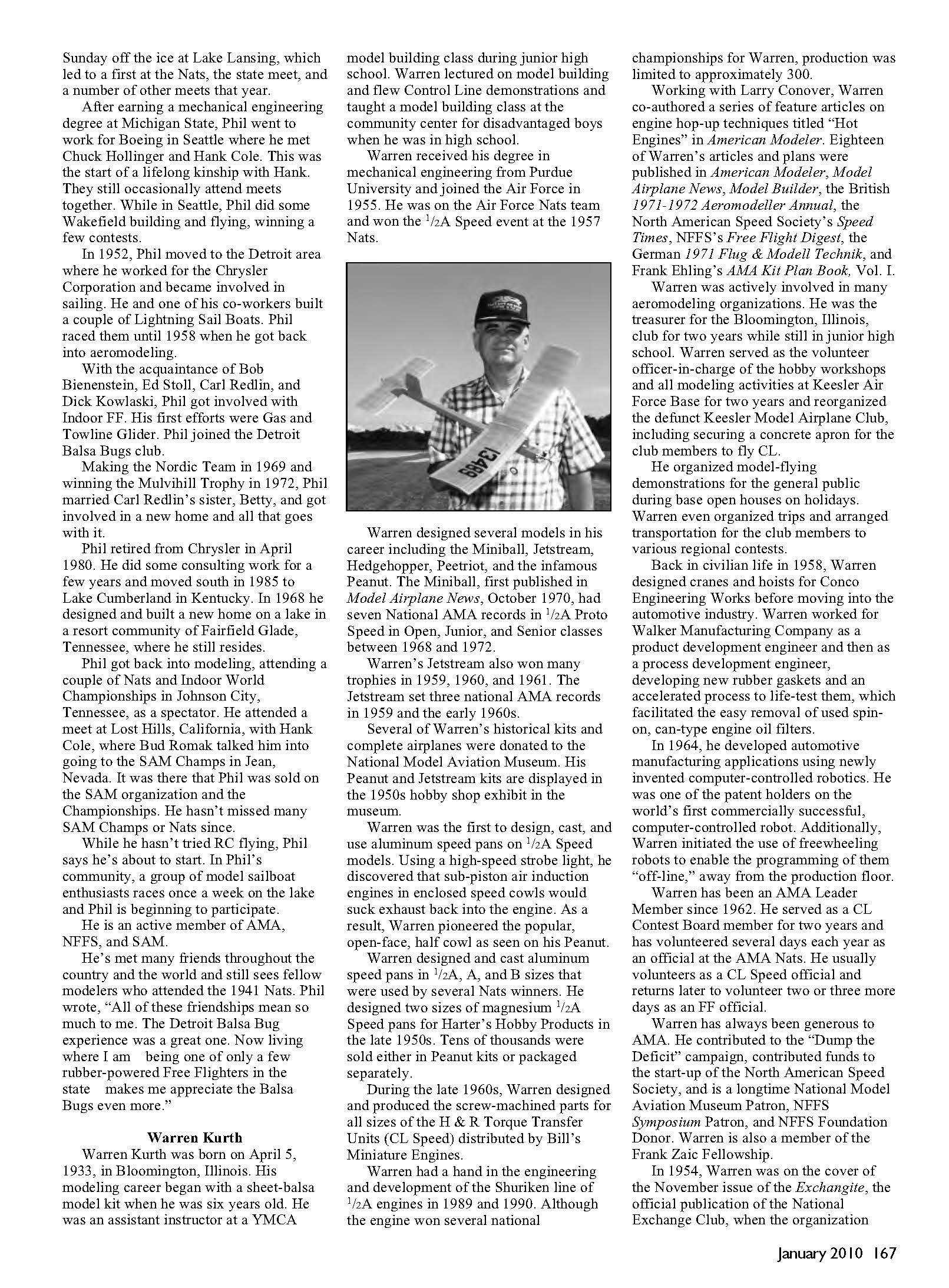
Warren Kurth
Warren Kurth was born on April 5, 1933, in Bloomington, Illinois. His modeling career began with a sheet-balsa model kit when he was six years old. He was an assistant instructor at a YMCA model building class during junior high school. Warren lectured on model building, flew control-line demonstrations, and taught a model building class at the community center for disadvantaged boys when he was in high school.
Warren received his degree in mechanical engineering from Purdue University and joined the Air Force in 1955. He was on the Air Force Nats team and won the 1/2A Speed event at the 1957 Nats.
Warren designed several models in his career including the Miniball, Jetstream, Hedgehopper, Peetriot, and the infamous Peanut. The Miniball, first published in Model Airplane News, October 1970, had seven National AMA records in 1/2A Proto Speed in Open, Junior, and Senior classes between 1968 and 1972.
Warren’s Jetstream also won many trophies in 1959, 1960, and 1961. The Jetstream set three national AMA records in 1959 and the early 1960s.
Several of Warren’s historical kits and complete airplanes were donated to the National Model Aviation Museum. His Peanut and Jetstream kits are displayed in the 1950s hobby shop exhibit in the museum.
Warren was the first to design, cast, and use aluminum speed pans on 1/2A Speed models. Using a high-speed strobe light, he discovered that sub-piston air induction engines in enclosed speed cowls would suck exhaust back into the engine. As a result, Warren pioneered the popular, open-face, half cowl as seen on his Peanut.
Warren designed and cast aluminum speed pans in 1/2A, A, and B sizes that were used by several Nats winners. He designed two sizes of magnesium 1/2A Speed pans for Harter’s Hobby Products in the late 1950s. Tens of thousands were sold either in Peanut kits or packaged separately.
During the late 1960s, Warren designed and produced the screw-machined parts for all sizes of the H & R Torque Transfer Units (CL Speed) distributed by Bill’s Miniature Engines.
Warren had a hand in the engineering and development of the Shuriken line of 1/2A engines in 1989 and 1990. Although the engine won several national championships for Warren, production was limited to approximately 300.
Working with Larry Conover, Warren co-authored a series of feature articles on engine hop-up techniques titled “Hot Engines” in American Modeler. Eighteen of Warren’s articles and plans were published in American Modeler, Model Airplane News, Model Builder, the British 1971-1972 Aeromodeller Annual, the North American Speed Society’s Speed Times, NFFS’s Free Flight Digest, the German 1971 Flug & Modell Technik, and Frank Ehling’s AMA Kit Plan Book, Vol. I.
Warren was actively involved in many aeromodeling organizations. He was the treasurer for the Bloomington, Illinois, club for two years while still in junior high school. Warren served as the volunteer officer-in-charge of the hobby workshops and all modeling activities at Keesler Air Force Base for two years and reorganized the defunct Keesler Model Airplane Club, including securing a concrete apron for the club members to fly CL.
He organized model-flying demonstrations for the general public during base open houses on holidays. Warren even organized trips and arranged transportation for the club members to various regional contests.
Back in civilian life in 1958, Warren designed cranes and hoists for Conco Engineering Works before moving into the automotive industry. Warren worked for Walker Manufacturing Company as a product development engineer and then as a process development engineer, developing new rubber gaskets and an accelerated process to life-test them, which facilitated the easy removal of used spin-on, can-type engine oil filters.
In 1964, he developed automotive manufacturing applications using newly invented computer-controlled robotics. He was one of the patent holders on the world’s first commercially successful, computer-controlled robot. Additionally, Warren initiated the use of freewheeling robots to enable the programming of them “off-line,” away from the production floor.
Warren has been an AMA Leader Member since 1962. He served as a CL Contest Board member for two years and has volunteered several days each year as an official at the AMA Nats. He usually volunteers as a CL Speed official and returns later to volunteer two or three more days as an FF official.
Warren has always been generous to AMA. He contributed to the “Dump the Deficit” campaign, contributed funds to the start-up of the North American Speed Society, and is a longtime National Model Aviation Museum Patron, NFFS Symposium Patron, and NFFS Foundation Donor. Warren is also a member of the Frank Zaic Fellowship.
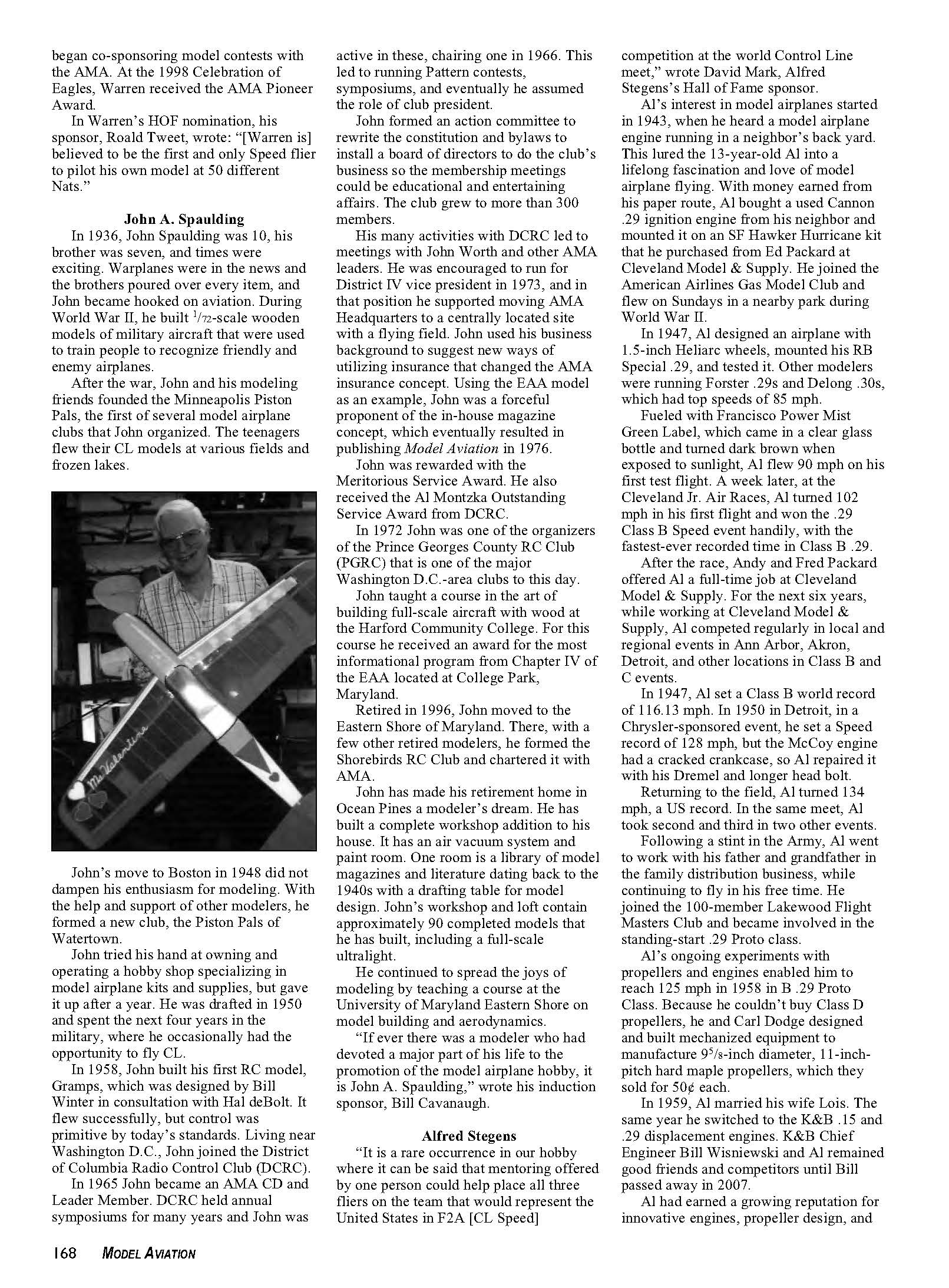
John A. Spaulding
In 1936, John Spaulding was 10, his brother was seven, and times were exciting. Warplanes were in the news and the brothers poured over every item, and John became hooked on aviation. During World War II, he built 1/72-scale wooden models of military aircraft that were used to train people to recognize friendly and enemy airplanes.
After the war, John and his modeling friends founded the Minneapolis Piston Pals, the first of several model airplane clubs that John organized. The teenagers flew their control-line models at various fields and frozen lakes.
John's move to Boston in 1948 did not dampen his enthusiasm for modeling. With the help and support of other modelers, he formed a new club, the Piston Pals of Watertown.
John tried his hand at owning and operating a hobby shop specializing in model airplane kits and supplies, but gave it up after a year. He was drafted in 1950 and spent the next four years in the military, where he occasionally had the opportunity to fly control-line.
In 1958, John built his first RC model, Gramps, which was designed by Bill Winter in consultation with Hal deBolt. It flew successfully, but control was primitive by today’s standards. Living near Washington D.C., John joined the District of Columbia Radio Control Club (DCRC).
In 1965 John became an AMA Contest Director and Leader Member. DCRC held annual symposiums for many years and John was active in these, chairing one in 1966. This led to running Pattern contests, symposiums, and eventually he assumed the role of club president.
John formed an action committee to rewrite the constitution and bylaws to install a board of directors to do the club’s business so the membership meetings could be educational and entertaining affairs. The club grew to more than 300 members.
His many activities with DCRC led to meetings with John Worth and other AMA leaders. He was encouraged to run for District IV vice president in 1973, and in that position he supported moving AMA Headquarters to a centrally located site with a flying field. John used his business background to suggest new ways of utilizing insurance that changed the AMA insurance concept. Using the EAA model as an example, John was a forceful proponent of the in-house magazine concept, which eventually resulted in publishing Model Aviation in 1976.
John was rewarded with the Meritorious Service Award. He also received the Al Montzka Outstanding Service Award from DCRC.
In 1972 John was one of the organizers of the Prince Georges County RC Club (PGRC) that is one of the major Washington D.C.-area clubs to this day.
John taught a course in the art of building full-scale aircraft with wood at Harford Community College. For this course he received an award for the most informational program from Chapter IV of the EAA located at College Park, Maryland.
Retired in 1996, John moved to the Eastern Shore of Maryland. There, with a few other retired modelers, he formed the Shorebirds RC Club and chartered it with AMA.
John has made his retirement home in Ocean Pines a modeler’s dream. He has built a complete workshop addition to his house. It has an air vacuum system and paint room. One room is a library of model magazines and literature dating back to the 1940s with a drafting table for model design. John’s workshop and loft contain approximately 90 completed models that he has built, including a full-scale ultralight.
He continued to spread the joys of modeling by teaching a course at the University of Maryland Eastern Shore on model building and aerodynamics.
“If ever there was a modeler who had devoted a major part of his life to the promotion of the model airplane hobby, it is John A. Spaulding,” wrote his induction sponsor, Bill Cavanaugh.
Alfred Stegens
“It is a rare occurrence in our hobby where it can be said that mentoring offered by one person could help place all three fliers on the team that would represent the United States in F2A [CL Speed] competition at the world Control Line meet,” wrote David Mark, Alfred Stegens’s Hall of Fame sponsor.
Al’s interest in model airplanes started in 1943, when he heard a model airplane engine running in a neighbor’s back yard. This lured the 13-year-old Al into a lifelong fascination and love of model airplane flying. With money earned from his paper route, Al bought a used Cannon .29 ignition engine from his neighbor and mounted it on an SF Hawker Hurricane kit that he purchased from Ed Packard at Cleveland Model & Supply. He joined the American Airlines Gas Model Club and flew on Sundays in a nearby park during World War II.
In 1947, Al designed an airplane with 1.5-inch Heliarc wheels, mounted his RB Special .29, and tested it. Other modelers were running Forster .29s and Delong .30s, which had top speeds of 85 mph.
Fueled with Francisco Power Mist Green Label, which came in a clear glass bottle and turned dark brown when exposed to sunlight, Al flew 90 mph on his first test flight. A week later, at the Cleveland Jr. Air Races, Al turned 102 mph in his first flight and won the .29 Class B Speed event handily, with the fastest-ever recorded time in Class B .29.
After the race, Andy and Fred Packard offered Al a full-time job at Cleveland Model & Supply. For the next six years, while working at Cleveland Model & Supply, Al competed regularly in local and regional events in Ann Arbor, Akron, Detroit, and other locations in Class B and C events.
In 1947, Al set a Class B world record of 116.13 mph. In 1950 in Detroit, in a Chrysler-sponsored event, he set a Speed record of 128 mph, but the McCoy engine had a cracked crankcase, so Al repaired it with his Dremel and longer head bolt. Returning to the field, Al turned 134 mph, a US record. In the same meet, Al took second and third in two other events.
Following a stint in the Army, Al went to work with his father and grandfather in the family distribution business, while continuing to fly in his free time. He joined the 100-member Lakewood Flight Masters Club and became involved in the standing-start .29 Proto class.
Al’s ongoing experiments with propellers and engines enabled him to reach 125 mph in 1958 in B .29 Proto Class. Because he couldn’t buy Class D propellers, he and Carl Dodge designed and built mechanized equipment to manufacture 9 5/8-inch diameter, 11-inch pitch hard maple propellers, which they sold for 50¢ each.
In 1959, Al married his wife Lois. The same year he switched to the K&B .15 and .29 displacement engines. K&B Chief Engineer Bill Wisniewski and Al remained good friends and competitors until Bill passed away in 2007.
Al had earned a growing reputation for innovative engines, propeller design, and speed. He and Carl Dodge, a Purdue engineering graduate, flew every Sunday at local and regional events, winning often. In 1965, they made their way to Willow Grove Naval Air Station to compete in the Nationals.
Bill Wisniewski told them it would be necessary to run 170 mph in B Speed if they wanted to beat Jim Nightingale, a West Coast flier, who was running a K&B modified "Wart." The event went to Al and Carl, who placed the winning speed on their third flight at slightly more than 170 mph to Jim's 169 mph. The next day, Al and Carl took first place in .29 Proto, turning 138.5 mph.
Except for his years in military service, Al had competed in all of Nationals since his first in 1946.
In 1966, Al and Carl ventured into Class D, .60-.65 displacement competition with a new Rossi .60 engine. At a regional competition in Detroit, using a homemade propeller, they turned 180 mph, a speed not yet officially reached, for a first-place finish.
Al and Carl further modified the Rossi and flew it to a Class D record and first-place finish at 184.16 mph at the 1966 Nationals.
Al and Carl bought several TWA FAI engines from Bill Wisniewski with plans to compete in the .15-displacement class A Speed. At the Chicago Glenview Nationals, they took first place with a speed of 164.10 mph. Bill Wisniewski, who had designed and built their engine, finished second at 163.57 mph.
Al's collection of trophies grew so large that it filled his basement and was eventually moved into storage. At one time, he held US National Speed records in 1/2A Speed, B Speed, B Proto, and C Speed.
In 1984, Al competed in an impromptu 1/2A Speed Race international event with a run of 118.7 mph, which was good enough for first place. In 1985, he introduced .21 Sport Speed. He drafted a set of rules and continued to fly provisional races until the early 1990s, when .21 Sport Speed became a recognized event.
In 1987, Al teamed with Chris Montagnino and the pair continue to compete in events in the Midwest.
Al retired from Cleveland after 45 years; he was chief engineer during the last 20. He was granted 20 design patents and was inducted into the Vacuum Dealers Trade Association Hall of Fame for his contributions to the industry.
Al plans to continue competing. "His wins are only surpassed by his innovations, contributions to the sport, and his eagerness to mentor youth and young fliers," sponsor David Mark wrote. "Al's unselfish giving of time and experience to officiate and a unique memory makes him the unofficial historian of Speed model flying. After more than six decades, he has earned and is worthy of serious consideration for induction into the Model Aviation Hall of Fame."
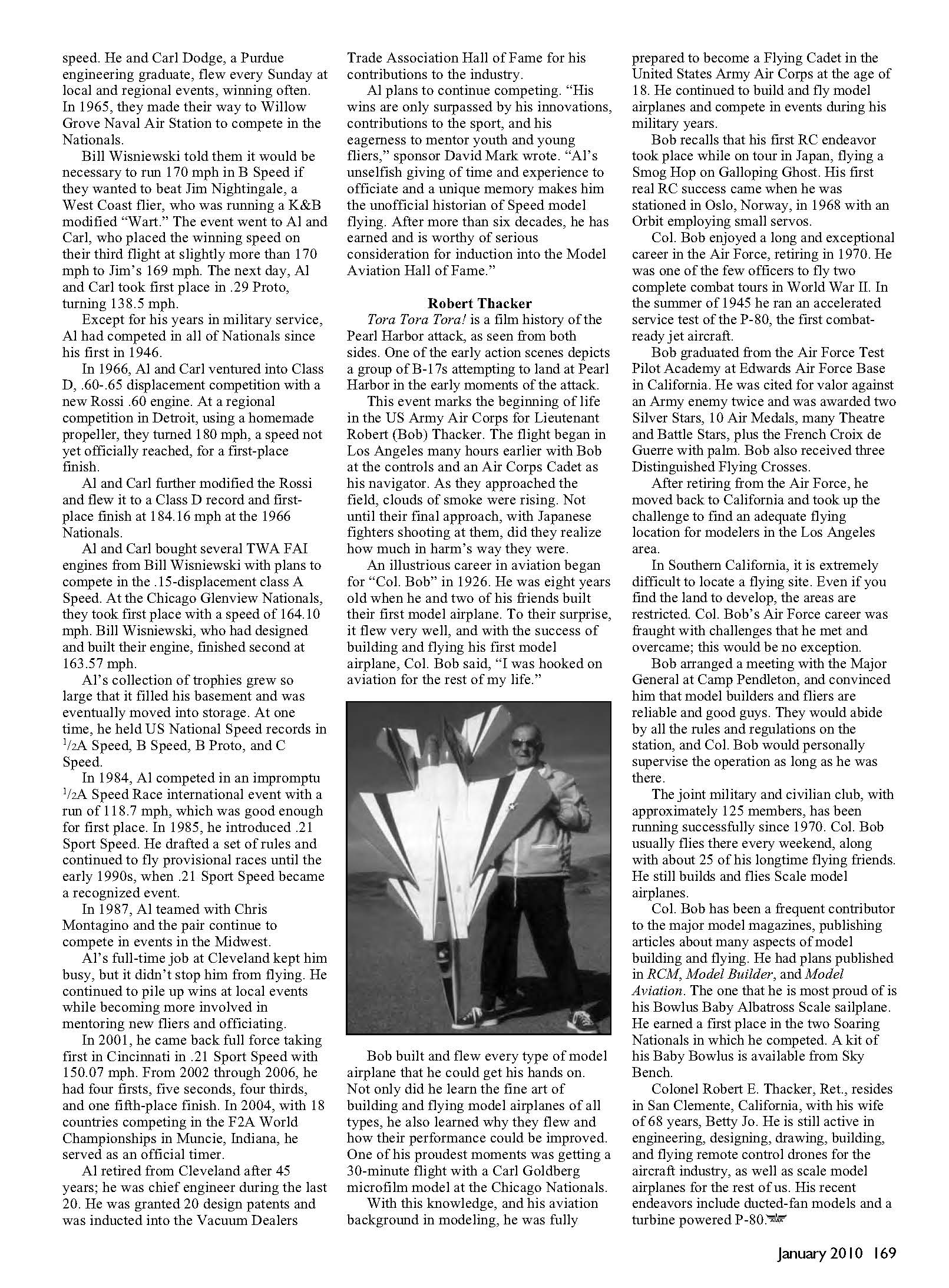
Robert Thacker
Tora! Tora! Tora! is a film history of the Pearl Harbor attack, as seen from both sides. One of the early action scenes depicts a group of B-17s attempting to land at Pearl Harbor in the early moments of the attack.
This event marks the beginning of life in the US Army Air Corps for Lieutenant Robert (Bob) Thacker. The flight began in Los Angeles many hours earlier with Bob at the controls and an Air Corps cadet as his navigator. As they approached the field, clouds of smoke were rising. Not until their final approach, with Japanese fighters shooting at them, did they realize how much in harm's way they were.
An illustrious career in aviation began for "Col. Bob" in 1926. He was eight years old when he and two of his friends built their first model airplane. To their surprise, it flew very well, and with the success of building and flying his first model airplane, Col. Bob said, "I was hooked on aviation for the rest of my life."
Bob built and flew every type of model airplane that he could get his hands on. Not only did he learn the fine art of building and flying model airplanes of all types, he also learned why they flew and how their performance could be improved. One of his proudest moments was getting a 30-minute flight with a Carl Goldberg microfilm model at the Chicago Nationals.
With this knowledge, and his aviation background in modeling, he was fully prepared to become a Flying Cadet in the United States Army Air Corps at the age of 18. He continued to build and fly model airplanes and compete in events during his military years.
Bob recalls that his first RC endeavor took place while on tour in Japan, flying a Smog Hop on Galloping Ghost. His first real RC success came when he was stationed in Oslo, Norway, in 1968 with an Orbit employing small servos.
Col. Bob enjoyed a long and exceptional career in the Air Force, retiring in 1970. He was one of the few officers to fly two complete combat tours in World War II. In the summer of 1945 he ran an accelerated service test of the P-80, the first combat-ready jet aircraft.
Bob graduated from the Air Force Test Pilot Academy at Edwards Air Force Base in California. He was cited for valor against an enemy twice and was awarded two Silver Stars, 10 Air Medals, many Theatre and Battle Stars, plus the French Croix de Guerre with palm. Bob also received three Distinguished Flying Crosses.
After retiring from the Air Force, he moved back to California and took up the challenge to find an adequate flying location for modelers in the Los Angeles area.
In Southern California, it is extremely difficult to locate a flying site. Even if you find the land to develop, the areas are restricted. Col. Bob's Air Force career was fraught with challenges that he met and overcame; this would be no exception.
Bob arranged a meeting with the Major General at Camp Pendleton, and convinced him that model builders and fliers are reliable and good citizens. They would abide by all the rules and regulations on the station, and Col. Bob would personally supervise the operation as long as he was there.
The joint military and civilian club, with approximately 125 members, has been running successfully since 1970. Col. Bob usually flies there every weekend, along with about 25 of his longtime flying friends. He still builds and flies scale model airplanes.
Col. Bob has been a frequent contributor to the major model magazines, publishing articles about many aspects of model building and flying. He had plans published in RCM, Model Builder, and Model Aviation. The one that he is most proud of is his Bowlus Baby Albatross scale sailplane. He earned a first place in the two Soaring Nationals in which he competed. A kit of his Baby Bowlus is available from Sky Bench.
Colonel Robert E. Thacker, Ret., resides in San Clemente, California, with his wife of 68 years, Betty Jo. He is still active in engineering, designing, drawing, building, and flying remote control drones for the aircraft industry, as well as scale model airplanes for the rest of us. His recent endeavors include ducted-fan models and a turbine-powered P-80.
Transcribed from original scans by AI. Minor OCR errors may remain.

