
The Lift From an Aircraft's Wing
By Gregory Romine
Why does an airplane fly? What provides the lift that keeps it in the air?
The first answer that would come to many people's minds would be based on Bernoulli's equation. Others might answer that the air deflected downward by an airplane wing with a positive angle of attack provides the lift.
Depending on the situation, both responses would be correct.
Those who answer with Bernoulli's equation are often parroting an answer they found in a book or were given by someone who knows something about the theory of flight without understanding why Bernoulli's equation provides lift to the wing.
Bernoulli's equation is often used to calculate the pressure difference between the upper and lower surfaces of a wing, but why the pressure difference exists is an arcane fact that needs further explanation.
In explaining Bernoulli's equation, it is quite useful to first lay out the conditions under which Bernoulli's equation is valid.
Bernoulli's equation can be used in any problem dealing with fluid flow, providing that the flow is nearly laminar (without turbulence), the fluid's viscosity is negligible (no friction), and the fluid is incompressible.
To a first approximation, air flowing around a wing can be considered a fluid under the conditions described above, despite the fact that a real fluid is viscous, flows turbulently, and (as with air) can be compressible.
The derivation of Bernoulli's equation is rooted in the conservation of energy. Without friction (negligible viscosity), the energy in a system remains constant but can change form.
The system's energy can come from the work done by moving a fluid because of a pressure difference, and appear in the moving fluid as gravitational potential energy (the fluid rises or falls) or as kinetic energy (causing the fluid to speed up or slow down).
Since work and energy are scalar quantities (there is a magnitude but no direction associated with the quantity) and the units are the same (joules), different forms of work and energy can be added directly together.
If no energy enters or leaves a conservative system, the total energy remains constant. This implies that if the kinetic energy, for instance, of the fluid rises, the work done by the pressure difference or the change in gravitational potential energy must fall to keep the total energy constant.
So if the changes in the different forms of energy present in an airstream moving under the restrictions noted above are added, they must equal zero.
The change in the work done by a pressure difference plus the change in the gravitational potential energy as the fluid rises or falls plus the change in the kinetic energy of the fluid as it slows down or speeds up must equal zero. Putting this into an equation, we have:
ΔW_pressure + ΔPE_height + ΔKE_speed = 0
If we follow a constant volume of the fluid flowing through a "pipe" that rises or falls and has a changing cross-section, we get:
(P_u - P_l) + ρg(h_u - h_l) + 1/2 ρ(v_u^2 - v_l^2) = 0
Where the subscript "u" stands for the air flowing over the upper surface of the wing, the subscript "l" stands for the air flowing beneath the lower surface of the wing.
"P" is for pressure, "h" is for height, "v" is for speed of the fluid, "ρ" is for the density of the fluid, and "g" is for the acceleration of gravity (32 feet/second^2).
Putting the upper terms on the left side of the equation and the lower terms on the right, we get:
P_u + ρgh_u + 1/2 ρv_u^2 = P_l + ρgh_l + 1/2 ρv_l^2
The preceding equation is the form of Bernoulli's equation that is usually found in textbooks.
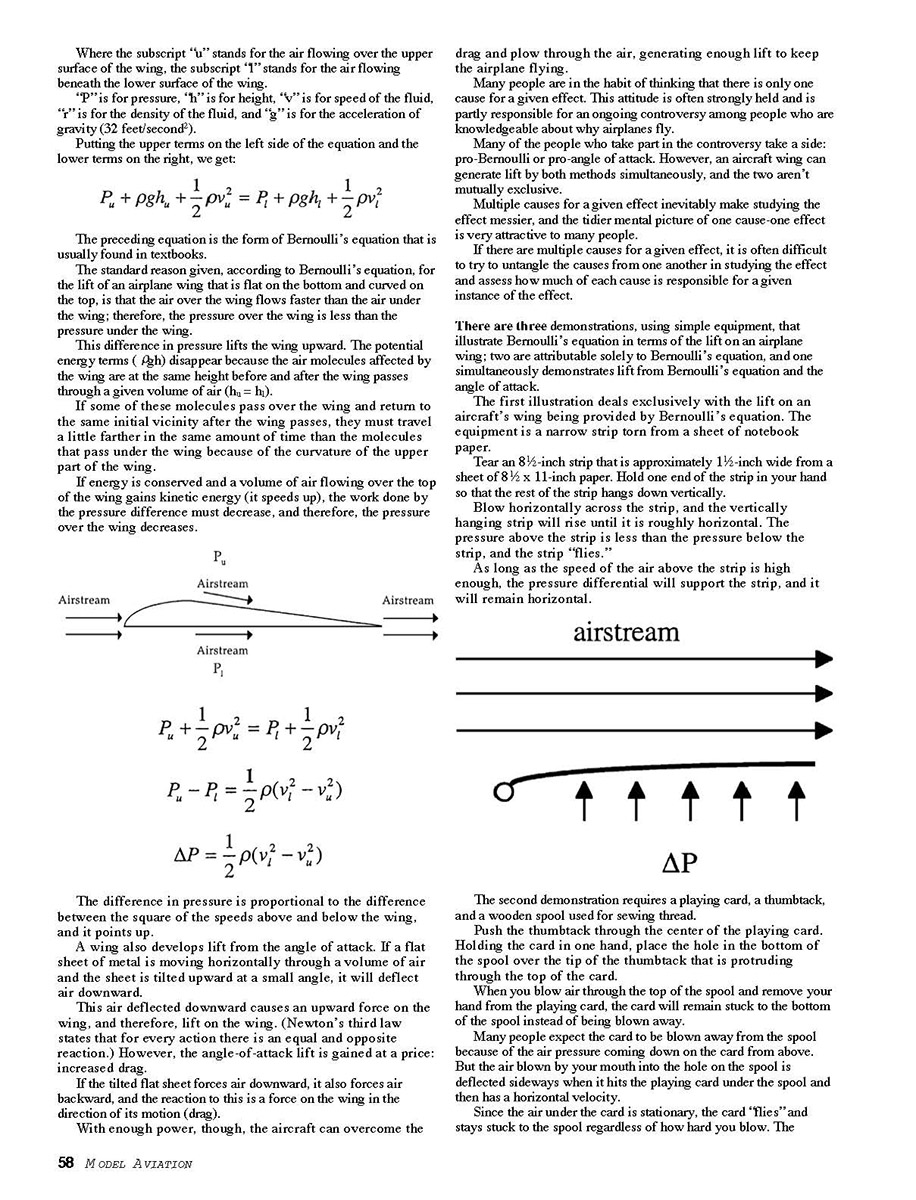
The standard reason given, according to Bernoulli's equation, for the lift of an airplane wing that is flat on the bottom and curved on the top, is that the air over the wing flows faster than the air under the wing; therefore, the pressure over the wing is less than the pressure under the wing.
This difference in pressure lifts the wing upward. The potential energy terms (ρgh) disappear because the air molecules affected by the wing are at the same height before and after the wing passes through a given volume of air (h_u = h_l).
If some of these molecules pass over the wing and return to the same initial vicinity after the wing passes, they must travel a little farther in the same amount of time than the molecules that pass under the wing because of the curvature of the upper part of the wing.
If energy is conserved and a volume of air flowing over the top of the wing gains kinetic energy (it speeds up), the work done by the pressure difference must decrease, and therefore, the pressure over the wing decreases.
P_u
The difference in pressure is proportional to the difference between the square of the speeds above and below the wing, and it points up.
A wing also develops lift from the angle of attack. If a flat sheet of metal is moving horizontally through a volume of air and the sheet is tilted upward at a small angle, it will deflect air downward.
This air deflected downward causes an upward force on the wing, and therefore, lift on the wing. (Newton's third law states that for every action there is an equal and opposite reaction.) However, the angle-of-attack lift is gained at a price: increased drag.
If the tilted flat sheet forces air downward, it also forces air backward, and the reaction to this is a force on the wing in the direction of its motion (drag).
With enough power, though, the aircraft can overcome the drag and plow through the air, generating enough lift to keep the airplane flying.
Many people are in the habit of thinking that there is only one cause for a given effect. This attitude is often strongly held and is partly responsible for an ongoing controversy among people who are knowledgeable about why airplanes fly.
Many of the people who take part in the controversy take a side: pro-Bernoulli or pro-angle of attack. However, an aircraft wing can generate lift by both methods simultaneously, and the two aren't mutually exclusive.
Multiple causes for a given effect inevitably make studying the effect messier, and the tidier mental picture of one cause-one effect is very attractive to many people.
If there are multiple causes for a given effect, it is often difficult to try to untangle the causes from one another in studying the effect and assess how much of each cause is responsible for a given instance of the effect.
There are three demonstrations, using simple equipment, that illustrate Bernoulli's equation in terms of the lift on an airplane wing; two are attributable solely to Bernoulli's equation, and one simultaneously demonstrates lift from Bernoulli's equation and angle of attack.
The first illustration deals exclusively with the lift on an aircraft's wing being provided by Bernoulli's equation. The equipment is a narrow strip torn from a sheet of notebook paper.
Tear an 8½-inch strip that is approximately 1½-inch wide from a sheet of 8½ × 11-inch paper. Hold one end of the strip in your hand so that the rest of the strip hangs down vertically.
Blow horizontally across the strip, and the vertically hanging strip will rise until it is roughly horizontal. The pressure above the strip is less than the pressure below the strip, and the strip "flies."
As long as the speed of the air above the strip is high enough, the pressure differential will support the strip, and it will remain horizontal.
The second demonstration requires a playing card, a thumbtack, and a wooden spool used for sewing thread.
Push the thumbtack through the center of the playing card. Holding the card in one hand, place the hole in the bottom of the spool over the tip of the thumbtack that is protruding through the top of the card.
When you blow air through the top of the spool and remove your hand from the playing card, the card will remain stuck to the bottom of the spool instead of being blown away.
Many people expect the card to blow away from the spool because of the air pressure coming down on the card from above. But the air blown by your mouth into the hole on the spool is deflected sideways when it hits the playing card under the spool and then has a horizontal velocity.
Since the air under the card is stationary, the card "flies" and stays stuck to the spool regardless of how hard you blow. The pressure difference between the upper and lower surfaces of the card is derived from Bernoulli's equation.
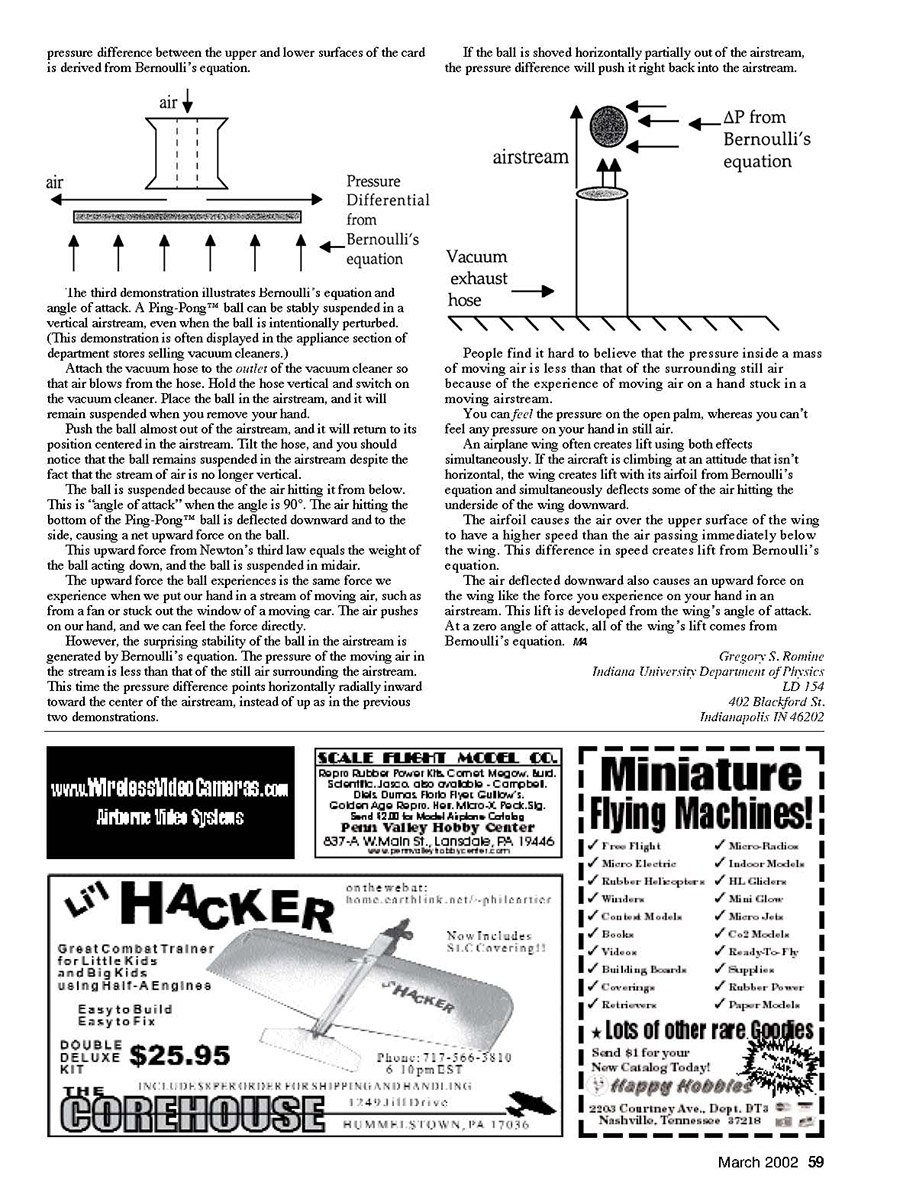
The third demonstration illustrates Bernoulli's equation and angle of attack. A Ping-Pong™ ball can be stably suspended in a vertical airstream, even when the ball is intentionally perturbed. (This demonstration is often displayed in the appliance section of department stores selling vacuum cleaners.)
Attach the vacuum hose to the outlet of the vacuum cleaner so that air blows from the hose. Hold the hose vertical and switch on the vacuum cleaner. Place the ball in the airstream, and it will remain suspended when you remove your hand.
Push the ball almost out of the airstream, and it will return to its position centered in the airstream. Tilt the hose, and you should notice that the ball remains suspended in the airstream despite the fact that the stream of air is no longer vertical.
The ball is suspended because of the air hitting it from below. This is "angle of attack" when the angle is 90°. The air hitting the bottom of the Ping-Pong™ ball is deflected downward and to the side, causing a net upward force on the ball.
This upward force from Newton's third law equals the weight of the ball acting down, and the ball is suspended in midair.
The upward force the ball experiences is the same force we experience when we put our hand in a stream of moving air, such as from a fan or stuck out the window of a moving car. The air pushes on our hand, and we can feel the force directly.
However, the surprising stability of the ball in the airstream is generated by Bernoulli's equation. The pressure of the moving air in the stream is less than that of the still air surrounding the airstream. This time the pressure difference points horizontally radially inward toward the center of the airstream, instead of up as in the previous two demonstrations.
If the ball is shoved horizontally partially out of the airstream, the pressure difference will push it right back into the airstream.
People find it hard to believe that the pressure inside a mass of moving air is less than that of the surrounding still air because of the experience of moving air on a hand stuck in a moving airstream.
You can feel the pressure on the open palm, whereas you can't feel any pressure on your hand in still air.
An airplane wing often creates lift using both effects simultaneously. If the aircraft is climbing at an attitude that isn't horizontal, the wing creates lift with its airfoil from Bernoulli's equation and simultaneously deflects some of the air hitting the underside of the wing downward.
The airfoil causes the air over the upper surface of the wing to have a higher speed than the air passing immediately below the wing. This difference in speed creates lift from Bernoulli's equation.
The air deflected downward also causes an upward force on the wing like the force you experience on your hand in an airstream. This lift is developed from the wing's angle of attack. At a zero angle of attack, all of the wing's lift comes from Bernoulli's equation.
Gregory S. Romine Indiana University, Department of Physics LD 154 402 Blackford St. Indianapolis, IN 46202
Transcribed from original scans by AI. Minor OCR errors may remain.

