
Li-Poly for F3A
by Mario Silvagni
I'M AN ITALIAN F3A (FAI R/C Aerobatics) pilot and an enthusiastic electric flier since 1992. At that time, and for several years after, finding a suitable and "satisfactory" arrangement to fly electric Aerobatics required great efforts.
Achieving some good results meant a lot of research, such as finding the suitable power train, choosing the right battery pack, and so on. Little information was available, and "electric people" had to investigate by themselves to identify the better solutions.
Nowadays, flying electric (even with high performance) has become much simpler because of the availability of many products, many suppliers, and the wide spread of information, allowing people to share their knowledge. This helps to easily address and solve various kinds of problems.
However, I still like making personal investigations to see if information or specifications are close to the reality. This happened for the Li-Poly packs used in F3A.
I was attending an Italian championship contest (where approximately half the pilots flew with electric power) and I heard someone saying, "You should fly with 'supplier X' packs because they are 15% more powerful than the others." That seemed amazing, but I was sure that 15% more was unbelievable from a technical point of view.
With that, I set off on my own to test, in a quantitative and scientific way, if such a significant difference could be reasonably claimed. A flight test couldn't be reliable, so I collected some packs and started conducting a specific test with a station developed to test cells under various operating conditions.
Tested Packs:
A Li-Poly pack for F3A usually consists of 10 cells in series with a total capacity of roughly 5000 mAh. Collecting packs is difficult (except for my personal ones), because not all suppliers assemble such large batteries and they are usually extremely expensive. The other main difficulty is the development of a testing procedure that shows the real differences between the tested packs.
The reader might ask, "Why would you test a complete pack instead of a single cell?" Testing the whole pack leads to direct results that can easily be related to our application. Moreover, it considers some "side effects" (such as thermal behavior) that cannot be investigated in any other simple way.
After some research, I found that only two suppliers are widely used in F3A around the world: FlightPower and Thunder Power. (See the source listing for contact information.) I'm quite sure that there are other suppliers, but they are not so easy to find, especially in Italy. I would be pleased to test any other packs if they are readily available.
(Editor's note: No products were donated for this project.)
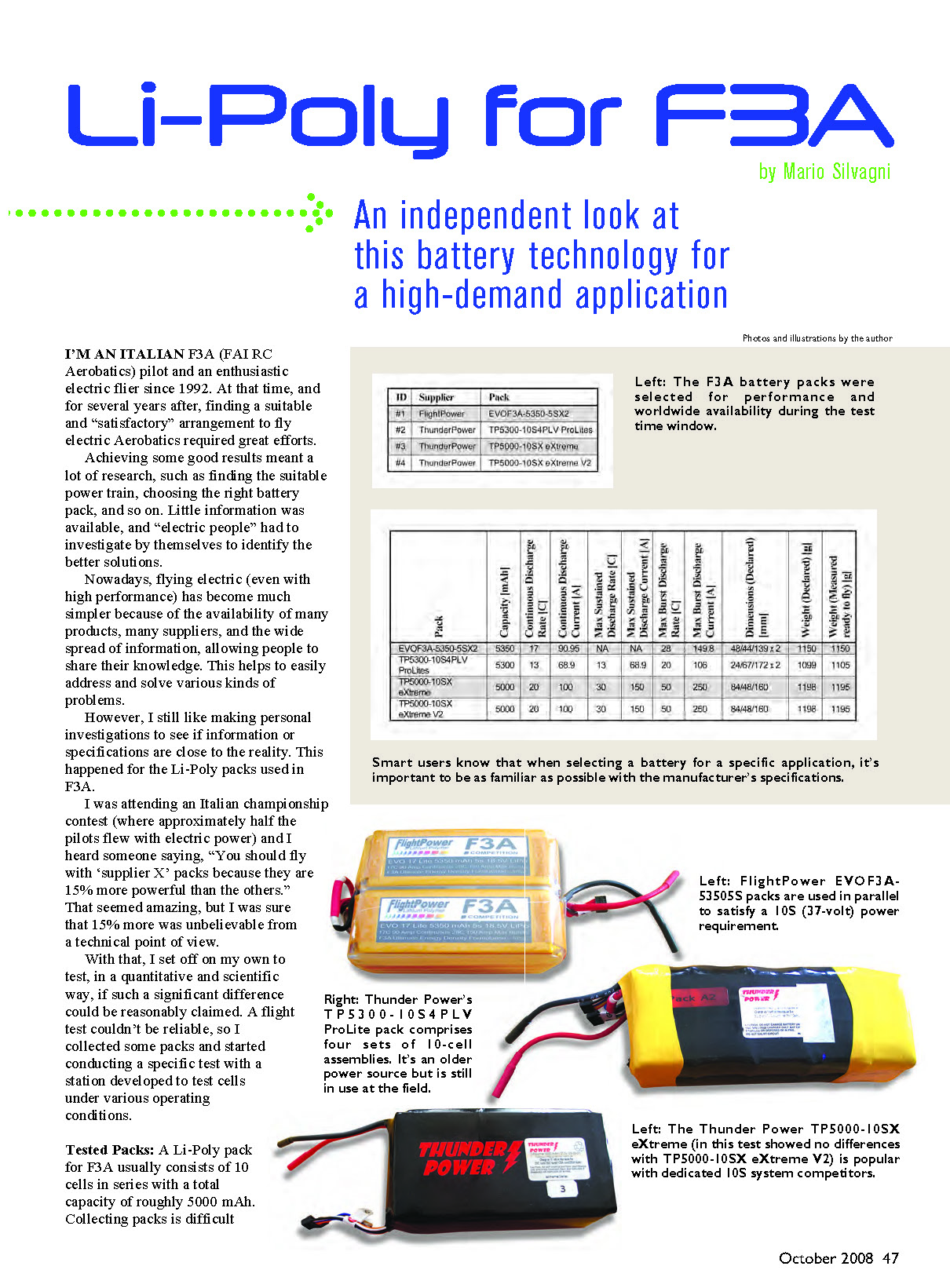
I collected the packs, which you will find listed in Table 1. The EVOF3A-5350S5X2 (Pack 1) is FlightPower's recently released F3A pack that is specially designed and matched to be used in competition, with the aim of developing a lightweight pack.
The TP5300-10S4PLV ProLite (Pack 2) is the first F3A pack that Thunder Power released. It has been on the market for some years, it's lightweight, and it's quite small. It's considered an "old" technology pack by today's standards, but I have chosen to test it because I own a couple packs I used during the past year, so I can show results of the new pack after a period of use.
The TP5000-10SX eXtreme (Pack 3) is Thunder Power's new-generation F3A pack. It's compact (single 10-cell packs) and designed for high current rate.
The TP5000-10SX eXtreme V2 (Pack 4) is the new Thunder Power F3A pack. It has an improved cell design (a wider anode and cathode tab—20mm instead of the previous version's 15mm) that should provide higher performance.
The selected packs' main characteristics are shown in Table 2.
Testing Procedure:
To assure reliable results and comparisons, I have developed a repeatable testing procedure. I implemented two discharge methods, the first of which consists of low constant-current discharge (three cycles at 1C, 2C, and 1C again) to activate the pack and to provide a baseline performance.
The second technique is an F3A equivalent pulsing discharge. It consists of discharging at an equivalent value of 5C (discharging the full pack in 12 minutes), with the current varying from 60 amps for three seconds to 16.58 amps for 12 seconds. This discharging drains 4000 mAh in nine-and-a-half minutes, which corresponds to a hard/windy F3A P07 (preliminary) flight.
During the constant-current discharge, the process is stopped as soon as one of the cells reaches 3.25 volts. During the equivalent discharge, this limit is lowered to 3.0 volts.
All packs are charged with a Schulze ISL6-636+ unit at 2.5 amps up the charger-detect end of charge. A Thunder Power TP-210 balancer is connected throughout the charge.
Special equipment has been developed to perform these tests, as follows.
- Controlled electronic load (for discharging): Up to 100 volts and 300 amps (maximum power approximately 4–5 kW).
- Data acquisition board (control discharge current, acquire data, and manage the whole test).
- Standard compatible Windows-based PC for acquisition-board management.
- Control software based on Borland Pascal.
- HP 3457A 6.5 digit multimeter (for tuning and some high-quality measurements).
- HP 3488A digital switch for extra measurements and to control the system.
- Temperature-controlled testing chamber (at 25±3 degrees Celsius).
As soon as the pack is connected and the test is started, the equipment manages the entire test (control current and sequence) and acquires the discharging current as well as each cell’s voltage together and the pack temperature.
Results:
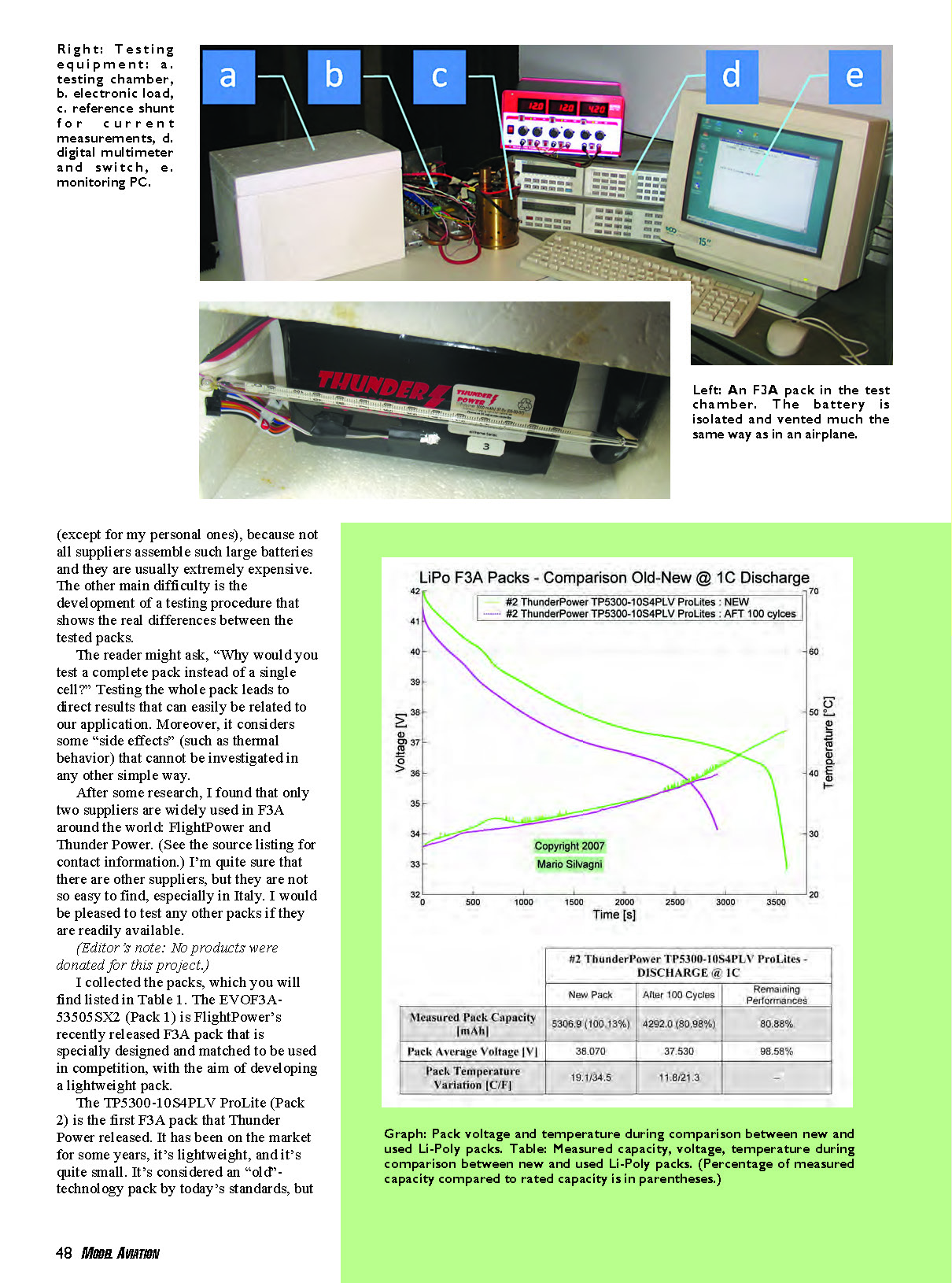
Let’s look at what happens to a used pack. Figure 6 and Table 2 show the results of the comparison between a new Thunder Power TP5300-10S4PLV ProLite and the same pack after 100 F3A flights. The difference is evident in terms of average voltage and available capacity.
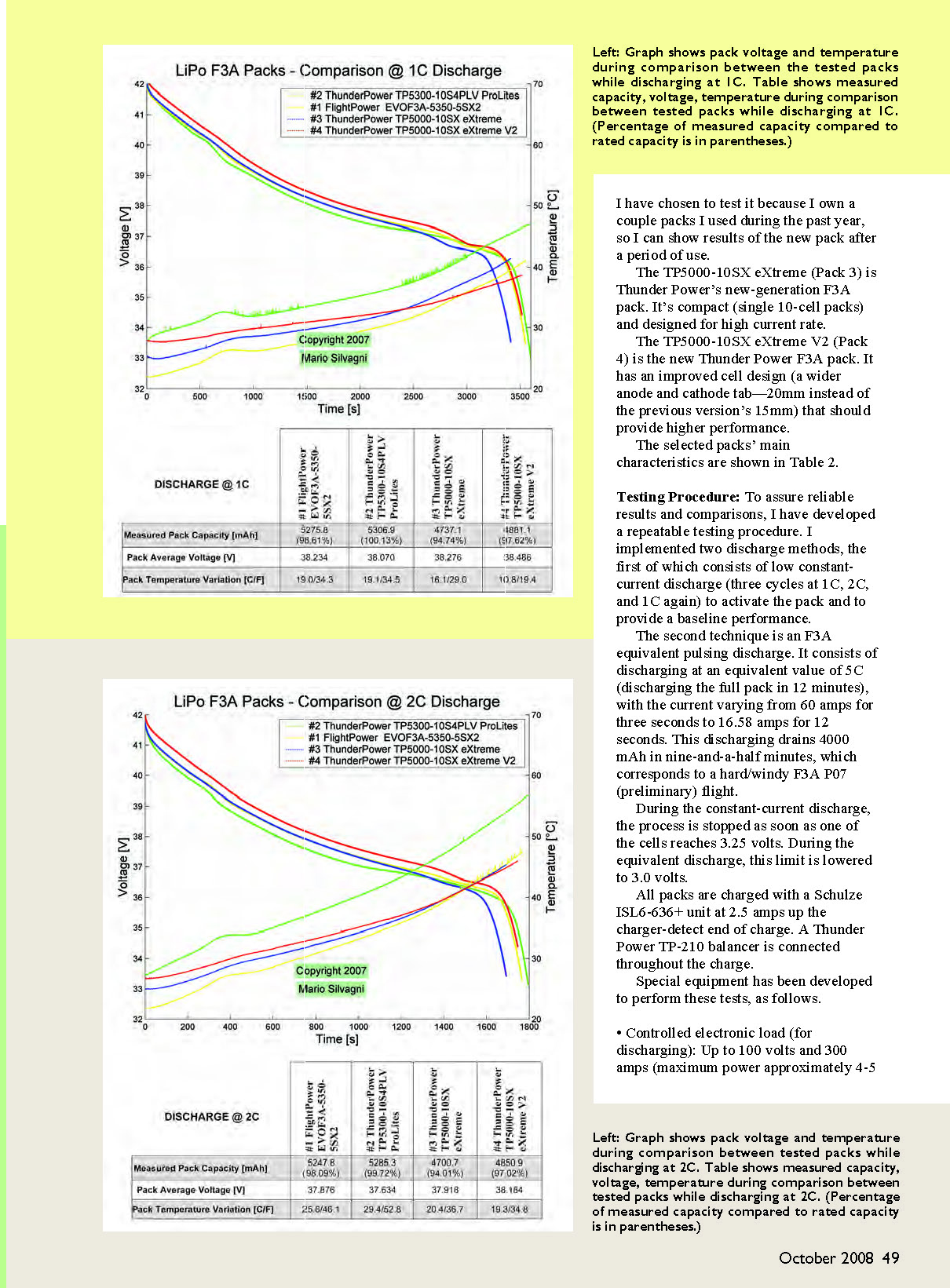
Figure 7 and Table 4 show the results of the tests performed on all the packs with a discharge of 1C. Figure 8 and Table 5 are the same results when packs are discharged at 2C. Even if the curves seem to be far from each other, differences between packs are small.
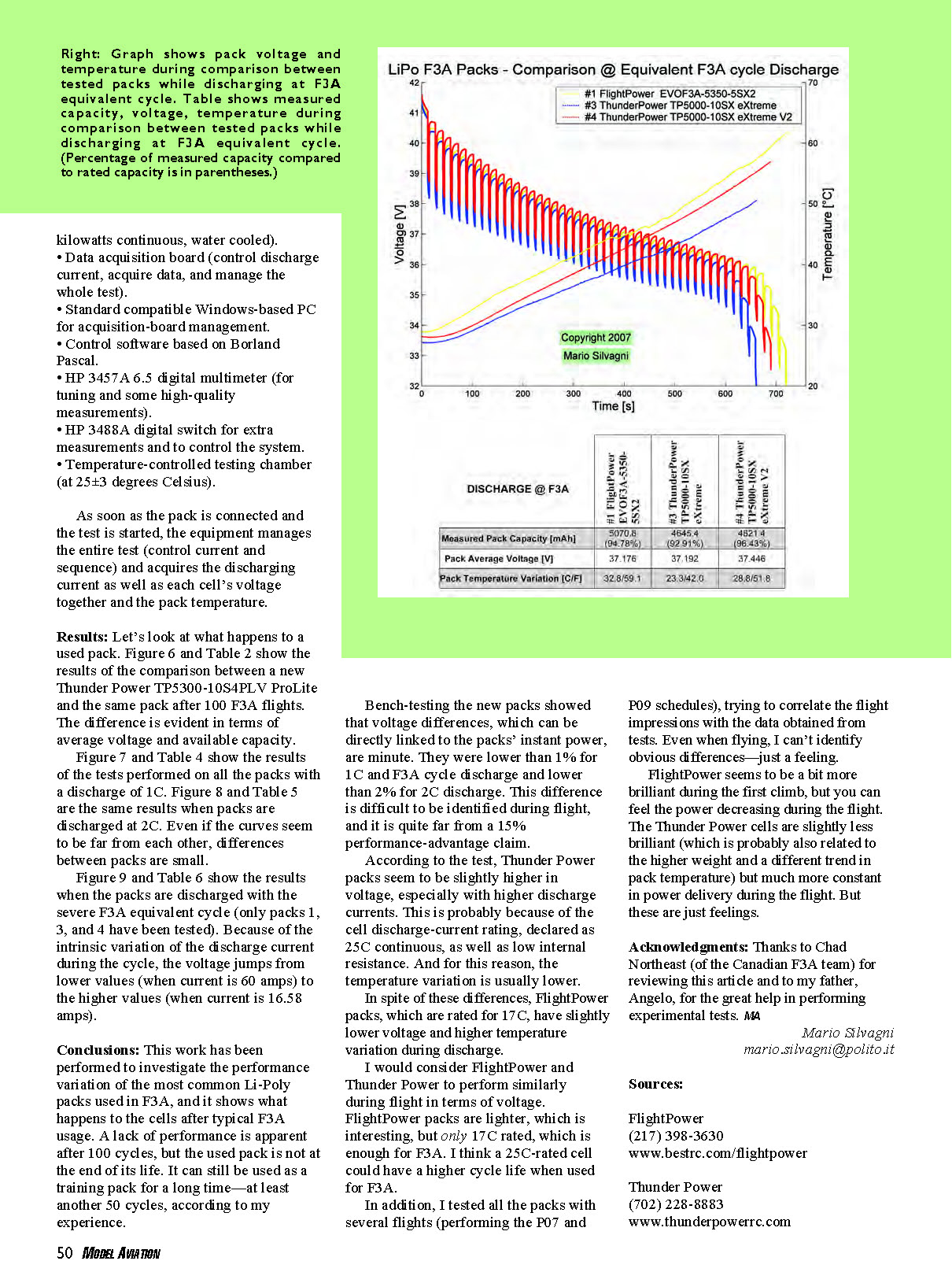
Figure 9 and Table 6 show the results when the packs are discharged with the severe F3A equivalent cycle (only packs 1, 3, and 4 have been tested). Because of the intrinsic variation of the discharge current during the cycle, the voltage jumps from lower values (when current is 60 amps) to the higher values (when current is 16.58 amps).
Conclusions:
This work has been performed to investigate the performance variation of the most common Li-Poly packs used in F3A, and shows what happens to the cells after typical F3A usage. A lack of performance is apparent after 100 cycles, but the used pack is not at the end of its life. It can still be used as a training pack for a long time—at least another 50 cycles, according to my experience.
Bench-testing the new packs showed that voltage differences, which can be directly linked to the packs’ instant power, are minute. They were lower than 1% for 1C and F3A cycle discharge and lower than 2% for 2C discharge. This difference is difficult to be identified during flight, and it is quite far from a 15% performance-advantage claim.
According to the test, Thunder Power packs seem to be slightly higher in voltage, especially with higher discharge currents. This is probably because of the cell discharge-current rating, declared as 25C continuous, as well as low internal resistance. And for this reason, the temperature variation is usually lower.
In spite of these differences, FlightPower packs, which are rated for 17C, have slightly lower voltage and higher temperature variation during discharge.
I would consider FlightPower and Thunder Power to perform similarly during flight in terms of voltage. FlightPower packs are lighter, which is interesting, but only 17C rated, which is enough for F3A. I think a 25C-rated cell could have a higher cycle life when used for F3A.
In addition, I tested all the packs with several flights (performing the P07 and P09 schedules), trying to correlate the flight impressions with the data obtained from tests. Even when flying, I can’t identify obvious differences—just a feeling.
FlightPower seems to be a bit more brilliant during the first climb, but you can feel the power decreasing during the flight. The Thunder Power cells are slightly less brilliant (which is probably also related to the higher weight and a different trend in pack temperature) but much more constant in power delivery during the flight. But these are just feelings.
Acknowledgments:
Thanks to Chad Northeast (of the Canadian F3A team) for reviewing this article and to my father, Angelo, for the great help in performing experimental tests.
Mario Silvagni mario.silvagni@polito.it
Sources:
FlightPower (217) 398-3630 www.bestrc.com/flightpower
Thunder Power (702) 228-8883 www.thunderpowerrc.com
Transcribed from original scans by AI. Minor OCR errors may remain.

