
Focal Point
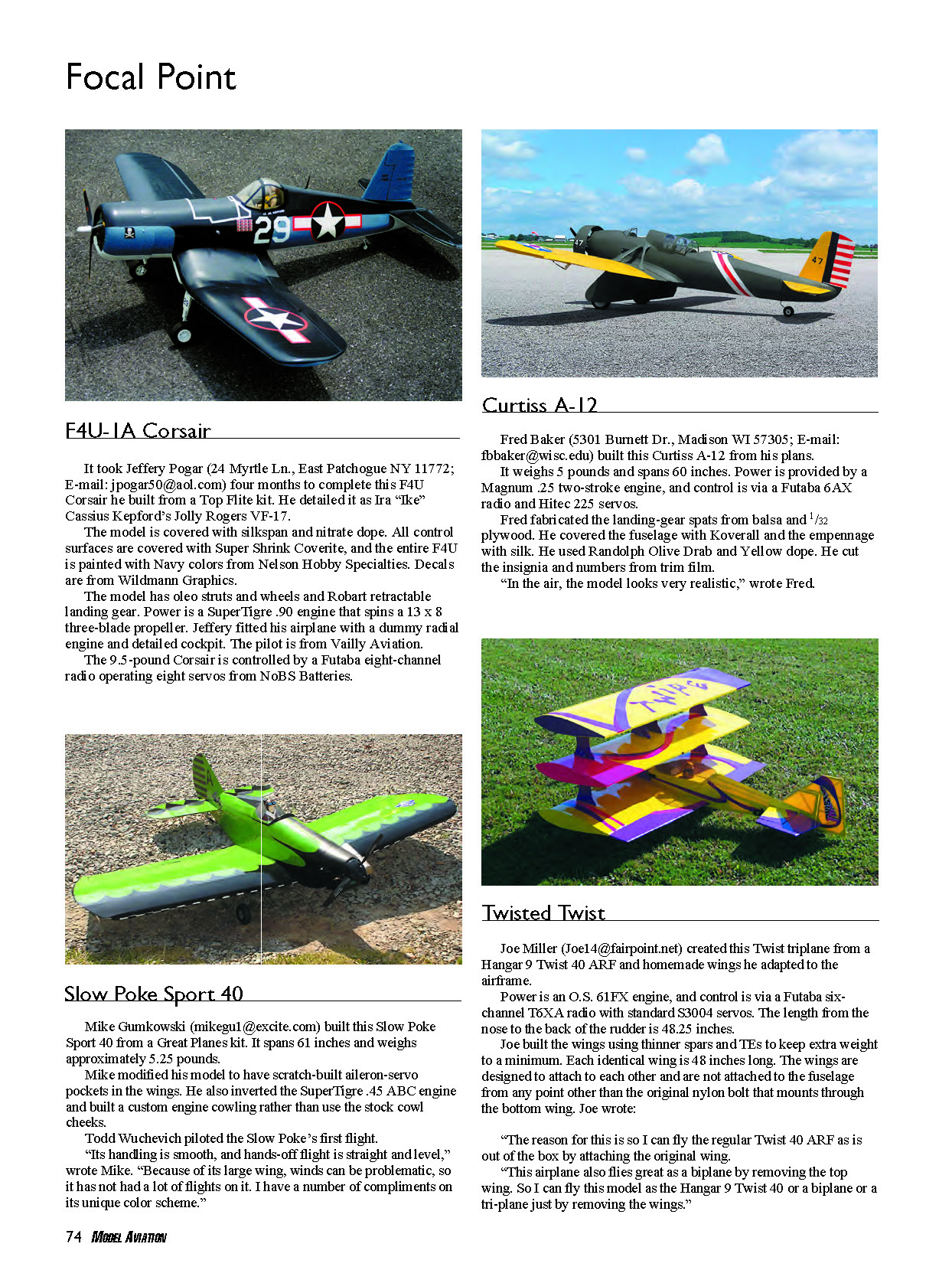
F4U-1A Corsair
It took Jeffery Pogar (24 Myrtle Ln., East Patchogue NY 11772; E-mail: jopogar50@aol.com) four months to complete this F4U Corsair he built from a Top Flite kit. He detailed it as Ira “Ike” Cassius Kepford’s Jolly Rogers VF-17.
The model is covered with silkspan and nitrate dope. All control surfaces are covered with Super Shrink Coverite, and the entire F4U is painted with Navy colors from Nelson Hobby Specialties. Decals are from Wildmann Graphics.
The model has oleo struts and wheels and Robart retractable landing gear. Power is a SuperTigre .90 engine that spins a 13 x 8 three-blade propeller. Jeffery fitted his airplane with a dummy radial engine and detailed cockpit. The pilot is from Vailly Aviation.
The 9.5-pound Corsair is controlled by a Futaba eight-channel radio operating eight servos from NoBS Batteries.
Curtiss A-12
Fred Baker (5301 Burnett Dr., Madison WI 53705; E-mail: fbbaker@wisc.edu) built this Curtiss A-12 from his plans.
It weighs 5 pounds and spans 60 inches. Power is provided by a Magnum .25 two-stroke engine, and control is via a Futaba 6AX radio and Hitec 225 servos.
Fred fabricated the landing-gear spats from balsa and 1/32 plywood. He covered the fuselage with Koverall and the empennage with silk. He used Randolph Olive Drab and Yellow dope. He cut the insignia and numbers from trim film.
“In the air, the model looks very realistic,” wrote Fred.
Slow Poke Sport 40
Mike Gumkowski (mikegull@excite.com) built this Slow Poke Sport 40 from a Great Planes kit. It spans 61 inches and weighs approximately 5.25 pounds.
Mike modified his model to have scratch-built aileron-servo pockets in the wings. He also inverted the SuperTigre .45 ABC engine and built a custom engine cowl rather than use the stock cowl cheeks.
Todd Wuchvechik piloted the Slow Poke’s first flight.
“Its handling is smooth, and hands-off flight is straight and level,” wrote Mike. “Because of its large wing, winds can be problematic, so it has not had a lot of flights on it. I have a number of compliments on its unique color scheme.”
Twisted Twist
Joe Miller (Joel4@fairpoint.net) created this Twist triplane from a Hangar 9 Twist 40 ARF and homemade wings he adapted to the airframe.
Power is an O.S. .61FX engine, and control is via a Futaba six-channel TXA radio with standard S3004 servos. The length from the nose to the back of the rudder is 48.25 inches.
Joe built the wings using thinner spars and TE’s to keep extra weight to a minimum. Each identical wing is 48 inches long. The wings are designed to attach to each other and are not attached to the fuselage from any point other than the original nylon bolt that mounts through the bottom wing. Joe wrote:
“The reason for this is so I can fly the regular Twist 40 ARF as it is out of the box by attaching the original wing.
“This airplane also flies great as a biplane by removing the top wing. So I can fly this model as the Hangar 9 Twist 40 or a biplane or a tri-plane just by removing the wings.”
Focal Point
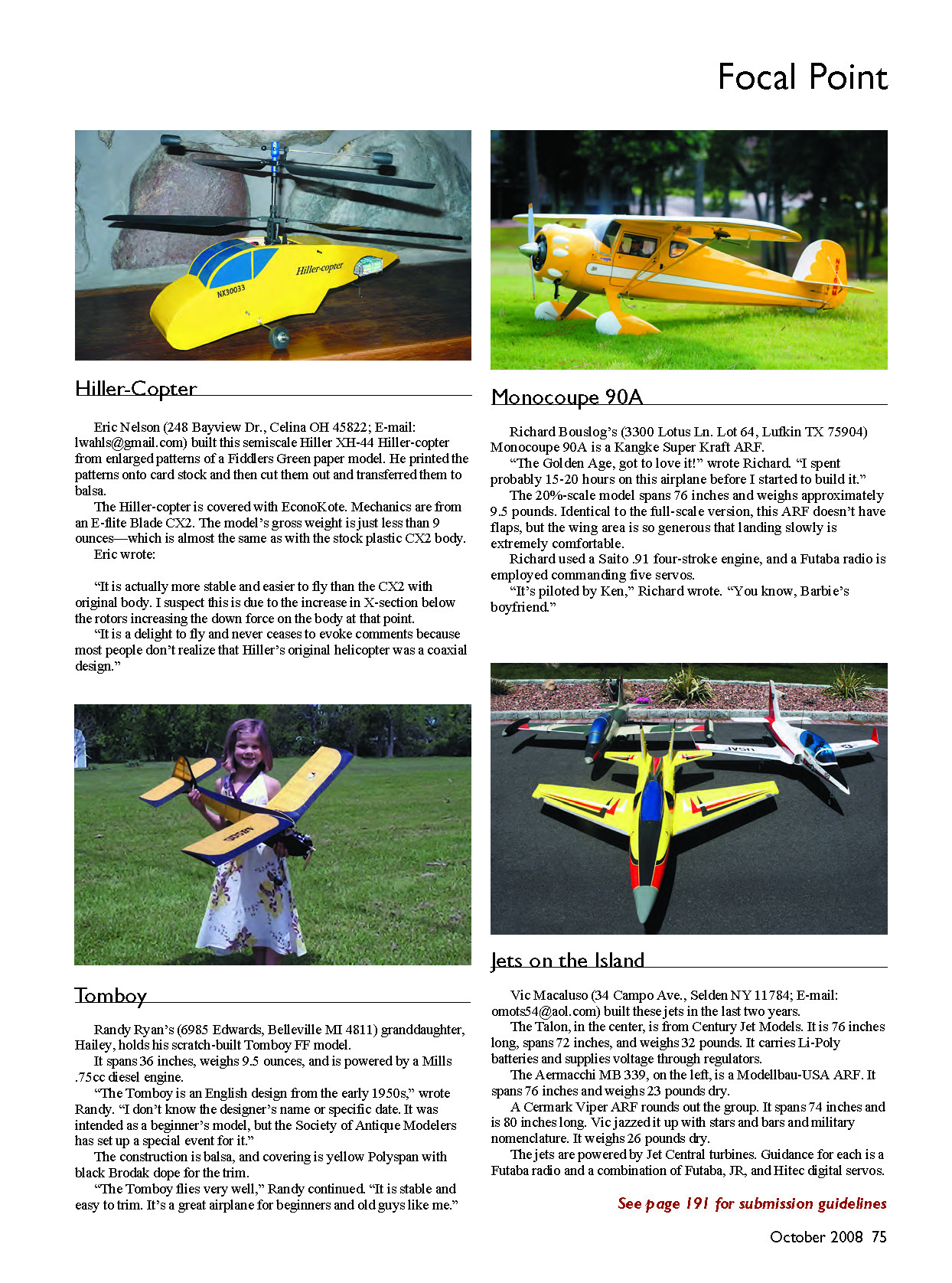
Hiller-Copter
Eric Nelson (248 Bayview Dr., Celina OH 45822; E-mail: lwallis@gmail.com) built this semiscale Hiller XH-44 Hiller-copter from enlarged patterns of a Fiddlers Green paper model. He printed the patterns onto card stock and then cut them out and transferred them to balsa.
The Hiller-copter is covered with EconoKote. Mechanics are from an E-flite Blade CX2. The model’s gross weight is just less than 9 ounces—which is almost the same as with the stock plastic CX2 body.
Eric wrote:
“It is actually more stable and easier to fly than the CX2 with original body. I suspect this is due to the increase in X-section below the rotors increasing the down force on the body at that point.
“It is a delight to fly and never ceases to evoke comments because most people don’t realize that Hiller’s original helicopter was a coaxial design.”
Monocoupe 90A
Richard Bouslog’s (3300 Lotus Ln. Lot 64, Lufkin TX 75904) Monocoupe 90A is a Kankke Super Kraft ARF.
“The Golden Age, got to love it!” wrote Richard. “I spent probably 15-20 hours on this airplane before I started to build it.”
The 20%-scale model spans 76 inches and weighs approximately 9.5 pounds. Identical to the full-scale version, this ARF doesn’t have flaps, but the wing area is so generous that landing slowly is extremely comfortable.
Richard used a Saito .91 four-stroke engine, and a Futaba radio is employed commanding five servos.
“It’s piloted by Ken,” Richard wrote. “You know, Barbie’s boyfriend.”
Tomboy
Randy Ryan’s (6985 Edwards, Belleville MI 4811) granddaughter, Hailey, holds his scratch-built Tomboy FF model.
It spans 36 inches, weighs 9.5 ounces, and is powered by a Mills .75cc diesel engine.
“The Tomboy is an English design from the early 1950s,” wrote Randy. “I don’t know the designer’s name or specific date. It was intended as a beginner’s model, but the Society of Antique Modelers has set up a special event for it.”
The construction is balsa, and covering is yellow Polyspan with black Brodak dope for the trim.
“The Tomboy flies very well,” Randy continued. “It is stable and easy to trim. It’s a great airplane for beginners and old guys like me.”
Jets on the Island
Vic Macaluso (34 Campo Ave., Selden NY 11784; E-mail: omots54@aol.com) built these jets in the last two years.
The Talon, in the center, is from Century Jet Models. It is 76 inches long, spans 72 inches, and weighs 32 pounds. It carries Li-Poly batteries and supplies voltage through regulators.
The Aermacchi MB 339, on the left, is a Modellbau-USA ARF. It spans 76 inches and weighs 23 pounds dry.
A Cermark Viper ARF rounds out the group. It spans 74 inches and is 80 inches long. Vic jazzed it up with stars and bars and military markings. It weighs 26 pounds dry.
The jets are powered by Jet Central turbines. Guidance for each is a Futaba radio and a combination of Futaba, JR, and Hitec digital servos.
Transcribed from original scans by AI. Minor OCR errors may remain.

