
Focal Point
Stealth Fighter
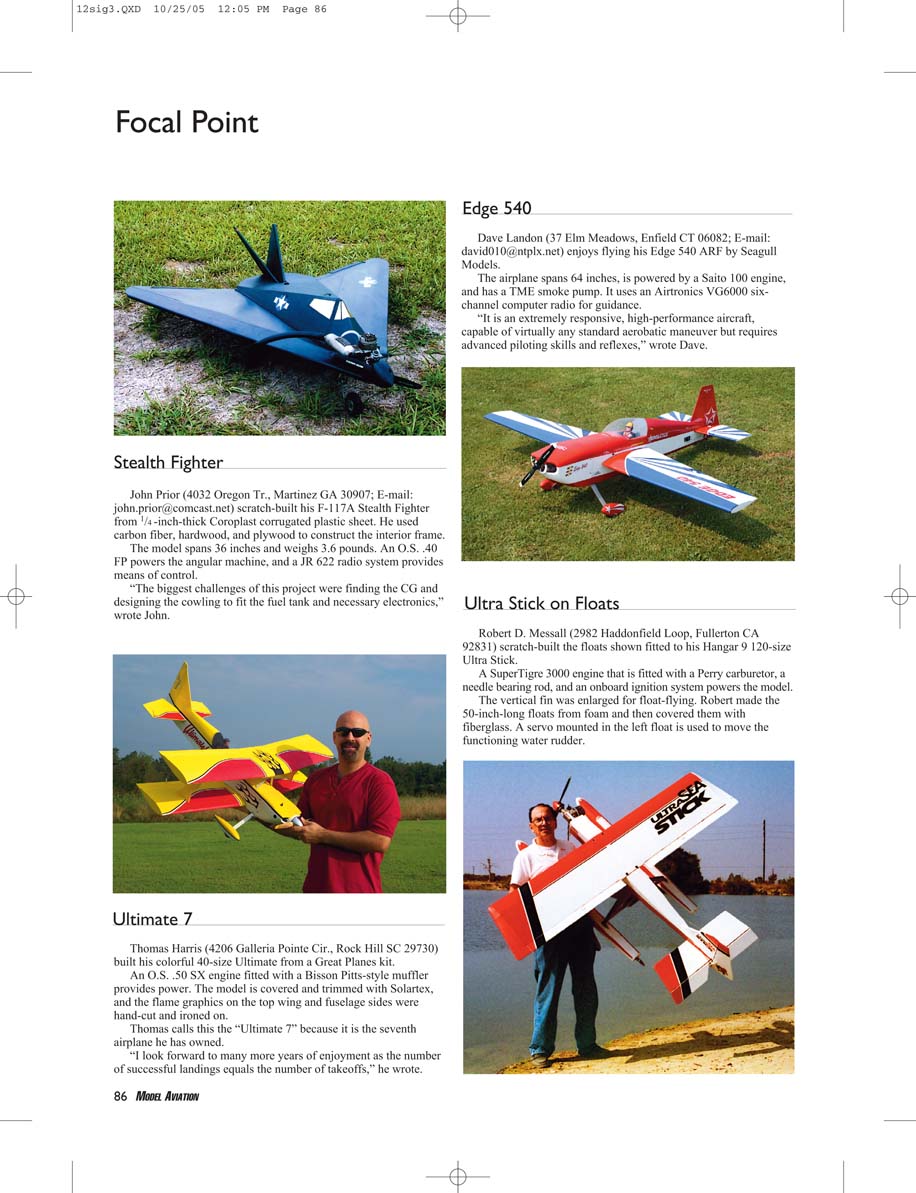
John Prior (4032 Oregon Tr., Martinez, GA 30907; E-mail: john.prior@comcast.net) scratch-built his F-117A Stealth Fighter from 1/4-inch-thick Coroplast corrugated plastic sheet. He used carbon fiber, hardwood, and plywood to construct the interior frame.
The model spans 36 inches and weighs 3.6 pounds. An O.S. .40 FP powers the angular machine, and a JR 622 radio system provides means of control.
"The biggest challenges of this project were finding the CG and designing the cowling to fit the fuel tank and necessary electronics," wrote John.
Edge 540
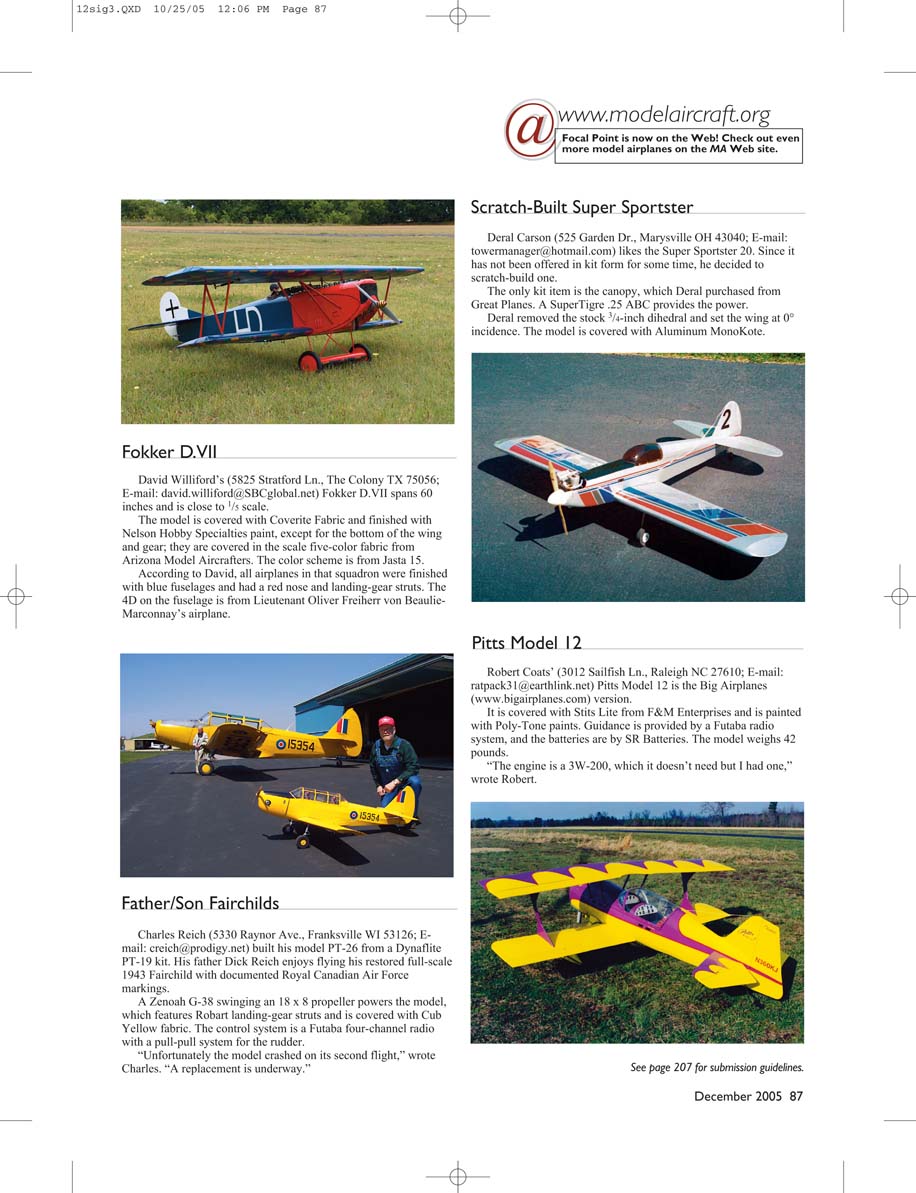
Dave Landon (37 Elm Meadows, Enfield, CT 06082; E-mail: david010@ntplx.net) enjoys flying his Edge 540 ARF by Seagull Models.
"The airplane spans 64 inches, is powered by a Saito 100 engine, and has a TME smoke pump. It uses an Airtronics VG6000 six-channel computer radio for guidance.
"It is an extremely responsive, high-performance aircraft, capable of virtually any standard aerobatic maneuver but requires advanced piloting skills and reflexes," wrote Dave.
Ultra Stick on Floats
Robert D. Messall (2982 Haddonfield Loop, Fullerton, CA 92831) scratch-built the floats shown fitted to his Hangar 9 120-size Ultra Stick.
A SuperTigre 3000 engine that is fitted with a Perry carburetor, a needle bearing rod, and an onboard ignition system powers the model.
The vertical fin was enlarged for float-flying. Robert made the 50-inch-long floats from foam and then covered them with fiberglass. A servo mounted in the left float is used to move the functioning water rudder.
Ultimate 7
Thomas Harris (4206 Galleria Pointe Cir., Rock Hill, SC 29730) built his colorful .40-size Ultimate from a Great Planes kit.
An O.S. .50 SX engine fitted with a Bisson Pitts-style muffler provides power. The model is covered and trimmed with Solartex, and the flame graphics on the top wing and fuselage sides were hand-cut and ironed on.
Thomas calls this the "Ultimate 7" because it is the seventh airplane he has owned.
"I look forward to many more years of enjoyment as the number of successful landings equals the number of takeoffs," he wrote.
Fokker D.VII
David Williford (5825 Stratford Ln., The Colony, TX 75056; E-mail: david.williford@SBCglobal.net) Fokker D.VII spans 60 inches and is close to 1/5 scale.
The model is covered with Coverite Fabric and finished with Nelson Hobby Specialties paint, except for the bottom of the wing and gear; they are covered in the scale five-color fabric from Arizona Model Aerofabrics. The color scheme is from Jasta 15.
According to David, all airplanes in that squadron were finished with blue fuselages and had a red nose and landing-gear struts. The 4D on the fuselage is from Lieutenant Oliver Freiherr von Beaulieu-Marconnay's airplane.
Scratch-Built Super Sportster
Deral Carson (525 Garden Dr., Marysville, OH 43040; E-mail: towermanager@hotmail.com) likes the Super Sportster 20. Since it has not been offered in kit form for some time, he decided to scratch-build one.
The only kit item is the canopy, which Deral purchased from Great Planes. A SuperTigre 25 ABC provides the power.
Deral removed the stock 3/4-inch dihedral and set the wing at 0° incidence. The model is covered with Aluminum MonoKote.
Pitts Model 12
Robert Coats (3012 Sailfish Ln., Raleigh, NC 27610; E-mail: ratpack31@earthlink.net) Pitts Model 12 is the Big Airplanes (www.bigairplanes.com) version.
It is covered with Stits Lite from F&M Enterprises and is painted with Poly-Tone paints. Guidance is provided by a Futaba radio system, and the batteries are by SR Batteries. The model weighs 42 pounds.
"The engine is a 3W-200, which it doesn't need but I had one," wrote Robert.
Father/Son Fairchilds
Charles Reich (5330 Raynor Ave., Franksville, WI 53126; E-mail: creich@prodigy.net) built his model PT-26 from a DynaFlite PT-19 kit. His father Dick Reich enjoys flying his restored full-scale 1943 Fairchild with documented Royal Canadian Air Force markings.
A Zenoah G-38 swinging an 18 x 8 propeller powers the model, which features Robart landing-gear struts and is covered with Cub Yellow fabric. The control system is a Futaba four-channel radio with a pull-pull system for the rudder.
"Unfortunately the model crashed on its second flight," wrote Charles. "A replacement is underway."
Transcribed from original scans by AI. Minor OCR errors may remain.

