
Focal Point
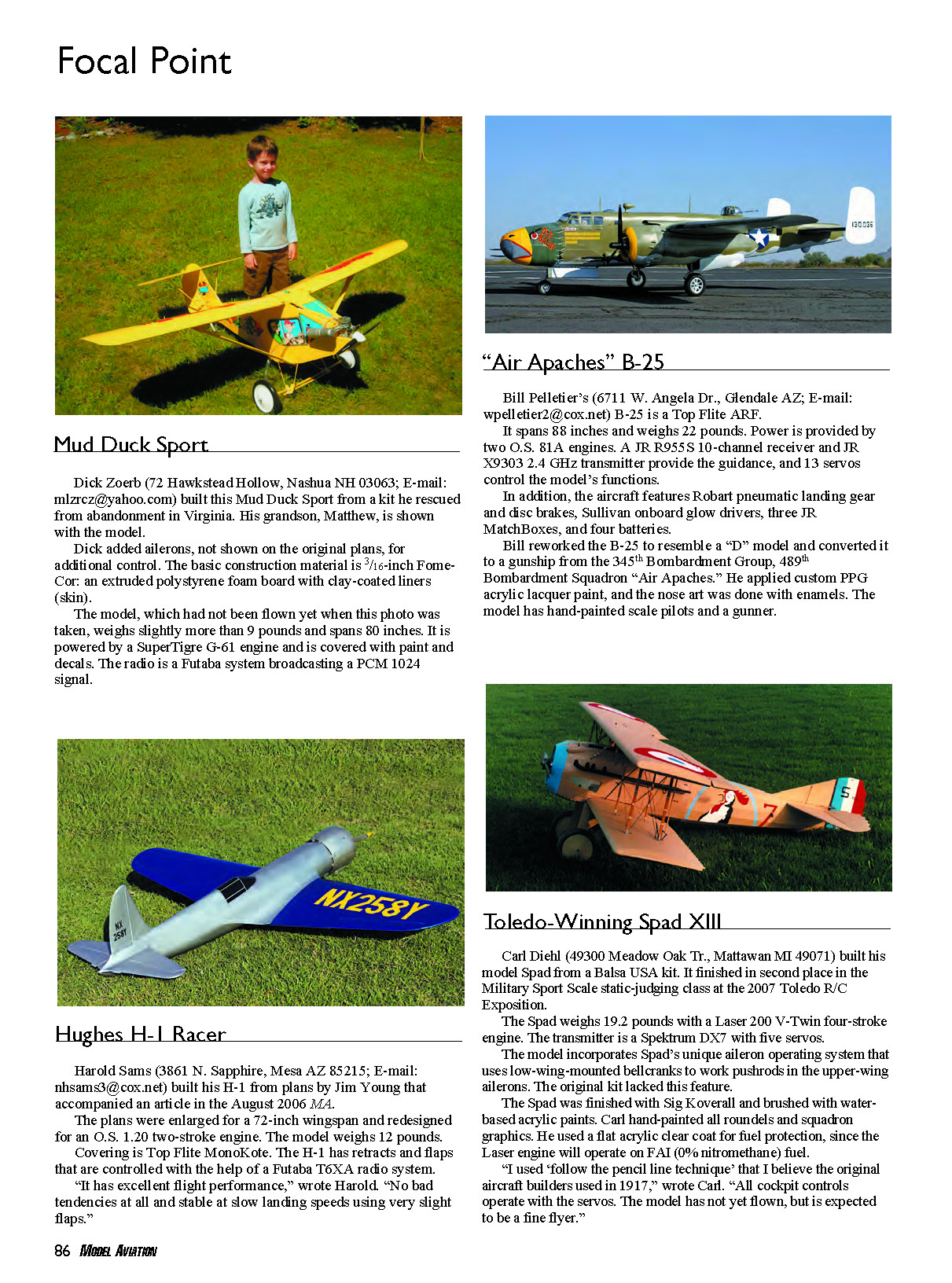
Mud Duck Sport
Dick Zoerb (72 Hawkstead Hollow, Nashua, NH 03063; E-mail: mlrzcrz@yahoo.com) built this Mud Duck Sport from a kit he rescued from abandonment in Virginia. His grandson, Matthew, is shown with the model.
Dick added ailerons, not shown on the original plans, for additional control. The basic construction material is 3/16-inch Fome-Cor: an extruded polystyrene foam board with clay-coated liners (skin).
The model, which had not been flown yet when the photo was taken, weighs slightly more than 9 pounds and spans 80 inches. It is powered by a SuperTigre G-61 engine and is covered with paint and decals. The radio is a Futaba system broadcasting a PCM 1024 signal.
Hughes H-1 Racer
Harold Sams (3861 N. Sapphire, Mesa, AZ 85215; E-mail: nhsams3@cox.net) built his H-1 from plans by Jim Young that appeared in an article in the August 2006 MA.
The plans were enlarged for a 72-inch wingspan and redesigned for an O.S. .120 two-stroke engine. The model weighs 12 pounds. Covering is Top Flite MonoKote. The H-1 has retracts and flaps that are controlled with the help of a Futaba T6XA radio system.
“It has excellent flight performance,” wrote Harold. “No bad tendencies at all and stable at slow landing speeds using very slight flaps.”
“Air Apaches” B-25
Bill Pelletier (6711 W. Angela Dr., Glendale, AZ; E-mail: wpellettier2@cox.net) built his B-25 from a Top Flite ARF.
- Wingspan: 88 inches
- Weight: 22 pounds
- Power: two O.S. 81A engines
- Radio: JR R9 55S 10-channel receiver and JR X9303 2.4 GHz transmitter
- Controls: 13 servos
Additional features include Robart pneumatic landing gear and disc brakes, Sullivan onboard glow drivers, three JR MatchBoxes, and four batteries.
Bill reworked the B-25 to resemble a “D” model and converted it to a gunship from the 345th Bombardment Group, 489th Bombardment Squadron “Air Apaches.” He applied custom PPG acrylic lacquer paint, and the nose art was done with enamels. The model has hand-painted scale pilots and a gunner.
Toledo-Winning Spad XIII
Carl Diehl (49300 Meadow Oak Tr., Mattawan, MI 49071) built his Spad from a Balsa USA kit. It finished in second place in the Military Sport Scale static-judging class at the 2007 Toledo R/C Exposition.
The Spad weighs 19.2 pounds and is powered by a Laser 200 V-Twin four-stroke engine. The transmitter is a Spektrum DX7 with five servos.
The model incorporates Spad’s unique aileron operating system that uses low-wing-mounted bellcranks to work pushrods in the upper-wing ailerons; the original kit lacked this feature.
The Spad was finished with Sig Koverall and brushed with water-based acrylic paints. Carl hand-painted all roundels and squadron graphics. He used a flat acrylic clear coat for fuel protection, since the Laser engine will operate on FAI (0% nitromethane) fuel.
“I used the ‘follow the pencil line technique’ that I believe the original aircraft builders used in 1917,” wrote Carl. “All cockpit controls operate with the servos. The model has not yet flown, but is expected to be a fine flyer.”
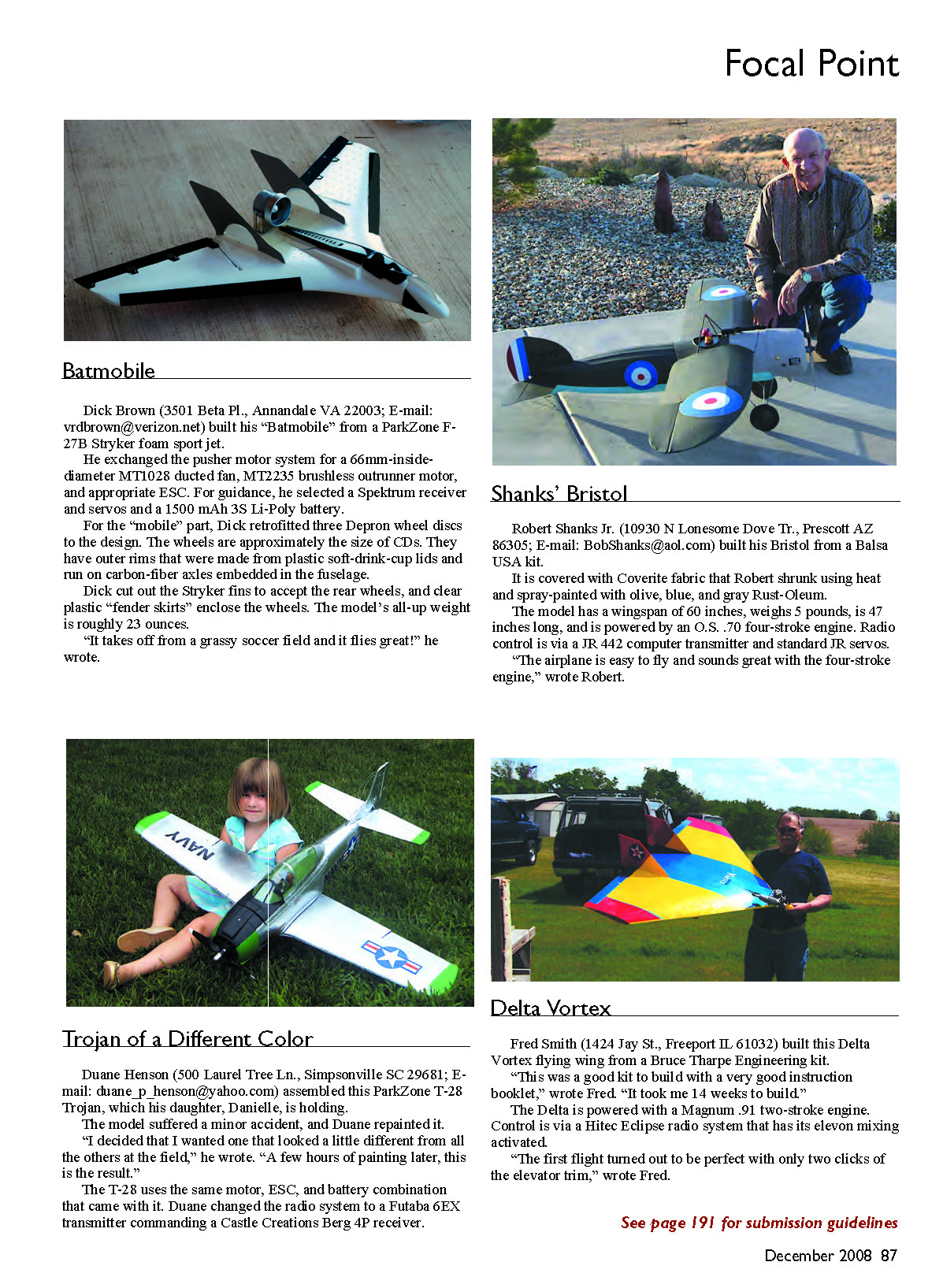
Batmobile
Dick Brown (3501 Beta Pl., Annandale, VA 22003; E-mail: vrdbrown@verizon.net) built his “Batmobile” from a ParkZone F-27B Stryker foam sport jet.
He exchanged the pusher motor system for a 66mm-inside-diameter MT1028 ducted fan, an MT2235 brushless outrunner motor, and an appropriate ESC. For guidance, he selected a Spektrum receiver and servos and a 1500 mAh 3S Li-Poly battery.
For the “mobile” part, Dick retrofitted three Depron wheel discs to the design. The wheels are approximately the size of CDs. They have outer rims made from plastic soft-drink-cup lids and run on carbon-fiber axles embedded in the fuselage.
Dick cut out the Stryker fins to accept the rear wheels, and clear plastic “fender skirts” enclose the wheels. The model’s all-up weight is roughly 23 ounces.
“It takes off from a grassy soccer field and it flies great!” he wrote.
Shanks’ Bristol
Robert Shanks Jr. (10930 N Lonesome Dove Tr., Prescott, AZ 86305; E-mail: BobShanks@aol.com) built his Bristol from a Balsa USA kit.
It is covered with Coverite fabric that Robert shrunk using heat and then spray-painted with olive, blue, and gray Rust-Oleum.
The model has a wingspan of 60 inches, weighs 5 pounds, is 47 inches long, and is powered by an O.S. .70 four-stroke engine. Radio control is via a JR 442 computer transmitter and standard JR servos.
“The airplane is easy to fly and sounds great with the four-stroke engine,” wrote Robert.
Trojan of a Different Color
Duane Henson (500 Laurel Tree Ln., Simpsonville, SC 29681; E-mail: duane_p_henson@yahoo.com) assembled this ParkZone T-28 Trojan, which his daughter, Danielle, is holding.
The model suffered a minor accident, and Duane repainted it. “I decided that I wanted one that looked a little different from all the others at the field,” he wrote. “A few hours of painting later, this is the result.”
The T-28 uses the same motor, ESC, and battery combination that came with it. Duane changed the radio system to a Futaba 6EX transmitter commanding a Castle Creations Berg 4P receiver.
Delta Vortex
Fred Smith (1424 Jay St., Freeport, IL 61032) built this Delta Vortex flying wing from a Bruce Tharpe Engineering kit.
“This was a good kit to build with a very good instruction booklet,” wrote Fred. “It took me 14 weeks to build.”
The Delta is powered with a Magnum .91 two-stroke engine. Control is via a Hitec Eclipse radio system that has its elevon mixing activated.
“The first flight turned out to be perfect with only two clicks of the elevator trim,” wrote Fred.
Transcribed from original scans by AI. Minor OCR errors may remain.

