
The Engine Shop
Joe Wagner | vecojoe@juno.com
Which propeller and how much rpm develops the most horsepower?
After answering several readers' requests for further information about topics I’ve mentioned in earlier columns, I saw a need for updated and amplified coverage of those subjects. One of those is the too-common tendency for RC fliers to install rather small, high-revving propellers on their engines.
This probably results from the old maxim “Glow engines are happier at high rpm.” Then there’s also the well-meaning advice “Choose a propeller for flying that lets your engine run at the speed where it develops its highest horsepower.”
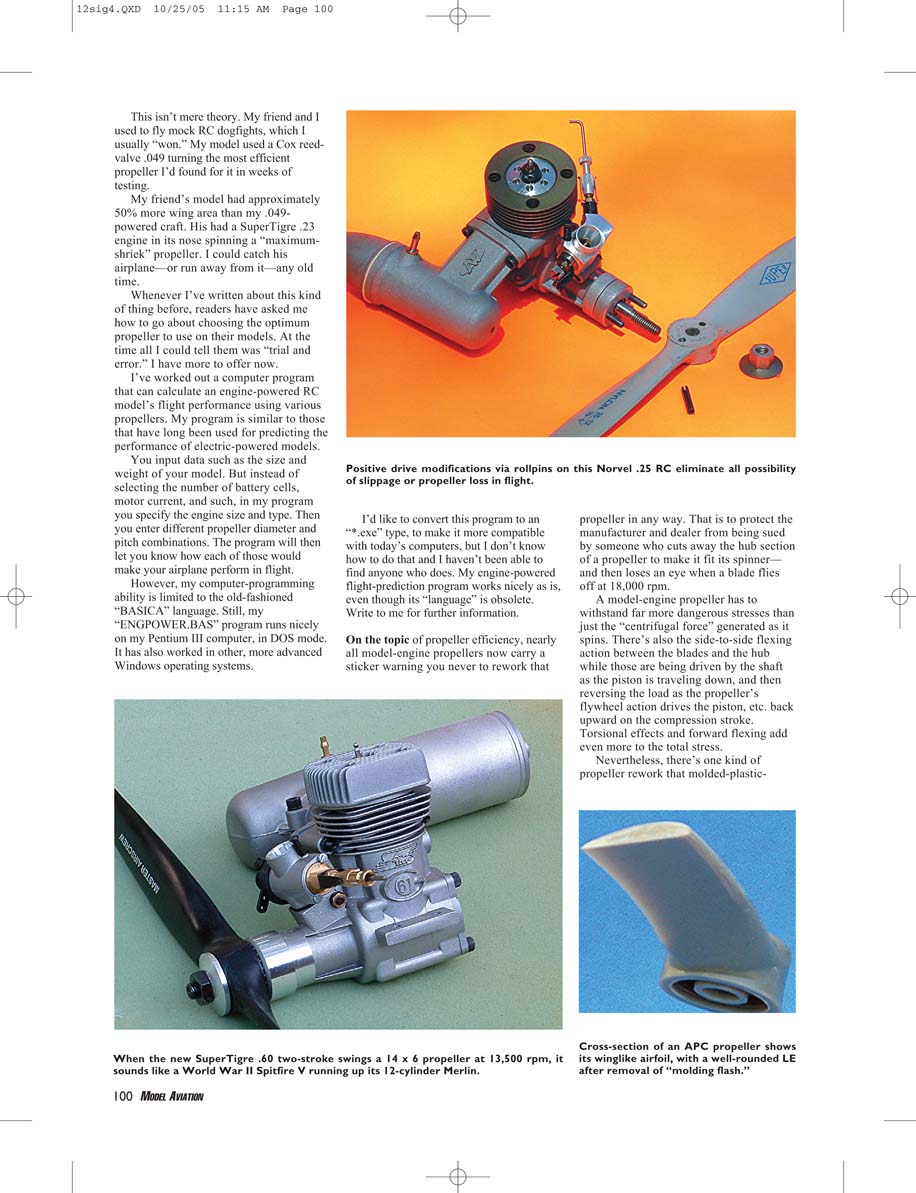
Both of those notions are outdated. Yes, decades ago model engines did function more reliably when running fast. That was partly because early glow plugs were mostly “hot” types and partly because nearly all model engines of that time had short intakes.
The faster those engines turned, the higher their fuel suction was. Also, at high rpm their “air-breathing” ability benefited from maximizing inlet airflow volume and velocity.
But now almost all RC fliers use pumps or muffler pressure for dependably delivering fuel to their engines at any speed. And the length of the intake passages in modern RC carburetor assemblies provides ample “air momentum” to minimize pulsation effects.
Flying with a propeller that lets the engine turn at its maximum power rpm sounds logical, but that idea is based on the premise that all propellers are equally efficient. And that’s far from true.
Consider this: you could put a piece of a yardstick with a hole in its center onto your engine’s shaft—one with a length that lets the motor run at the maximum horsepower rpm. But it wouldn’t fly your model!
Most propellers we use on our RC and CL models work more efficiently at lower revolutions. That’s why you can often get the best performance from your RC model by installing a larger, slower-turning propeller. Total propulsive efficiency is what pulls your airplane through the air—not merely the engine’s “brake horsepower” (bhp).
It’s better to use a propeller that is 68% efficient, turning at a speed where the engine develops .92 bhp, than using a propeller that is only 41% efficient but lets the engine turn fast enough to put out 1.33 bhp. (The first combination gives you .625 net hp to haul your model through the sky; the second provides only .545 net hp.)
Also included in this column:
- Recommended propeller rework
- Rollpin positive drive explained
- Searching for a realistic engine sound
The Engine Shop
Joe Wagner
This isn't mere theory. My friend and I used to fly mock RC dogfights, which I usually "won." My model used a Cox reed-valve .049 turning the most efficient propeller I'd found for it in weeks of testing.
My friend's model had approximately 50% more wing area than my .049-powered craft. His had a SuperTigre .23 engine in its nose spinning a "maximum-shriek" propeller. I could catch his airplane—or run away from it—any old time.
Whenever I've written about this kind of thing before, readers have asked me how to go about choosing the optimum propeller to use on their models. At the time all I could tell them was "trial and error." I have more to offer now.
I've worked out a computer program that can calculate an engine-powered RC model's flight performance using various propellers. My program is similar to those that have long been used for predicting the performance of electric-powered models.
You input data such as the size and weight of your model. But instead of selecting the number of battery cells, motor current, and such, in my program you specify the engine size and type. Then you enter different propeller diameter and pitch combinations. The program will then let you know how each of those would make your airplane perform in flight.
However, my computer-programming ability is limited to the old-fashioned "BASICA" language. Still, my "ENGPOWER.BAS" program runs nicely on my Pentium III computer, in DOS mode. It has also worked in other, more advanced Windows operating systems.
I'd like to convert this program to an ".exe" type, to make it more compatible with today's computers, but I don't know how to do that and I haven't been able to find anyone who does. My engine-powered flight-prediction program works nicely as is, even though its "language" is obsolete. Write to me for further information.
On the topic of propeller efficiency, nearly all model-engine propellers now carry a sticker warning you never to rework that propeller in any way. That is to protect the manufacturer and dealer from being sued by someone who cuts away the hub section of a propeller to make it fit its spinner—and then loses an eye when a blade flies off at 18,000 rpm.
A model-engine propeller has to withstand far more dangerous stresses than just the "centrifugal force" generated as it spins. There's also the side-to-side flexing action between the blades and the hub while those are being driven by the shaft as the piston is traveling down, and then reversing the load as the propeller's flywheel action drives the piston, etc.) back upward on the compression stroke.
Torsional effects and forward flexing add even more to the total stress.
Nevertheless, there's one kind of propeller rework that molded-plastic-propeller makers do recommend: rounding off the sharp LE of the blades. Doing that makes the propeller slightly less hazardous as a "cutting instrument," but at the same time it improves the propeller's all-round efficiency.
That's because propellers are rotating airfoils (not "airscrews"). And the sharper the airfoil's LE, the smaller the angle of attack at which it stalls. Competition FF and CL Speed models mainly fly at maximum speed. Their propellers—if optimally chosen—do most of their work at a constant angle of attack. Sharp propeller LEs work all right on those kinds of airplanes.
But RC aircraft (and CL Precision Aerobatics and Combat models) fly at a wide range of speeds. Their propellers need to work well at a variety of attack angles as their models' velocities change. And to maximize propellers' overall efficiency under varying conditions, a well-rounded blade LE helps significantly.
I've learned that the best method to remove "molding flash" and to radius plastic propellers' LEs isn't by scraping with a sharp knife, but by draw-filing in a tip-to-tip direction with a fine-tooth file. ("Draw-filing" means to move the file sideways across the surface to be smoothed instead of using the conventional fore-and-aft filing motion.)
Another "prop topic" I want to cover is the "rollpin positive drive" rework I wrote about in an earlier column. That was directed toward four-stroke engines—those being more likely to lose their propellers in flight than two-strokers. But propeller slippage and loosening can occur on all kinds of piston-type model engines, even CO2s.
That's why I think it's a good idea to modify two-stroke engines too by adding "rollpin drivers"—especially the larger-size power plants. I recommend rollpins (sometimes called "spring pins") rather than screws because their smooth, hardened-steel surfaces are far less likely to fracture. And because rollpins are springy, they adapt to slight misalignment.
For my earlier rollpin drive modifications to four-stroke engines I made a precision drill guide to ensure proper alignment between the holes I added to the propeller and its driver. I used four equally spaced pins too.
Since then I've decided that two rollpins are enough and that the propeller hub itself can be used as a guide for drilling the driver holes. (If the propeller is broken later, its hub can still serve as a drilling guide for other propellers.)
One more pertinent point is that rollpins alone probably shouldn't be used for "positive drive" in a wooden propeller. I don't fly with wooden propellers much anymore, but if I did need positive drive on a big one I'd modify its hub first.
I'd sand front and rear hub surfaces flat and parallel, and then I'd use Gorilla Glue to adhere an approximately .080-thick 7075-T3 aluminum disk onto the front and rear. Then I'd install the rollpins—long ones to pass all the way through both metal hub disks and roughly 1/4 inch into holes in the engine's propeller driver. I'd still check my propeller nut's tightness before each flight.
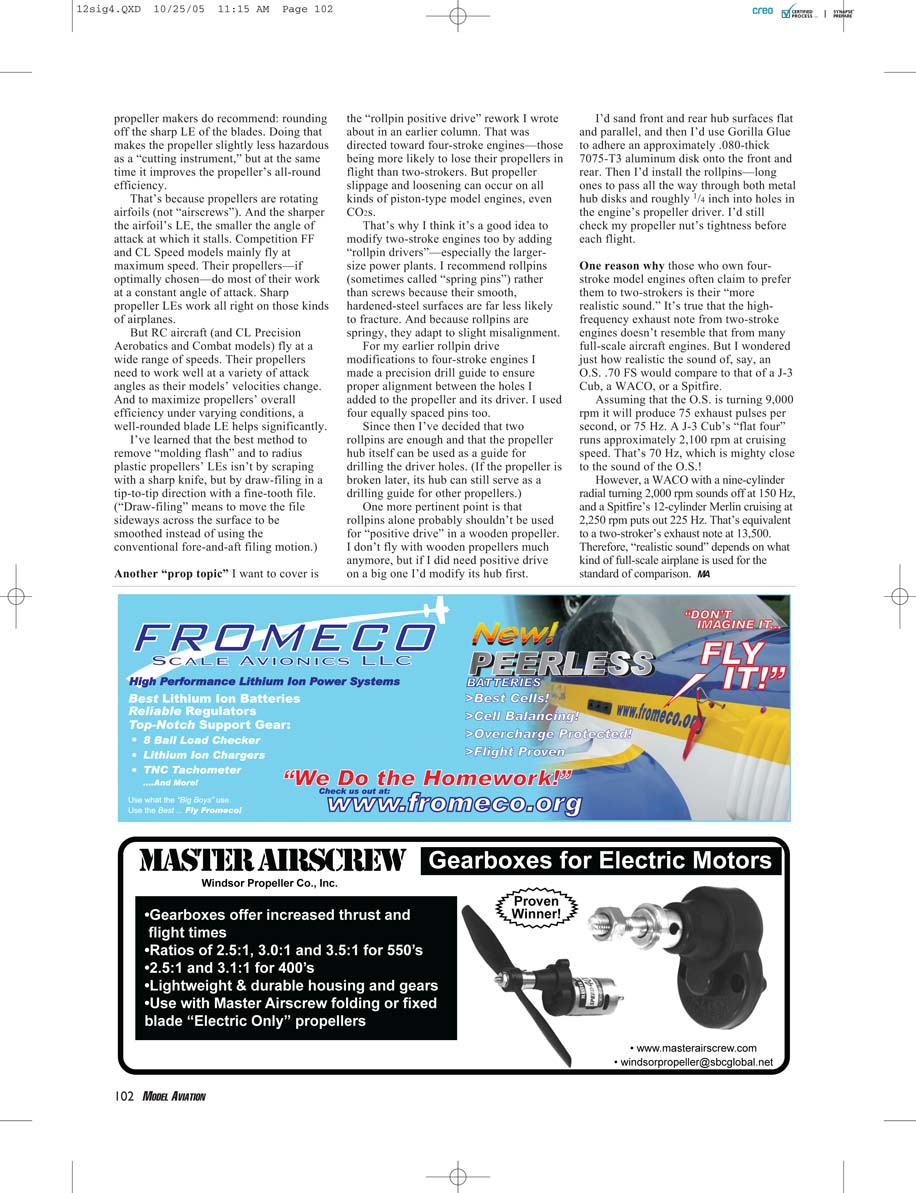
One reason why those who own four-stroke model engines often claim to prefer them to two-strokers is their "more realistic sound." It's true that the higher-frequency exhaust note from two-stroke engines doesn't resemble that from many full-scale aircraft engines. But I wondered just how realistic the sound, say, an O.S. .70 FS would compare to, let us say, a WACO, or a Spitfire.
Assuming that the O.S. is turning 9,000 rpm it will produce 75 exhaust pulses per second, or 75 Hz. A J-3 Cub's "flat four" runs approximately 2,100 rpm at cruising speed. That's 70 Hz, which is mighty close to the sound of the O.S.!
However, a WACO with a nine-cylinder radial turning 2,000 rpm sounds off at 150 Hz, and a Spitfire's 12-cylinder Merlin cruising at 2,250 rpm puts out 225 Hz. That's equivalent to a two-stroker's exhaust note at 13,500. Therefore, "realistic sound" depends on what kind of full-scale airplane is used for the standard of comparison. JW
Transcribed from original scans by AI. Minor OCR errors may remain.

