


The Engine Shop
Joe Wagner
212 S. Pine Ave., Ozark AL 36360
RECENT LETTERS and E-mails from readers with model-engine problems—plus some experiences of my own—opened my eyes to an aspect of operating glow engines that I hadn’t given much thought to before. That is that they usually provide amazing dependability and versatility in spite of the fact that they shouldn’t.
Think about it. Other types of internal-combustion engines employ “timed ignition” of one sort or another to control the instant when their fuel-air mixture fires. Engines with spark plugs have ways of altering the timing of their sparks for efficient running with different-sized propellers and at varying speeds. Model diesels use adjustable compression for the same purpose.
But a glow engine’s operation depends entirely on the behavior of a minuscule coil of heated wire within its combustion chamber. It is expected to fire the fuel-air charge in the chamber, at the proper time, again and again and again, thousands of times per minute, at speeds from slow idling to top rpm.
We change propellers, use different fuels, and fly in a wide range of climatic conditions. Yet we’ve come to expect reliable performance regardless. It’s astonishing that glow engines work as well as they do! Of course, sometimes they don’t . . .
When model-engine glow plugs first came out almost 60 years ago, their development had been based on small-sized engines. Early glow plugs worked fine in those. But except for a few CL Racing engines (e.g., the Hornet and McCoy .60s), engines larger than roughly .29 cubic inch didn’t function well with glow ignition. Some wouldn’t run at all.
Improvements in fuels, engines, and the plugs themselves have made a big difference since then. Even so, there are now many variables in model-engine operation to make a “one-size-fits-all” glow plug possible. I relearned that lesson recently.
While restoring a few old-time 1/2A engines for friends to use in an upcoming all-Dakota FF event at this year’s Nats, I discovered that every one of those little power plants needed to have precisely the right plug installed to run well. I had to try three or four different makes and heat-range plugs in each engine before I found the one particular type that would get it to start quickly and run reliably.
Evidently the same procedure is needed at times for larger glow engines. Most of us realize that four-stroke power plants require a special kind of plug—one that retains its heat between the every-other-time firing strokes—but many don’t appreciate the fact that two-stroke engines can vary considerably in their plug requirements.
Small variations can make big differences. For instance, Fox once manufactured a racing engine that used two glow plugs. It would start and run well with one of the plugs energized. However, heating both plugs with the starting battery made roughly 2,500 rpm difference in the top speed—even after the battery was disconnected!
Several types of glow plugs are available. One variation is the long- and short-reach style, but those "standard sizes" themselves can vary somewhat. A short Fireball plug may differ as much as a full millimeter in threaded length from a bargain-price, no-name, short-reach plug from a mail-order hobby dealer.
And that variation can affect the compression ratio of the combustion chamber more than you might think.
Heat range is another important variable. In general, the smaller the engine, the hotter the plug it needs. (That was why early glow plugs didn't work in large engines; they were way too hot and caused preignition.) Also, the more nitromethane there is in the fuel, the colder the plug should be. Cold-weather operation usually calls for a hotter plug. Bigger propellers need colder plugs.
(Rossi provides model-engine glow plugs in the widest heat range spectrum I know of. Its "standard" plugs are available in eight ratings, from the "extra-hot" R-1 to the "super-cold" R-8. Rossi also makes "RC" plugs in hot and cold versions. The US-made Fireball glow plugs come in at least four types: Hot, Medium, Cool, and Super Cool. O.S. supplies "P-series" plugs in heat ranges from the "super hot" P-3 to the "cold" P-8.)
Different heat-rated glow plugs affect engine operation by igniting the fuel-air mixture earlier or later in the stroke. This does the same thing as advancing or retarding the spark in ignition engines. It can also affect power output considerably. Years ago Bill Cannon (the micro-RC-system pioneer) manufactured replacement heads for Cox engines that allowed the use of standard glow plugs in those.
I found that with the same propeller and fuel, changing from a "standard" heat plug to a "hot" one made roughly 3,000 rpm difference in top rpm on a Black Widow .049. The engine started easily with either plug and ran reliably, but what a difference in performance that plug change made!
Glow-plug selection for larger RC engines has to be a compromise. The plug must provide reliable ignition throughout a wide range of speeds. That's not easy! An RC .45 runs far cooler at 2,500 rpm than it does at 14,000 rpm.
Yet in making an "emergency go-around" from a bad landing situation, when a pilot slams his throttle stick full forward, he or she expects the engine to respond with an instant surge. Flameouts are not an option.
The fuel in use has a considerable effect too. Three widely separated readers wrote to me about poor idling problems with fuel that they believe had accumulated water. This input resulted from my mention in an earlier column of adding 20% water to 15%-nitromethane glow fuel and successfully running one of my CL Stunt engines on that—even gaining a bit of rpm as a result.
As I wrote in that column, I did have to readjust the needle and keep the glow plug lit longer than usual to achieve those results. Also, the Johnson .29 I used in my test is an unthrottled, open-exhaust engine that is noted for its "friendliness" and adaptability.
Evidently the RC engines that Jerry, Ken, and Tom reported difficulties with were more sensitive—because the amount of water contamination in the glow fuel in question couldn't have even approached the 20% that I purposely added to my Johnson's fuel.
(Society of Antique Modelers [SAM] columnist Bob Angel in northern California corroborated my results with tests on 1/2A FF engines. He ran those on glow fuel with as much as 15% water added before noticing any detrimental effects.)
To fully investigate the possible extent of glow fuel absorbing moisture from the air, I checked the properties of humid air in scientific reference books. From that data I calculated the maximum amount of water that atmospheric air can contain at 100% relative humidity. (By the way, 100% humidity does not mean solid water. It only means that the air can't hold anymore moisture.)
I won't detail the calculations here, but I did find that the greatest amount of water contained in a layer of air in contact with the fuel surface in a gallon can is a mere 0.00015 fluid ounce! And even if the jug is only one-third full, and the rest of its internal volume contains air at 90 degrees Fahrenheit and 100% relative humidity, that's still less than 0.004 fluid ounce of water—not even close to a hundredth of 1% of the fuel volume.
The only conclusion I can reach about all this is that it seems more likely that marginal glow-plug performance is affecting the RC engines that Jerry, Tom, and Ken wrote to me about. Either that or the idling problems they described could be overcome by adjusting the carburetor needles.
Also, glow plugs don't last forever. Even if one still glows brightly, its element could be coated with a glassy surface film from silicone contamination of the fuel. (Some fliers routinely add a dash of Armor All or the like to their fuel as antifoaming protection.) Other additives, such as dye, can also affect the catalytic ability of glow plugs' platinum alloy elements.
As I wrote at the beginning of this column, it's surprising that glow-plug model engines work as well as they do. To be certain that your power plants perform their best, make sure you use the optimum type of plug in each of them.
How can you do that? Trial and error is the only way I know! There are just too many variables involved: fuel, engine type, compression ratio, atmospheric conditions, propeller size, and even the type of model and the way you prefer to fly it.
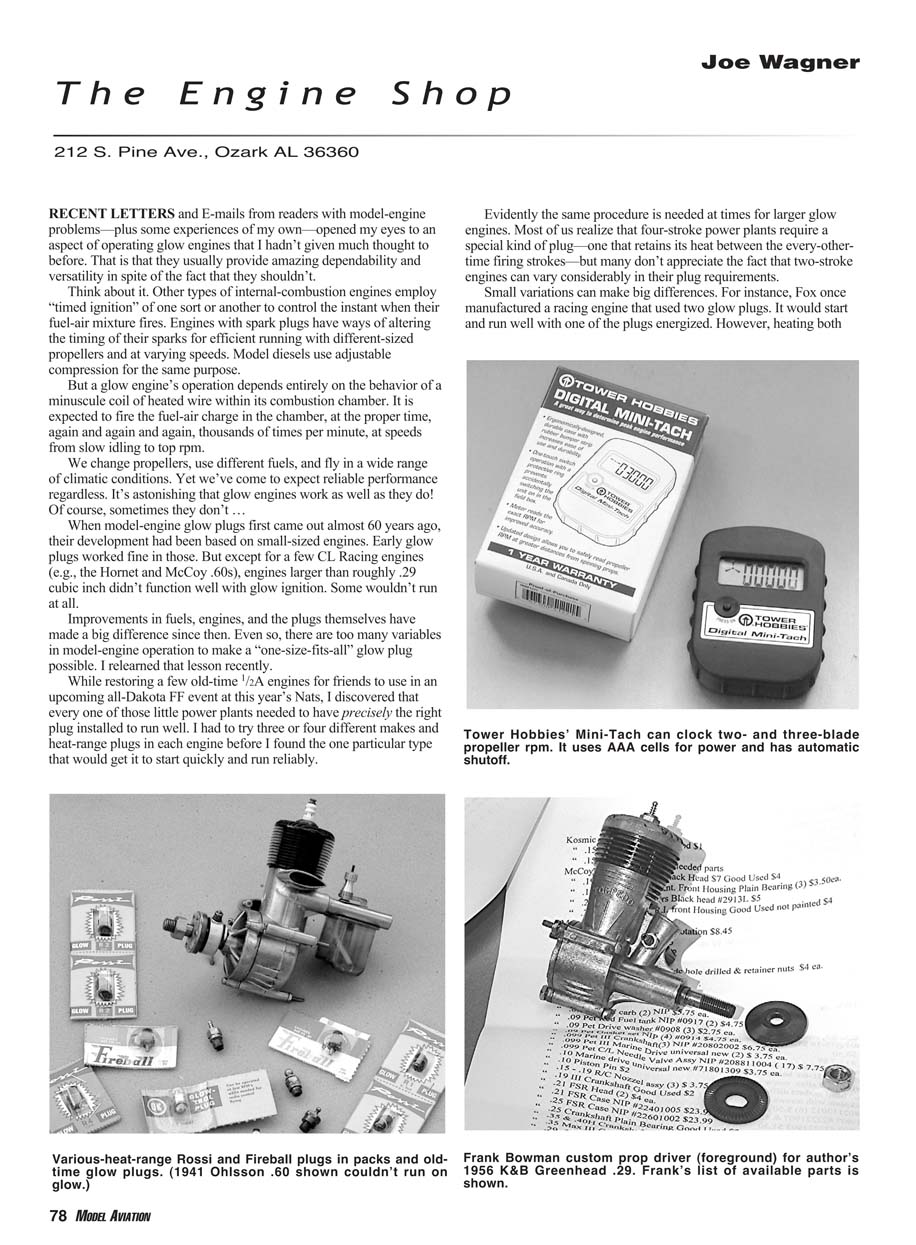
An essential instrument for testing and adjusting model-airplane engines is an optical tachometer. Good ones have been costly until recently, but Tower Hobbies recently introduced a digital LCD Mini-Tachometer for less than $20.
I bought one to see how it stacked up against my more expensive unit. I was pleasantly surprised to see that the Mini-Tach worked just as well. It's even better because it uses low-cost AAA batteries and has an automatic shutoff to conserve those, in case of "user absentmindedness."
I encountered a mystery while testing my new Mini-Tach. It worked fine when checking rpm from in front of the propeller, but it worked erratically from behind the propeller. I tried it both ways several times, with the same result.
I repeated the tests with my expensive digital tachometer, and the same thing happened with that! I'd get accurate rpm measurements from the front side of the propeller, but from the back my rpm readings jumped up and down inconsistently.
Later I figured out the reason. The rear faces of my propeller blades were flat, shiny, and reflective. And the tachometer reads optical signals. From the front, the rotating blades merely interrupt the light shining through the propeller disk, and the tachometer circuitry counts how often that happens. But from the rear, the light reflected from those shiny blade faces produced extra pulses that confused the units.
The cure was simple: I painted two small radial stripes on the rear face of one propeller blade with black paint. That provided a nonreflective target to interrupt the light reliably, and both tachometers read the same rpm from either side of the propeller after that.
If you intend to use optical tachometers, be aware of this potential problem. It can save you a lot of head-scratching.
That's it for now—see you next month.
Joe Wagner
The Engine Shop
Joe Wagner
It seems that many model fliers continue to use old engines. For SAM events and Old Time Stunt, that's often a requirement. But Foxes, K&Bs, and Vecos from more than 30 years ago can still run as well as they ever did—as long as missing or broken parts can be provided when needed.
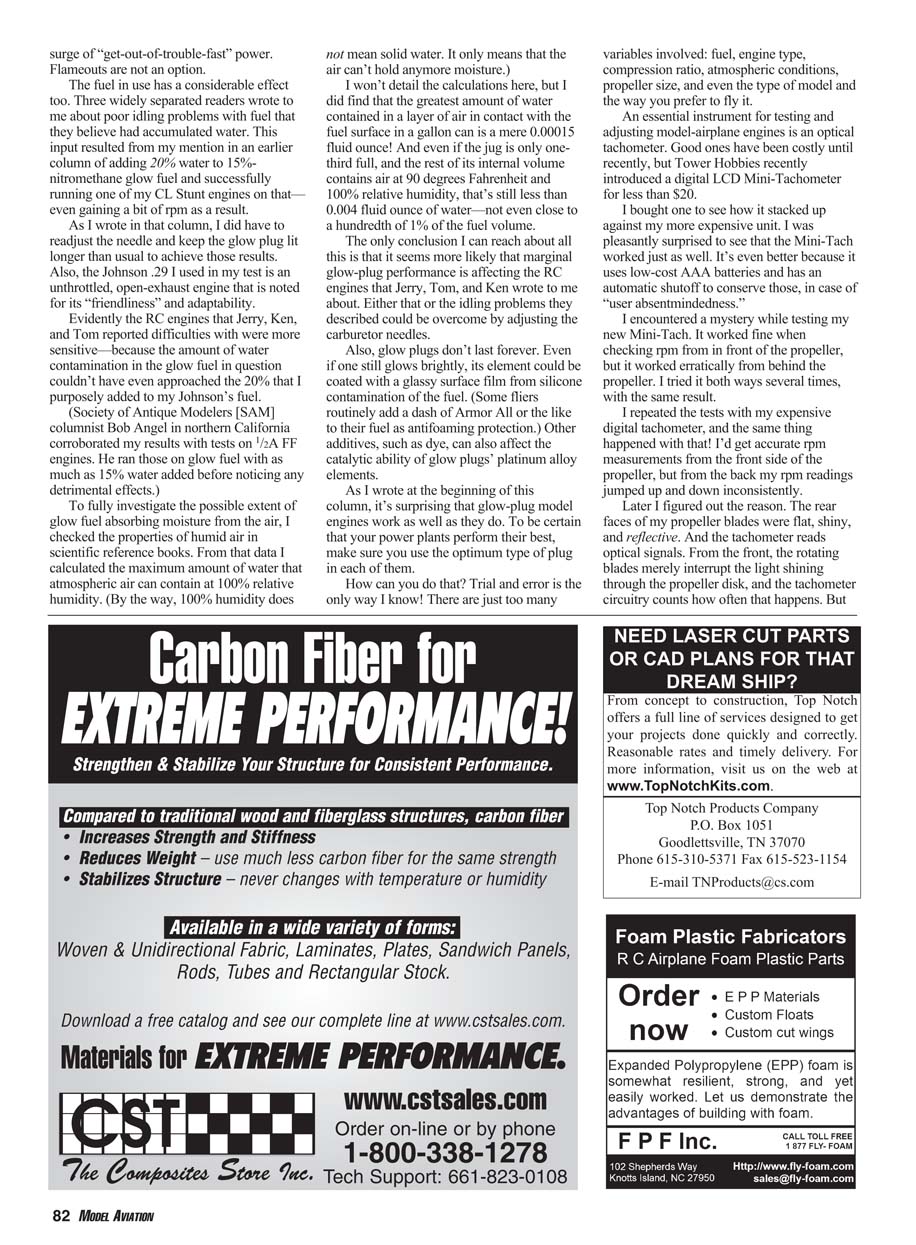
Frank Bowman (1211 N. Allen Ave., Farmington NM 87401; E-mail: frankbowman@mylifeline.net) can supply many parts for older engines. Some are original factory-manufactured components, and others are those that Frank makes as needed. He can also supply custom-machined piston rings for almost any model engine, old or new.
I recently asked Frank if he had a prop driver for a K&B Greenhead .29 that I'd acquired awhile back. He didn't, but he made me an exact duplicate of the part—with a "D"-shaped center hole, a knurled face, and even the parkerized black finish that the original K&B part had. Contact Frank for your old-engine-part needs.
Richard Linthicum (rlinthicum@charter.net) also caters to those who use old engines. His specialty is custom-machining "tongue-type" mufflers. He makes these from magnesium bar stock, one at a time to fit a specific engine. His prices vary according to the complexity of the work required, but they're quite reasonable.
Late last year Richard made a muffler for my early-model Fox .29. Since that engine lacks any provision for mounting a muffler, I had to make a retaining strap (from K&S brass sheet) to attach the Linthicum unit to my old Fox. That was easy enough; making the actual muffler would have been far more difficult. For me, that is—not for Richard Linthicum.
I'll pass along one more tip before signing off. I've found that half-gallon grapefruit-juice jugs make ideal glow-fuel containers. They're lighter and less bulky than the stock gallon jugs or cans, and their caps are far easier for me to open and close than the "child-proof" sort. Yet they seal just as well.
MA
Transcribed from original scans by AI. Minor OCR errors may remain.

