


Control Line Combat - 2010/01
The 2009 United States F2D Team Trials
Thirty-seven pilots from across the US made the trip to Detroit, Michigan, for the 2009 Labor Day weekend (September 5–6) to do battle with F2D—FAI CL Combat—models for the honor and responsibility of representing the US at the 2010 Control Line World Championships.
The F2D Team Selection Committee (TSC) is composed of one representative from each of the 11 AMA districts, and it is charged with putting together the program by which the three-member team, along with a Junior member, is chosen. The TSC adopts the Official United States F2D FAI Combat Team Selection Program every two odd-numbered years. This document is currently nine pages long and is broken down into seven sections: Format, Rules, Budget, Schedule (Guidelines), Current Planning, Additional Duties, and Junior Award. At some point during the two-year cycle, bids to host the Team Selection Contest are requested and then the TSC votes.
The Strathmoor Model Airplane Club of Detroit was awarded the honor of hosting the 2009 Team Trials. Mark Warwashana ran the Friday-night pilots’ meeting and the contest’s daily operations. Ron Colombo, who is retired, spent a great deal of time preparing the field and helped install a permanent concrete center circle of the required F2D dimensions.
With so many pilots entered and the contest being a triple-elimination format, there were many matches to be flown in two days. Fortunately, Mother Nature cooperated with beautiful weather; otherwise completing the competition would have been an ordeal.
The River Rouge facility has unique attributes that can be tricky for pilots. The flying area sits in a valley, with nearby hills and a tall set of trees next to one side of the competition circle. Models are momentarily visually “lost” when flown in this area—a distinct advantage for those who have grown up flying at this site. Wind is unpredictable because it comes off the nearby hills or the trees. The bottom line is that everyone had to fly in the same conditions.
The site’s downsides include a lack of practice fields; many pilots like to make a test flight or two while waiting between matches to trim and adjust models. A good public-address system would have helped move the contest along and given pilots a heads-up when their matches were coming up. The officials’ tent was located at one end of the pit area, and because of space restrictions some pilots had to set up some 75 yards away. A knowledgeable announcer would have made the competition more enjoyable for spectators. Perhaps future Team Trials will reach the point where each score is announced after each match.
Thanks to all of the judges for doing their best during the two long days of flying, and to circle marshals Jordy Segal and Steve Kott. Paul Smith spent two days inspecting models to ensure that venturi openings were no larger than the 4 mm specified by the rules.
Equipment at the Team Trials
Most of the models used were Ukrainian or Russian purchased units. Three or four pilots flew homemade foam designs, though none of the foam-model pilots made it to the final rounds.
Notable equipment and pilots:
- Pete Athans: great-flying airplanes powered by Cyclon PC8 and PC9 engines.
- Phil Cartier: own design powered by the Cyclon Top Combat engine.
- Bobby and Andy Mears: Cyclon PC7s, well sorted out and exhibiting good power.
- Andy and Cary Minor: Profi engines.
- Andrew Nadien, Alexsey Voyenkov, Greg Hill, Chuck Rudner: used AKM power plants at various times.
- Ron Colombo, Ed Brzys, Mike Evans: flew older Profi “Billy Goat” engines; Ron enjoys reworking engines to get extra performance.
- Most other pilots used FORA engines; the author may have been the only flier using a ZALP in conjunction with FORAs.
Having the right propellers for the conditions and setting head clearance properly can make a big difference. The only way to find out what works is to experiment.
All sorts of fuel-shutoff devices were used, and most seemed to work well. I saw only Justin Ehlen's model fly off into the trees under full power with no sign of the shutoff working. Some pilots experienced premature shutdowns during launch; others had devices that shut down when the model went slack on the lines. Mike Willcox and a couple of other pilots used Alex Prokofiev's electronic shutoff units.
Flying at the Team Trials
Probably 50% of the pilots entered were capable of making the team with a bit of luck. Many matches were contested between very good pilots.
- First alternate: Mark Rudner — one win away from the team; flew well throughout the contest but a mental mistake at the end cost him the spot.
- Second alternate: Richard Stubblefield — still flying impressively in his mid-60s.
- Four pilots tied for the third alternate spot with identical 5–3 records: George Cleveland, Tom Seigler, James McKinney, and the author.
Mike "Emo" Willcox made the team again with the best record: nine wins and one loss. Mike puts a lot of effort into F2D, including several trips to competitions in Europe each year. He is comfortable in the circle and quick to take advantage of opponent mistakes—a former World Champion who shows it.
Norman Lester Haury (often called Lester) has been paying his dues for several years and it finally paid off. He went undefeated for most of the contest and finished with eight wins and one loss. Lester is a keen student of the rules and F2D strategy; he will make a fine representative at the 2010 World Championships.
Greg Hill has been knocking at the door for many years and finally pried it open to take a spot on the team, finishing with eight wins and two losses. Greg has natural ability and practices regularly at the sod farm in San Diego with Frank Tomich, Sean Dea, Darrin Albert, Charlie Johnson, Roger Ochoa, Stewart Mossman, and others.
The Stubblefield/Cleveland team suffered a couple of brain failures that cost them matches: one instance involved the wrong pilot entering the circle to fly a match, and another involved an early launch before the start of a bout.
Darryl Ellison attended to help his sons, Josh and Derek, gain valuable experience in their first Team Trials. For the second cycle in a row, the US will not be sending a Junior pilot to the World Championships because none entered.
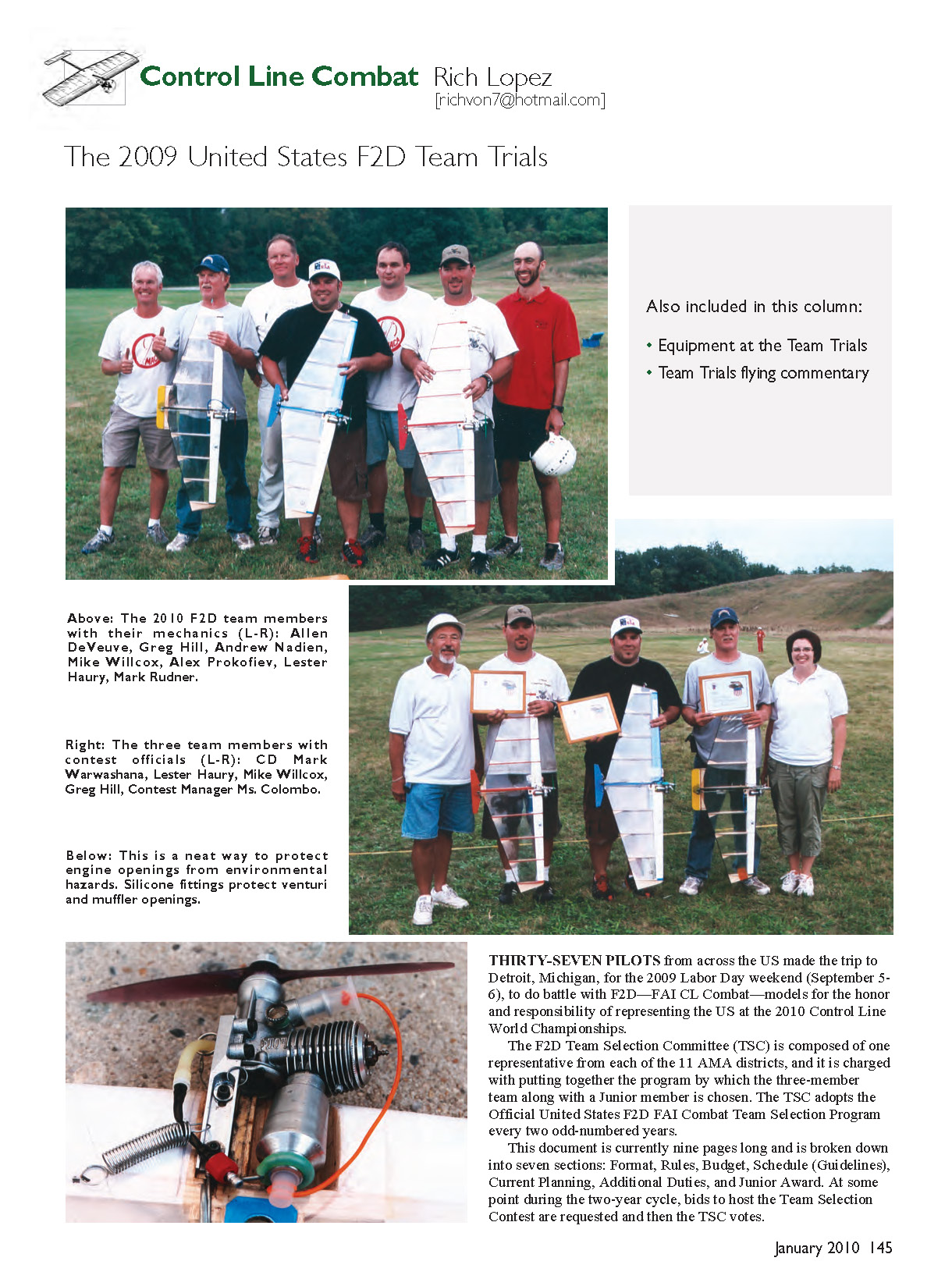
Mike Willcox, Lester Haury, and Greg Hill form a strong team and will represent the US in Gyula, Hungary, in July 2010. Congratulations!
Sources
- Miniature Aircraft Combat Association — www.maca.hobby-site.com:3535
- Alex Prokofiev's electronic shutoff site — www.e-shutoff.com
Transcribed from original scans by AI. Minor OCR errors may remain.

