
AMA Plans Service Showcase
AG-1 Agrivation
Dust off your RC flying skills with this scalelike trainer
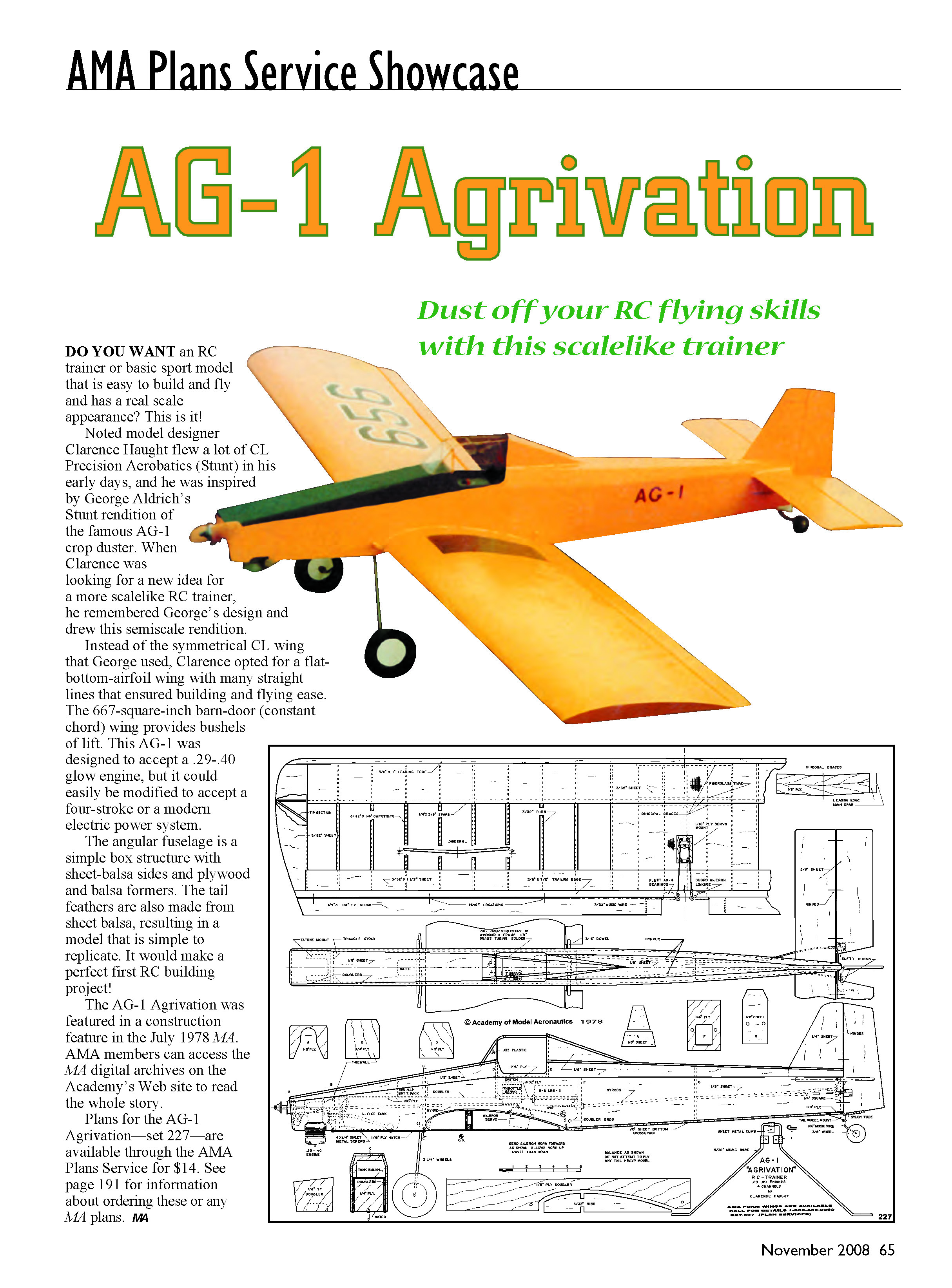
DO YOU WANT an RC trainer or basic sport model that is easy to build and fly and has a real scale appearance? This is it!
Noted model designer Clarence Haught flew a lot of CL Precision Aerobatics (Stunt) in his early days, and he was inspired by George Aldrich's Stunt rendition of the famous AG-1 crop duster. When Clarence was looking for a new idea for a more scalelike RC trainer, he remembered George's design and drew this semiscale rendition.
Instead of the symmetrical CL wing that George used, Clarence opted for a flat-bottom-airfoil wing with many straight lines that ensured building and flying ease. The 667-square-inch barn-door (constant chord) wing provides bushels of lift. This AG-1 was designed to accept a .29-.40 glow engine, but it could easily be modified to accept a four-stroke or a modern electric power system.
The angular fuselage is a simple box structure with sheet-balsa sides and plywood and balsa formers. The tail feathers are also made from sheet balsa, resulting in a model that is simple to replicate. It would make a perfect first RC building project!
The AG-1 Agrivation was featured in a construction feature in the July 1978 MA. AMA members can access the MA digital archives on the Academy's Web site to read the whole story.
Plans for the AG-1 Agrivation—set 227—are available through the AMA Plans Service for $14. See page 191 for information about ordering these or any MA plans. MA
My P-51 had been flown several times through the years. It was such a joy to fly because it was almost like a big trainer. The only minor problem was that the retractable landing gear didn't want to close all the way at times. This problem was solved with larger air cylinders to handle the larger wheels' weight.
In early 2003, I received a call about using my model as the centerpiece at the Dayton Convention Center for the Black Heritage Festival dinner honoring the Tuskegee Airmen. This was during the 2003 Centennial of Flight celebrations that were going on in Dayton.
I was told that many Airmen throughout the US would be attending. I agreed to take my P-51 if I could attend the event and meet some of the pilots. That was readily agreed to.
I figured that maybe eight to 10 Airmen would be there, but 44 attended. That was when I decided to have all of them sign the model and that its flying days were over. It was both a joyful and a sad evening, because the airplane flew so well.
One of the signatures was that of active black Four-Star General Lester L. Lyles, who was the keynote speaker of the event. His father was also a Tuskegee Airman. Upon signing the aircraft, Lyles presented me with one of his General's coins, which I cherish.
Before the dinner, I was asked to display my P-51 at the three-day Black Heritage Festival at the Montgomery County Fairgrounds in Dayton. It was an opportunity to meet more of the Airmen and talk with them!
Then the Ohio chapter of Tuskegee pilots asked if I would take the model to display in their tent at the Dayton Air Show, which was to be a four-day event. Thanks to their exhibiting my aircraft, more than 200,000 people saw it.
That was where I really got to know several of the original Airmen, such as C.I., retired Master Sgt. Robert Peoples, Staff Sgt. Alex Boudreaux (an air traffic controller), and 2nd Lt. Don Cummings (a B-25 pilot), and spend time with them. It was a living history lesson.
After being washed out of the pilot training program because there were too many in his class (178), Boudreaux went on to become the first black civilian air traffic controller for the Federal Aviation Administration and retired as an air traffic controller. He went on to get his commercial multiengine rating and instrument instructor rating through the G.I. Bill after World War II.
Peoples worked in aircraft maintenance, including on B-52 bombers, before retiring from active duty. After C.I. retired, he went on to become an engineer at NCR Corporation in Dayton. Cummings owned a construction business in Columbus.
It was also at the Dayton Air Show that I decided to join the Ohio Chapter of the Tuskegee Airmen Incorporated—especially after finding out about their scholarship program. I have been a proud member since then.
In addition, I had the pleasure of meeting Don Hinz, who was project manager and pilot of the full-scale "C" Mustang that was on display by our tent. He allowed me to sit in the airplane as he explained all the instruments and controls to me.
This full-scale P-51 carried the Tuskegee paint scheme. Don used a great deal of his own money to make sure it was restored so he could use it as a museum without walls to tell the pilots’ story.
Don died in 2004 while flying the “C” Mustang in an air show; it crashed as the result of an in-flight engine failure. He put the airplane into a stand of trees to miss several houses and keep from causing more deaths. The P-51 is being restored to flight status so the story can be told again.
I also had the pleasure of meeting retired Col. Charles McGee, whom I have talked with many times through the years. He is noted for flying more combat missions than any pilot in US history; he flew 409, spanning the World War II, Korea, and Vietnam years.
I have displayed my model with Tuskegee Airmen International members at a YMCA in Englewood, Ohio; at Wilbur Wright Middle School in Dayton; at the Wright-Patterson Air Force Base Officers’ Club for an awards banquet; in a couple of Veterans’ Day parades in downtown Columbus; at a Fourth of July parade at Groveport, Ohio; and at Wright State University for a film debut of the Red Tail Project.
Most recently I showed the P-51 at the Gathering of Mustangs and Legends, held at Columbus’s Rickenbacker International Airport. The event drew an estimated 250,000–300,000 people during its four-day run, and approximately 100 full-scale Mustangs were on exhibit and flown. I was in Mustang heaven!
I built a new model to replace the signature-bearing tribute; it was another Giant Scale flying Mustang. As was the first, my new airplane was a Composite-ARF P-51D with all the items working as closely to those on the full-scale Mustangs as possible.
This model was marked to honor 1st Lt. Lee Archer, the only known ace of the Tuskegee Airmen. He was awarded the Distinguished Flying Cross, the Air Medal with 12 oak leaf clusters, and the Legion of Merit.
Archer went on to retire as a lieutenant colonel in the Air Force after the Vietnam War. He flew 159 combat missions during World War II.
At the Mustang event, my longtime dream of getting Archer to sign my airplane came true. I had been trying to contact him for several years, but it had not worked out. I talked with him on the phone on numerous occasions while I was completing the new model.
Now the first P-51 bears more than 70 Original Tuskegee Airmen’s (OTA’s) names on the wings and fuselage. I use that model only on special occasions. At the Gathering of Mustangs, Archer also signed his name on the sliding canopy, in the proper location, of the new airplane. What a rewarding time this was for me!
Another famous OTA at the Mustang event was Lt. Roscoe C. Brown Jr., who is noted for shooting down the first Me 262 jet for the 15th Air Force. That same day, two pilots under his command destroyed two more Me 262s, earning them a unit citation. He was a captain in the US Air Force at the time.
Brown went on to earn a doctorate from New York University. His TPAC (Teacher Preparation and Credentials) is in education and specializes in psychometrics.
He was a professor at New York University for 25 years and president of Medgar Evers College (formerly part of the City University of New York) for 16 years. Now, in his early 90s, Brown is working at the City University of New York Graduate Center Ph.D. Programs and is the director of the Center for Urban Education Policy.
The Tuskegee Airmen as a group has recently received a Congressional Gold Medal from President Bush for its outstanding service during World War II.
All these experiences I’ve been privileged with came about because I wanted to honor the Tuskegee Airmen after I learned who and what they were. As I mentioned, it has been a living history lesson to become friends with these special people.
Through my small efforts, I hope I’m able to help tell their story and build interest. I try to do this with all the Scale models I build, but the Tuskegee models have been special because of the friendships I have formed.
Thanks to model aviation, I have met many interesting people. I hope to give something back to modeling by sharing my airplanes at shows and events. I encourage modelers to get involved in the research for a chosen aircraft; you never know whom you might meet or what opportunities might come along.
As a result of this project, I had the opportunity to go on a refueling flight in a KC-135 Stratotanker with the Air National Guard unit stationed at Rickenbacker International Airport. I’ll never forget it.
Gary Webb gcwent@woh.rr.com
Sources:
Tuskegee Airmen Incorporated (703) 286-7653 www.tuskegeeairmen.org
CARF Models Ltd. +852 2153-9085 www.composite-arf.com
Transcribed from original scans by AI. Minor OCR errors may remain.

