
In the Air
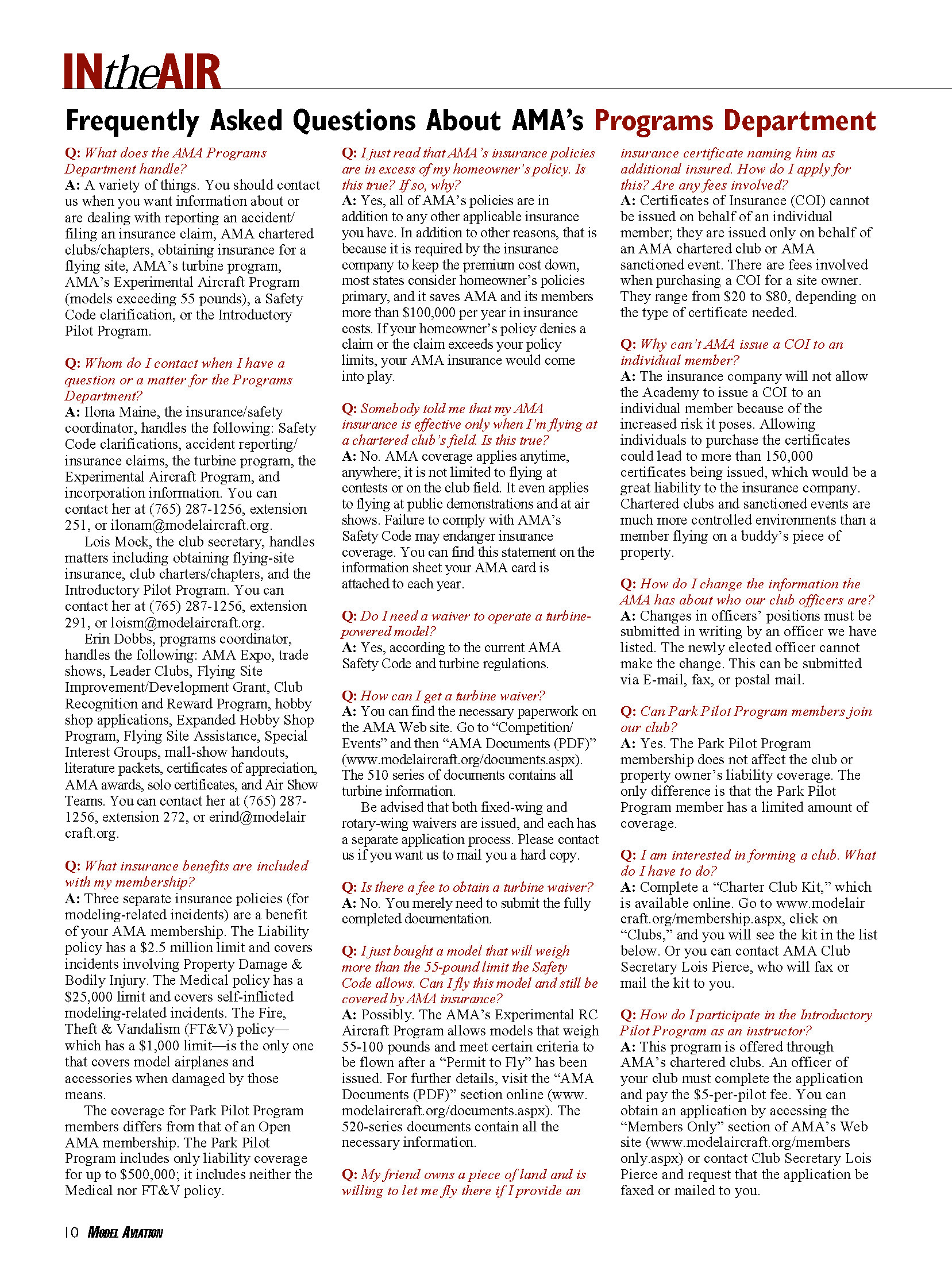
Model Aeronautics and a Family Bond
My husband, Malcolm Pugh, has flown model airplanes since he was 8 and has a passion and love for the sport, which has trickled down to our son, Max, who is 4. Since Max was born in October 2003, he has been continually exposed to model airplanes through his father's flying, building, repairing, etc. Whatever his daddy was doing with or to his airplane, Max wanted to help.
For Christmas 2005, I purchased my husband a RealFlight G3.5 simulator for our computer. Once Malcolm showed Max the basics of how it worked, Daddy got very little flight time on it. Max was a little older than 2 at that time, and it was soon obvious to Malcolm that Max was displaying a natural ability.
Right after Max's 3rd birthday, Malcolm began working with him on the buddy box, flying a Midwest Trainer 20. Max was taking off and flying around, as he did on the computer.
One weekend, while waiting for his dad to get home from work to go for their weekend flying, Max got “his airplane” from the garage and proceeded to hand-launch it in the backyard. It didn't survive those landings, but it was obvious to us that this 3-year-old—whose attention span was only supposed to be minutes for a given activity—was really into these models.
Through the cold months, Max continued flying the simulator. Malcolm could tell him to do a maneuver, and he not only comprehended the instructions but also performed the maneuver.
In the summer and fall before Max's 4th birthday, Malcolm flew a Superstar 40 via buddy box with Max. He was taking off, flying around, and landing this airplane with little intervention from his dad. The model fell victim to radio interference and crashed to its destruction. Max continued to practice on the simulator, and Malcolm began teaching him hovering and 3-D maneuvers.
We took our family vacation in May 2008 and went to the Joe Nall Fly-In. This has become an annual event for our family, and we camp there the whole week. Max's interest in the sport was at its peak when we returned from this event, so we bought him an electric ParkZone T-28.
Since mid-June, Malcolm has gone to the flying field with Max almost every day after work and every weekend (weather permitting). Max is taking off, flying, rolling, flying inverted, and landing his new T-28. The minute that Malcolm walks in the door from work, Max starts the pleas of, “Can I go fly my airplane, daddy?”
One evening, I could tell that Malcolm was exhausted after working outside in temperatures near 100°, and I told him that he should stay home and rest. His reply is what prompted me to write this letter and title it the way that I have. He said:
“I have to take him because I can remember wanting to go fly when I was his age, but no one would take me. I had to wait until I was old enough to walk to the park by myself to fly my airplane, and I want him to be able to fly when he wants to.”
I can't even begin to explain the positive impact that this sport has on our life. We spend countless hours at the flying field, where we take lunch and spend quality time doing something we all enjoy.
Malcolm and Max are our pilots; Alexandria (our 6-year-old daughter) is the artist, who often draws pictures of Daddy and Max with their airplanes, and I am the amateur photographer and video recorder. It has been refreshing to see all the supportive modelers at the field giving Max high fives after he's flown. Many of them talk about how amazing his coordination is for a 4-year-old, but Malcolm says, “He doesn't know he can't.” I guess he's right. When you're 4, you place no pressures on yourself; you're just having fun.
Max received his AMA membership card in the mail and couldn't wait to show it to everyone he saw. With it, he was able to register and fly at his first Giant Scale Fly-In at Bowling Green, Kentucky, on July 27, put on by SkyMac. They let him fly his T-28, and then he flew his dad's 30%-Yak 54. Fellow modelers received him with open arms and encouraged him beyond belief.
Some people whose husbands or significant others are in the sport ask me, “Doesn't this hobby get expensive?” or “Don't you get tired of listening to this all the time?” To which I can only say, “There are much worse things our husbands could spend money on, and I will never grow tired of our family sharing this common bond.”
MA
— Tina D. Larkin Nashville, Tennessee
Frequently Asked Questions About AMA’s Programs Department
Q: What does the AMA Programs Department handle?
A: A variety of things. You should contact us when you want information about or are dealing with reporting an accident/filing an insurance claim, AMA chartered clubs/chapters, obtaining insurance for a flying site, AMA’s turbine program, AMA’s Experimental Aircraft Program (models exceeding 55 pounds), a Safety Code clarification, or the Introductory Pilot Program.
Q: Whom do I contact when I have a question or a matter for the Programs Department?
A: Ilona Maine, the insurance/safety coordinator, handles the following: Safety Code clarifications, accident reporting/insurance claims, the turbine program, the Experimental Aircraft Program, and incorporation information. You can contact her at (765) 287-1256, extension 251, or ilonam@modelaircraft.org.
Lois Mock, the club secretary, handles matters including obtaining flying-site insurance, club charters/chapters, and the Introductory Pilot Program. You can contact her at (765) 287-1256, extension 291, or loism@modelaircraft.org.
Erin Dobbs, programs coordinator, handles the following: AMA Expo, trade shows, Leader Clubs, Flying Site Improvement/Development Grant, Club Recognition and Reward Program, hobby shop applications, Expanded Hobby Shop Program, Flying Site Assistance, Special Interest Groups, mall-show handouts, literature packets, certificates of appreciation, AMA awards, solo certificates, and Air Show Teams. You can contact her at (765) 287-1256, extension 272, or erind@modelaircraft.org.
Q: What insurance benefits are included with my membership?
A: Three separate insurance policies (for modeling-related incidents) are a benefit of your AMA membership:
- Liability policy: $2.5 million limit; covers Property Damage & Bodily Injury.
- Medical policy: $25,000 limit; covers self-inflicted modeling-related incidents.
- Fire, Theft & Vandalism (FT&V) policy: $1,000 limit; covers model airplanes and accessories when damaged by those means.
The coverage for Park Pilot Program members differs from that of an Open AMA membership. The Park Pilot Program includes only liability coverage for up to $500,000; it includes neither the Medical nor FT&V policy.
Q: I just read that AMA’s insurance policies are in excess of my homeowner’s policy. Is this true? If so, why?
A: Yes, all of AMA’s policies are in addition to any other applicable insurance you have. In addition to other reasons, that is because it is required by the insurance company to keep the premium cost down, most states consider homeowner’s policies primary, and it saves AMA and its members more than $100,000 per year in insurance costs. If your homeowner’s policy denies a claim or the claim exceeds your policy limits, your AMA insurance would come into play.
Q: Somebody told me that my AMA insurance is effective only when I’m flying at a chartered club’s field. Is this true?
A: No. AMA coverage applies anytime, anywhere; it is not limited to flying at contests or on the club field. It even applies to flying at public demonstrations and at air shows. Failure to comply with AMA’s Safety Code may endanger insurance coverage. You can find this statement on the information sheet your AMA card is attached to each year.
Q: Do I need a waiver to operate a turbine-powered model?
A: Yes, according to the current AMA Safety Code and turbine regulations.
Q: How can I get a turbine waiver?
A: You can find the necessary paperwork on the AMA Web site. Go to “Competition/Events” and then “AMA Documents (PDF)” (www.modelaircraft.org/documents.aspx). The 510 series of documents contain all turbine information.
Be advised that both fixed-wing and rotary-wing waivers are issued, and each has a separate application process. Please contact us if you want us to mail you a hard copy.
Q: Is there a fee to obtain a turbine waiver?
A: No. You merely need to submit the fully completed documentation.
Q: I just bought a model that will weigh more than the 55-pound limit the Safety Code allows. Can I fly this model and still be covered by AMA insurance?
A: Possibly. The AMA’s Experimental RC Aircraft Program allows models that weigh 55–100 pounds and meet certain criteria to be flown after a “Permit to Fly” has been issued. For further details, visit the “AMA Documents (PDF)” section online (www.modelaircraft.org/documents.aspx). The 520-series documents contain all the necessary information.
Q: My friend owns a piece of land and is willing to let me fly there if I provide an insurance certificate naming him as additional insured. How do I apply for this? Are any fees involved?
A: Certificates of Insurance (COI) cannot be issued on behalf of an individual member; they are issued only on behalf of an AMA chartered club or AMA sanctioned event. There are fees involved when purchasing a COI for a site owner. They range from $20 to $80, depending on the type of certificate needed.
Q: Why can’t AMA issue a COI to an individual member?
A: The insurance company will not allow the Academy to issue a COI to an individual member because of the increased risk it poses. Allowing individuals to purchase the certificates could lead to more than 150,000 certificates being issued, which would be a great liability to the insurance company. Chartered clubs and sanctioned events are much more controlled environments than a member flying on a buddy’s piece of property.
Q: How do I change the information the AMA has about who our club officers are?
A: Changes in officers’ positions must be submitted in writing by an officer we have listed. The newly elected officer cannot make the change. This can be submitted via e-mail, fax, or postal mail.
Q: Can Park Pilot Program members join our club?
A: Yes. The Park Pilot Program membership does not affect the club or property owner’s liability coverage. The only difference is that the Park Pilot Program member has a limited amount of coverage.
DC/RC 2008 Summer Camp
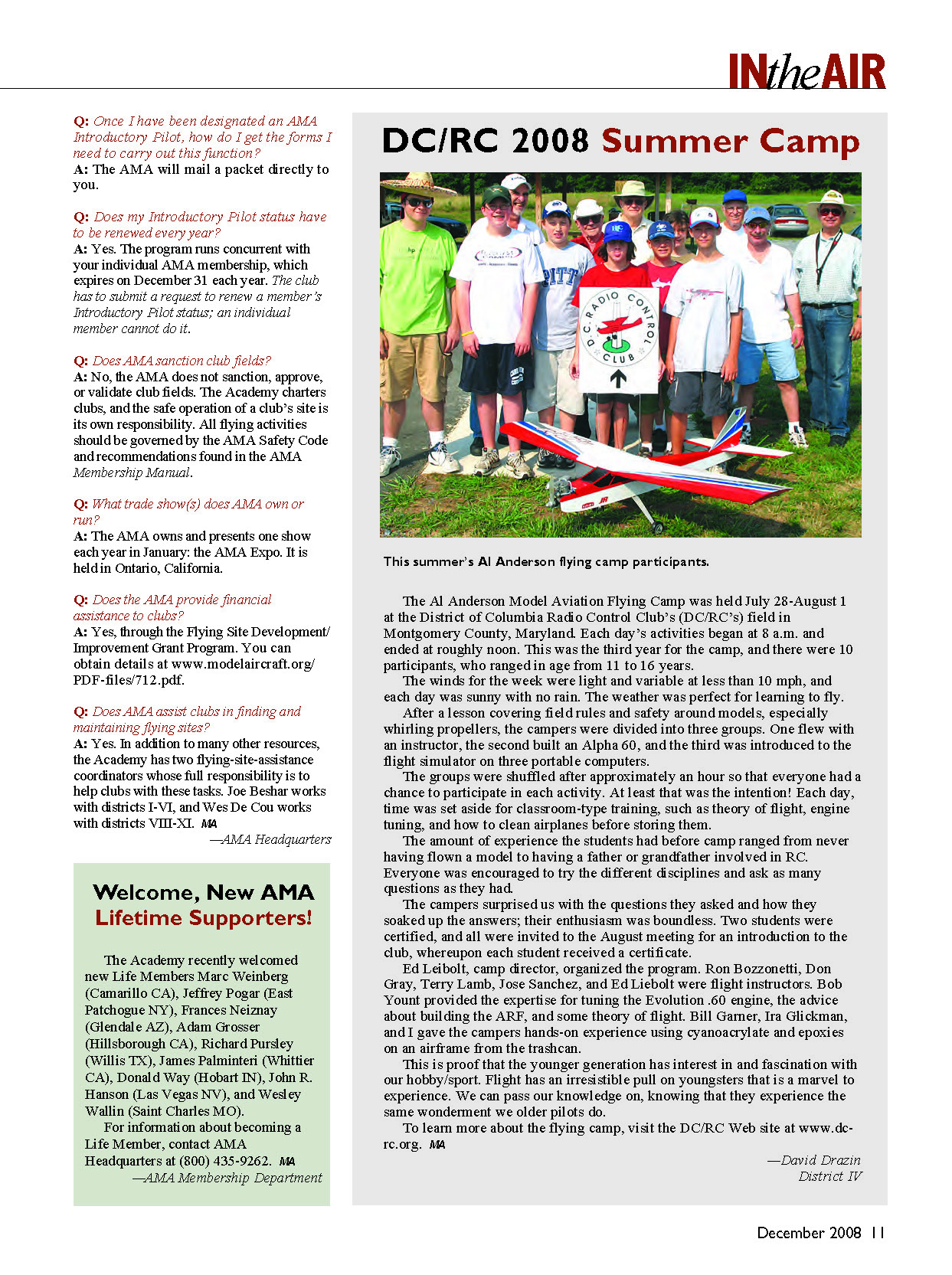
The Al Anderson flying camp participants
The Al Anderson Model Aviation Flying Camp was held July 28–August 1 at the District of Columbia Radio Control Club’s (DC/RC’s) field in Montgomery County, Maryland. Each day’s activities began at 8 a.m. and ended at roughly noon. This was the third year for the camp, and there were 10 participants, who ranged in age from 11 to 16 years.
The winds for the week were light and variable at less than 10 mph, and each day was sunny with no rain. The weather was perfect for learning to fly.
After a lesson covering field rules and safety around models, especially whirling propellers, the campers were divided into three groups. One flew with an instructor, the second built an Alpha 60, and the third was introduced to the flight simulator on three portable computers.
The groups were shuffled after approximately an hour so that everyone had a chance to participate in each activity. At least that was the intention! Each day, time was set aside for classroom-type training, such as theory of flight, engine tuning, and how to clean airplanes before storing them.
The amount of experience the students had before camp ranged from never having flown a model to having a father or grandfather involved in RC. Everyone was encouraged to try the different disciplines and ask as many questions as they had.
The campers surprised us with the questions they asked and how they soaked up the answers; their enthusiasm was boundless. Two students were certified, and all were invited to the August meeting for an introduction to the club, whereupon each student received a certificate.
Ed Leibold, camp director, organized the program. Ron Bozzonetti, Don Gray, Terry Lamb, Jose Sanchez, and Ed Leibold were flight instructors. Bob Yount provided the expertise for tuning the Evolution .60 engine, advice about building the ARF, and some theory of flight. Bill Garner, Ira Glickman, and I gave the campers hands-on experience using cyanoacrylate and epoxies on an airframe from the trashcan.
This is proof that the younger generation has interest in and fascination with our hobby/sport. Flight has an irresistible pull on youngsters that is a marvel to experience. We can pass our knowledge on, knowing that they experience the same wonderment we older pilots do.
To learn more about the flying camp, visit the DC/RC Web site at www.dc-rc.org.
MA
— David Drazin District IV
World Soaring Masters
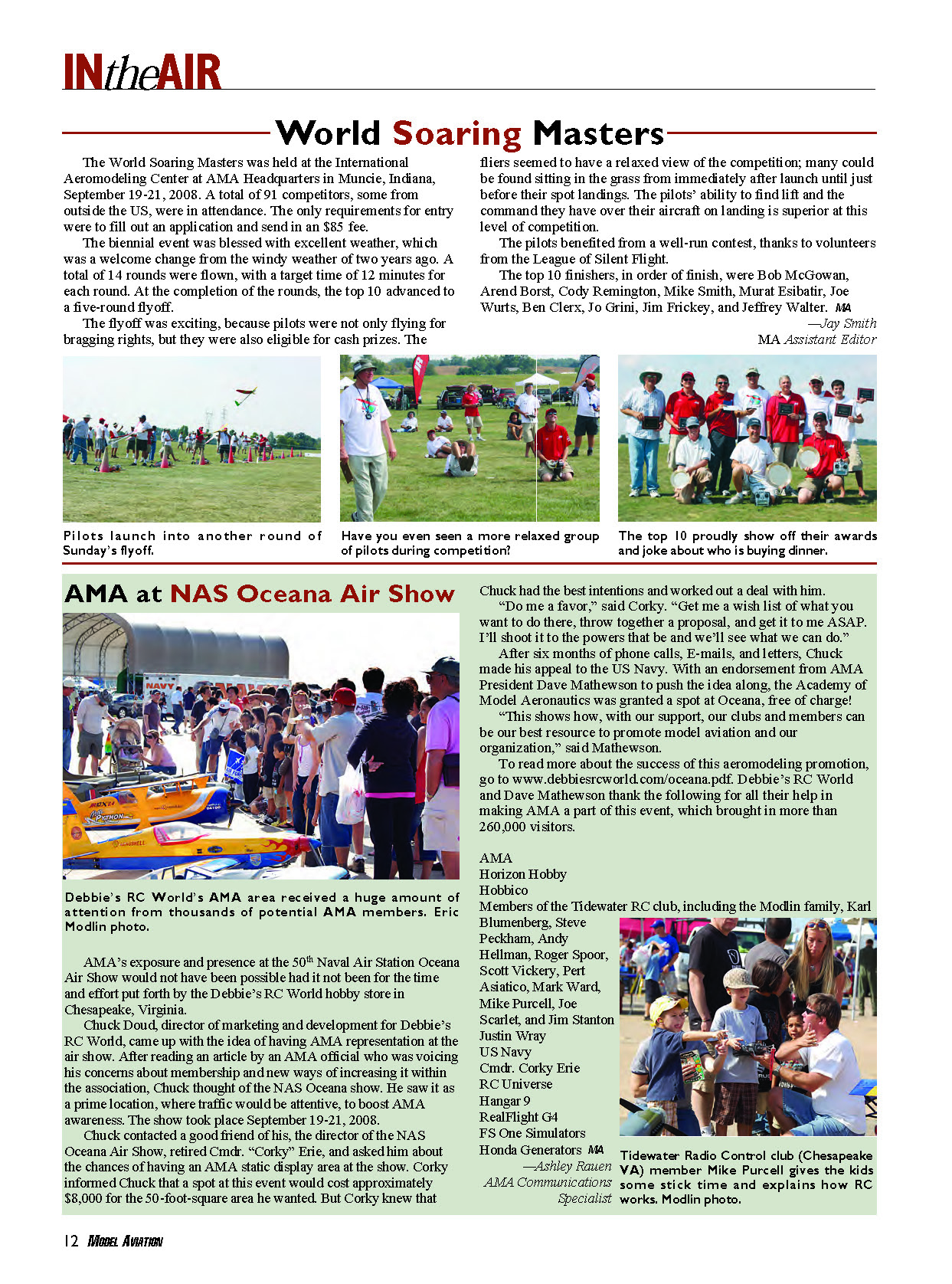
The World Soaring Masters was held at the International Aeromodeling Center at AMA Headquarters in Muncie, Indiana, September 19–21, 2008. A total of 91 competitors, some from outside the U.S., were in attendance. The only requirements for entry were to fill out an application and send in an $85 fee.
The biennial event was blessed with excellent weather, which was a welcome change from the windy weather of two years ago. A total of 14 rounds were flown, with a target time of 12 minutes for each round. At the completion of the rounds, the top 10 advanced to a five-round flyoff.
The flyoff was exciting, because pilots were not only flying for bragging rights, but they were also eligible for cash prizes. The fliers seemed to have a relaxed view of the competition; many could be found sitting in the grass from immediately after launch until just before their spot landings. The pilots' ability to find lift and the command they have over their aircraft on landing is superior at this level of competition.
The pilots benefited from a well-run contest, thanks to volunteers from the League of Silent Flight.
The top 10 finishers, in order of finish, were:
- Bob McGowan
- Arend Borst
- Cody Remington
- Mike Smith
- Murat Esibitar
- Joe Wurts
- Ben Clerx
- Jo Grini
- Jim Frickey
- Jeffrey Walter
MA
— Jay Smith MA Assistant Editor
Transcribed from original scans by AI. Minor OCR errors may remain.

