
Aero Mail
September Issue Corrections
There was an error on page 11. Horizon Hobby—not Hobby Lobby—has supported the Walker School Aviation Activity Day for the last seven years and has been extremely generous with its donation of prizes.
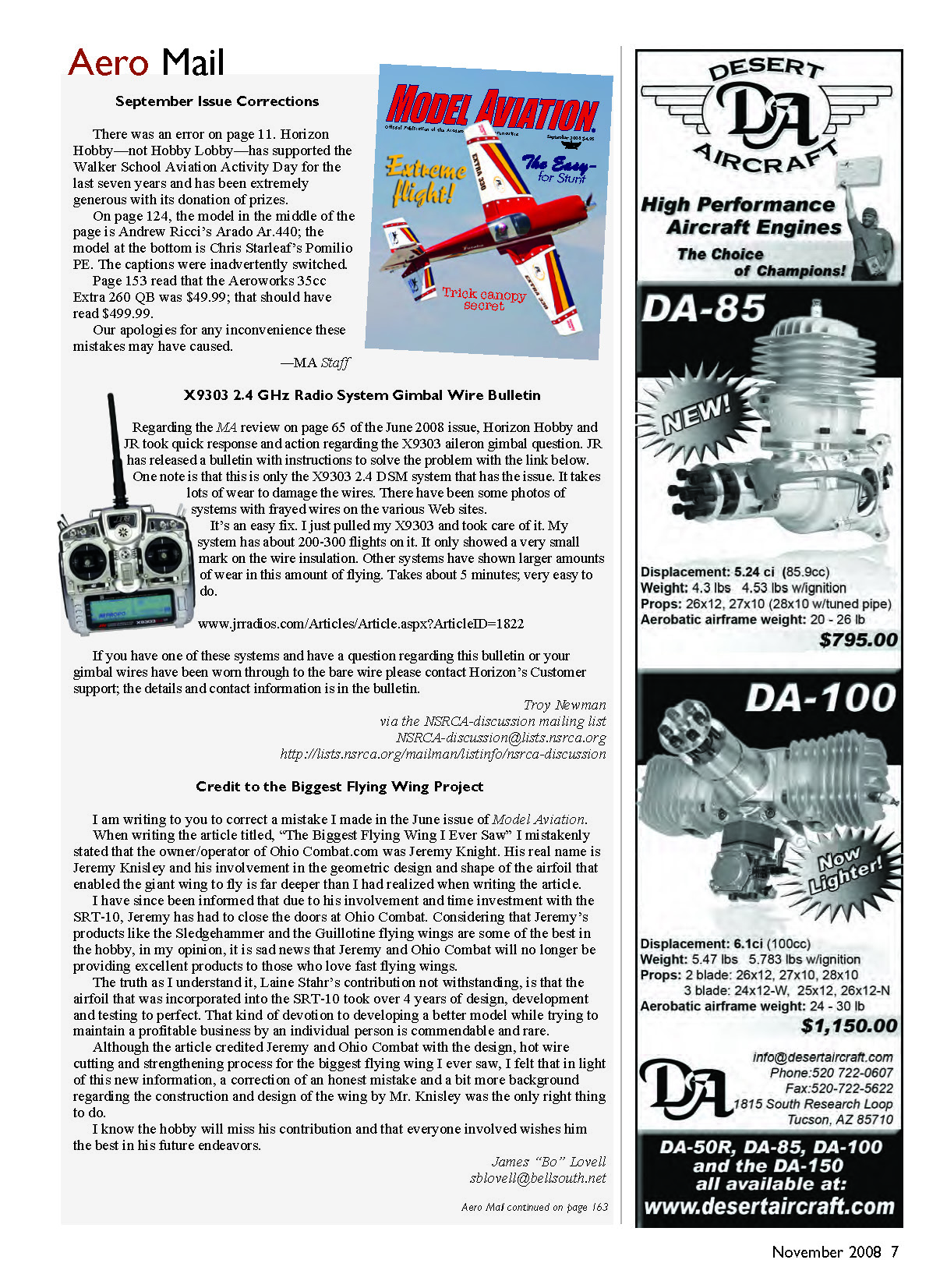
On page 124, the model in the middle of the page is Andrew Ricci’s Arado Ar.440; the model at the bottom is Chris Starleaf’s Pomilio PE. The captions were inadvertently switched.
Page 153 read that the Aeroworks 35cc Extra 260 QB was $49.99; that should have read $499.99.
Our apologies for any inconvenience these mistakes may have caused.
—MA Staff
X9303 2.4 GHz Radio System Gimbal Wire Bulletin
Regarding the MA review on page 65 of the June 2008 issue, Horizon Hobby and JR took quick response and action regarding the X9303 aileron gimbal question. JR has released a bulletin with instructions to solve the problem with the link below. One note is that this is only the X9303 2.4 DSM system that has the issue. It takes lots of wear to damage the wires. There have been some photos of systems with frayed wires on the various Web sites.
It’s an easy fix. I just pulled my X9303 and took care of it. My system has about 200–300 flights on it. It only showed a very small mark on the wire insulation. Other systems have shown larger amounts of wear in this amount of flying. Takes about 5 minutes; very easy to do.
www.jrradios.com/Articles/Article.aspx?ArticleID=1822
If you have one of these systems and have a question regarding this bulletin or your gimbal wires have been worn through to the bare wire please contact Horizon’s Customer support; the details and contact information is in the bulletin.
Troy Newman via the NSRCA-discussion mailing list NSRCA-discussion@lists.nsrca.org http://lists.nsrca.org/mailman/listinfo/nsrca-discussion
Credit to the Biggest Flying Wing Project
I am writing to you to correct a mistake I made in the June issue of Model Aviation. When writing the article titled, “The Biggest Flying Wing I Ever Saw” I mistakenly stated that the owner/operator of Ohio Combat.com was Jeremy Knight. His real name is Jeremy Knisley and his involvement in the geometric design and shape of the airfoil that enabled the giant wing to fly is far deeper than I had realized when writing the article.
I have since been informed that due to his involvement and time investment with the SRT-10, Jeremy has had to close the doors at Ohio Combat. Considering that Jeremy’s products like the Sledgehammer and the Guillotine flying wings are some of the best in the hobby, in my opinion, it is sad news that Jeremy and Ohio Combat will no longer be providing excellent products to those who love fast flying wings.
The truth as I understand it, Laine Stahjr’s contribution notwithstanding, is that the airfoil that was incorporated into the SRT-10 took over 4 years of development and testing to perfect. That kind of devotion to developing a better model while trying to maintain a profitable business by an individual person is commendable and rare.
Although the article credited Jeremy and Ohio Combat with the design, it was the cutting and strengthening process for the biggest flying wing I ever saw, I felt that in light of this new information, a correction and an honest mistake and bit more background regarding the construction and design of the wing by Mr. Knisley was the only right thing to do.
I know the hobby will miss his contribution and that everyone involved wishes him the best in his future endeavors.
James “Bo” Lovell sblovell@bellsouth.net
Aero Mail continued on page 163
Aero Mail
More Turbine Talk
I just wanted to tell you how great the article on turbines in the August Model Aviation was. It was long overdue. The article answered all of the questions anyone would have about turbine operation and was well-written and clear.
The article did make me appreciate my electric ducted fan aircraft even more. Although it said that turbine was the most reliable power system, turbines can fail due to a fuel line popping off in flight or a minor glitch somewhere outside the actual turbine. Electric ducted fan jets keep going until the battery runs out. Electric is by far the most reliable of the choices.
The turbine does have the great jet sound, but the fuel cost and messing around is a lot of trouble. The electric jets sound pretty neat and are performing as well as the turbines with the proper battery/motor/fan combos. I've gone electric with my jets and helicopter for these reasons. (There's nothing like an electric heli for sound and not having that smoke pouring out like it's on fire.)
I remember the glow-powered ducted fans and all the trouble associated with them. They are dinosaurs compared to the turbines, but the electric jets are the way of the future in jet aeromodelling. Especially with the price/availability of fuel these days.
Although the turbines are realistic-sounding and way better than glow-powered ducted fans, the electrics are superior in every way. The article made me appreciate electric so much more than I already had. Very interesting and well-written article nonetheless.
Lance Novak Savannah, Georgia
I enjoyed your article in the Model Aviation issue for August 2008 which speaks of "practical jets"... I agree wholeheartedly that many of the more elaborate models are well beyond the reach financially of most of us "oxygen-breathing, red blooded" individuals.
Also, the time—time—factor. I'm sure many are out there in the work force striving to prevent "falling-into-the red" every two weeks.
For a touch of "background information", I'm in the airline piloting "profession" (or ... what's remaining of it in this country) and I neither (a) have the time to get any more elaborate than an ARF, and (b) have the financial resources to delve into that "dream Jet" ARF/kit of the F9F Panther or F9F Cougar and emulate the marking of those that were on my Dad's aircraft carrier (10 years after he was a crewmember onboard) The USS Yorktown, CV-10. Those jets served well during the Korean War.
I also have two ARFs—yes, ARFs, the Nitro brand F6F "Hellcat" and A6M "Zero" ... neither, for 2 years have I had time to work on, whatsoever. But—they're "dream kits" of mine—and these two served onboard the carrier while my Dad was a Marine anti-aircraft gunner on the Yorktown, for 3½ years—as an original crewmember.
But, I'm going off on a tangent—whereas, the jets are great—yea—if many of us had the financial resources for the "big ones".
The Park flyers are the answer! As much as many groan about the ARFS, time is a commodity.
Good article—good read. Thank you.
Edward A. Sarkisian via E-mail
I received my copy of the August edition of the Model Aviation Magazine in yesterday's mail. I read your article "Turbine Modeling Made Easy" and I found the article filled your stated goal—to give us an understanding of what goes on with turbine power.
I found the article to be most informative and very worthwhile reading. I really don't understand the controversy (or care for that matter) that appeared in the RC Universe on-line magazine over the past two or so weeks.
Although I had a pretty good idea of what is involved, I had never seen it all in one neat package—without glamour or hype, or a "greater than thou" attitude.
Thanks for a great article. I'll be looking for your next one.
Paul Rogers Honolulu, Hawaii
Transcribed from original scans by AI. Minor OCR errors may remain.

